Gustave Roussy Cancer Center, Department of Pediatric and Adolescent Oncology, Paris-Saclay University, Villejuif, France.
Gustave Roussy Cancer Center, Combined Research Unit 8203, National Center of Scientific Research, Paris-Saclay University, Villejuif, France.
Neuro Oncol. 2020 Nov 26;22(11):1686-1695. doi: 10.1093/neuonc/noaa083.
Previous pilot studies have shown the feasibility of preoperative chemotherapy in patients with medulloblastoma, but benefits and risks compared with initial surgery have not been assessed.
Two therapeutic strategies were retrospectively compared in 92 patients with metastatic medulloblastoma treated at Gustave Roussy between 2002 and 2015: surgery at diagnosis (n = 54, group A) and surgery delayed after carboplatin and etoposide-based neoadjuvant therapy (n = 38, group B). Treatment strategies were similar in both groups.
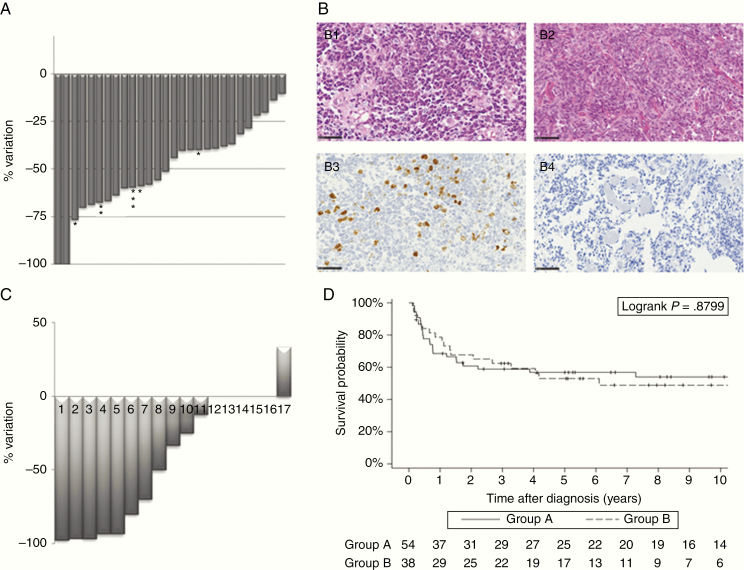
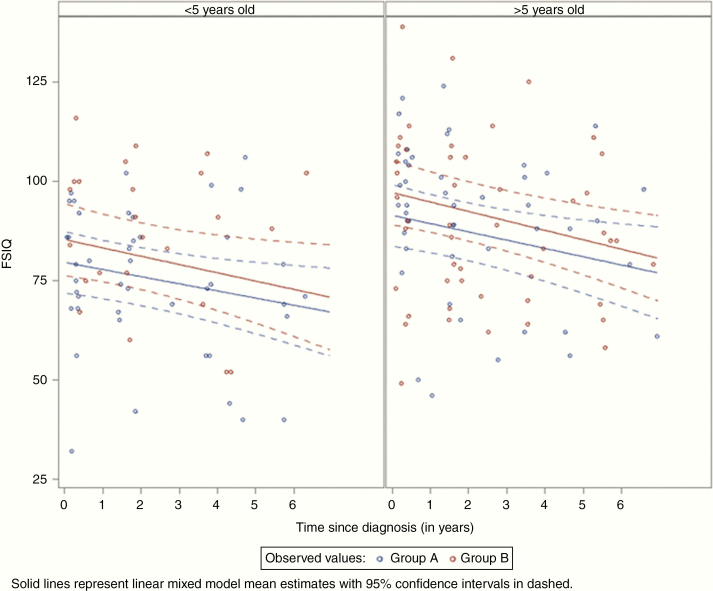
The rate of complete tumor excision was significantly higher in group B than in group A (93.3% vs 57.4%, P = 0.0013). Postoperative complications, chemotherapy-associated side effects, and local progressions were not increased in group B. Neoadjuvant chemotherapy led to a decrease in the primary tumor size in all patients; meanwhile 4/38 patients experienced a distant progression. The histological review of 19 matched tumor pairs (before and after chemotherapy) showed that proliferation was reduced and histological diagnosis feasible and accurate even after neoadjuvant chemotherapy. The 5-year progression-free and overall survival rates were comparable between groups. Comparison of the longitudinal neuropsychological data showed that intellectual outcome tended to be better in group B (the mean predicted intellectual quotient value was 6 points higher throughout the follow-up).
Preoperative chemotherapy is a safe and efficient strategy for metastatic medulloblastoma. It increases the rate of complete tumor excision and may improve the neuropsychological outcome without jeopardizing survival.
先前的试点研究表明,在患有髓母细胞瘤的患者中进行术前化疗是可行的,但与初始手术相比,其益处和风险尚未得到评估。
在 2002 年至 2015 年期间,古斯塔夫·鲁西(Gustave Roussy)治疗了 92 例转移性髓母细胞瘤患者,回顾性比较了两种治疗策略:诊断时手术(n = 54,A 组)和卡铂和依托泊苷为基础的新辅助治疗后延迟手术(n = 38,B 组)。两组的治疗策略相似。
B 组完全切除肿瘤的比例明显高于 A 组(93.3%比 57.4%,P = 0.0013)。B 组术后并发症、化疗相关副作用和局部进展并不增加。新辅助化疗使所有患者的原发肿瘤体积减小;同时,有 4/38 例患者出现远处进展。对 19 对匹配的肿瘤(化疗前后)的组织学检查显示,增殖减少,即使在新辅助化疗后,组织学诊断也是可行且准确的。两组的 5 年无进展生存率和总生存率相当。对纵向神经心理学数据的比较表明,B 组的智力结果倾向于更好(整个随访过程中平均预测智商值高 6 分)。
术前化疗是治疗转移性髓母细胞瘤的一种安全有效的策略。它可以提高完全切除肿瘤的比例,并且可能改善神经心理学结局,而不会危及生存。