Swiss Tropical and Public Health Institute and University of Basel, Basel, Switzerland.
University of Washington, Seattle, USA.
Malar J. 2020 Apr 8;19(1):141. doi: 10.1186/s12936-020-03208-6.
As more countries progress towards malaria elimination, a better understanding of the most critical health system features for enabling and supporting malaria control and elimination is needed.
All available health systems data relevant for malaria control were collated from 23 online data repositories. Principal component analysis was used to create domain specific health system performance measures. Multiple regression model selection approaches were used to identify key health systems predictors of progress in malaria control in the 2000-2016 period among 105 countries. Additional analysis was performed within malaria burden groups.
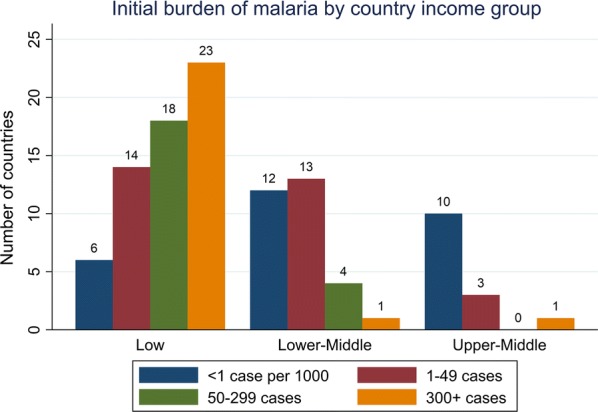
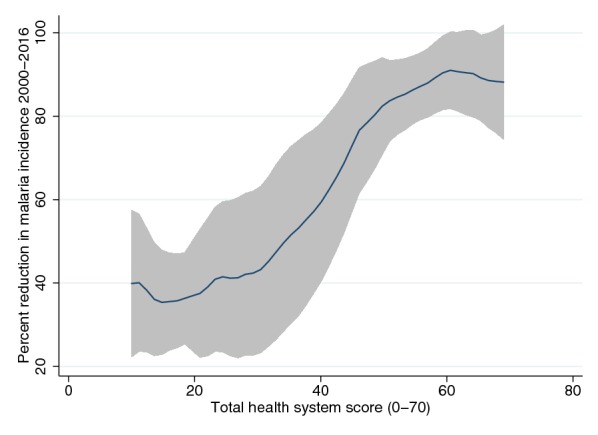
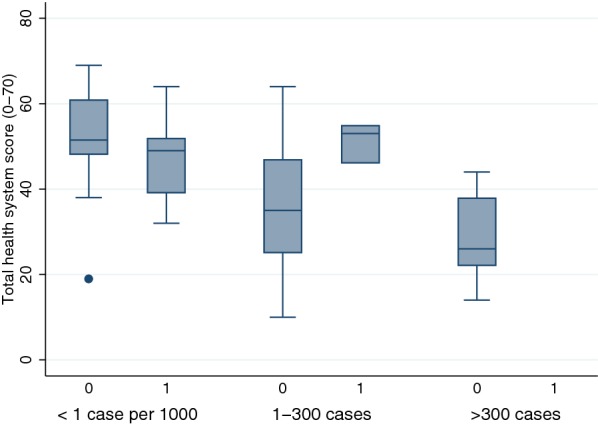
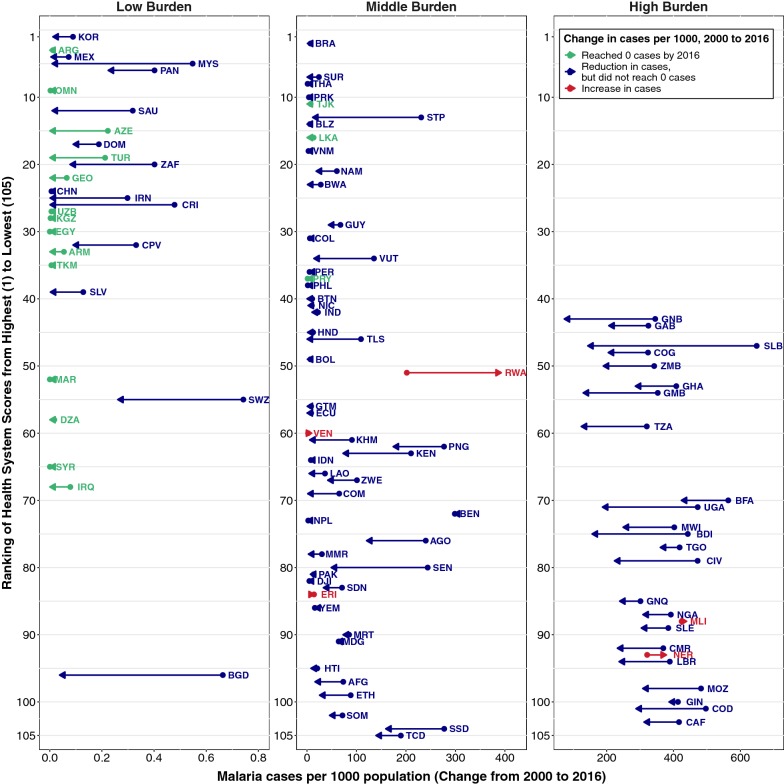
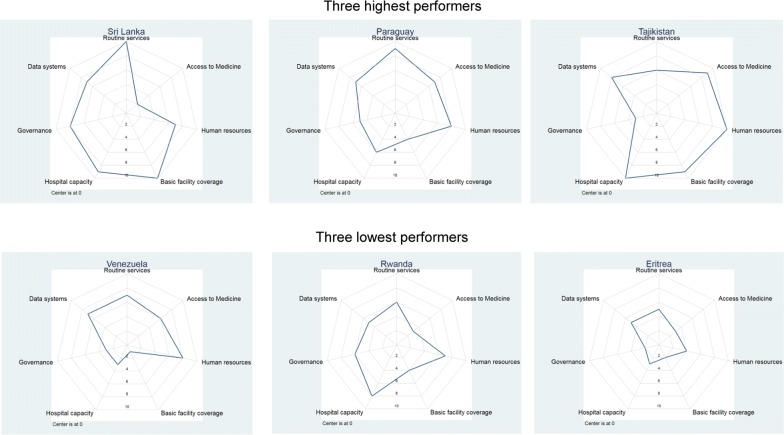
There was large heterogeneity in progress in malaria control in the 2000-2016 period. In univariate analysis, several health systems factors displayed a strong positive correlation with reductions in malaria burden between 2000 and 2016. In multivariable models, delivery of routine services and hospital capacity were strongly predictive of reductions in malaria cases, especially in high burden countries. In low-burden countries approaching elimination, primary health center density appeared negatively associated with progress while hospital capacity was positively correlated with eliminating malaria.
The findings presented in this manuscript suggest that strengthening health systems can be an effective strategy for reducing malaria cases, especially in countries with high malaria burden. Potential returns appear particularly high in the area of service delivery.
随着越来越多的国家朝着消除疟疾的方向前进,需要更好地了解对疟疾控制和消除具有关键作用的卫生系统特征。
从 23 个在线数据库中收集了与疟疾控制相关的所有现有卫生系统数据。使用主成分分析创建特定于域的卫生系统绩效衡量标准。使用多元回归模型选择方法,在 2000 年至 2016 年间,在 105 个国家中确定了疟疾控制进展的关键卫生系统预测因素。在疟疾负担组内进行了额外的分析。
在 2000 年至 2016 年间,疟疾控制进展存在很大的异质性。在单变量分析中,一些卫生系统因素与 2000 年至 2016 年期间疟疾负担的减少呈强正相关。在多变量模型中,常规服务的提供和医院能力是疟疾病例减少的有力预测因素,尤其是在高负担国家。在接近消除的低负担国家中,初级保健中心密度与进展呈负相关,而医院能力与消除疟疾呈正相关。
本文提出的研究结果表明,加强卫生系统可以成为减少疟疾病例的有效策略,尤其是在疟疾负担较高的国家。在服务提供领域,潜在回报似乎特别高。