Kesić Maja, Baković Petra, Horvatiček Marina, Proust Bastien Lucien Jean, Štefulj Jasminka, Čičin-Šain Lipa
Laboratory of Neurochemistry and Molecular Neurobiology, Department of Molecular Biology, Ruđer Bošković Institute, Zagreb, Croatia.
Front Neurosci. 2020 Mar 25;14:219. doi: 10.3389/fnins.2020.00219. eCollection 2020.
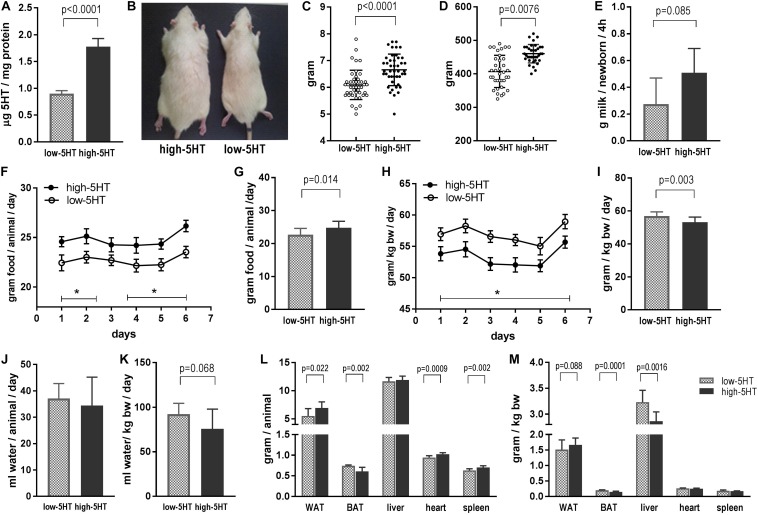
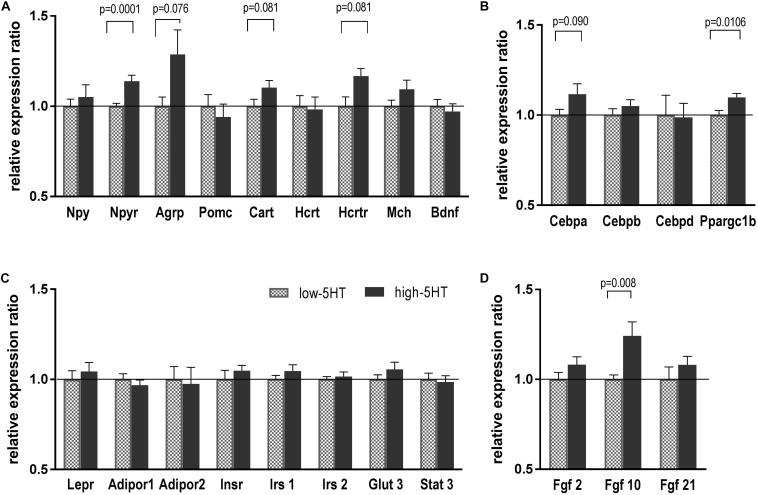
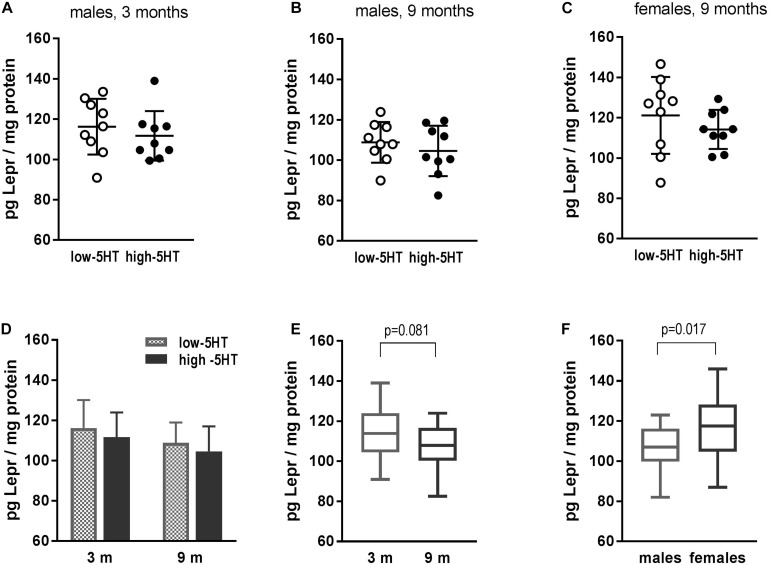
Central and peripheral pools of biogenic monoamine serotonin (5-hydroxytryptamine [5HT]) exert opposite effects on the body weight regulation: increase in brain 5HT activity is expected to decrease body weight, whereas increase in peripheral 5HT activity will increase body weight and adiposity. In a genetic model of rats with constitutionally high- or low-5HT homeostasis (hyperserotonergic/hyposerotonergic rats), we have studied how individual differences in endogenous 5HT tone modulate net energy balance of the organism. The high-5HT and low-5HT sublines of the model were developed by selective breeding toward extreme platelet activities of 5HT transporter, a key molecule determining 5HT bioavailability/activity. In animals from high-5HT and low-5HT sublines, we assessed physiological characteristics associated with body weight homeostasis and expression profile of a large scale of body weight-regulating genes in hypothalamus, a major brain region controlling energy balance. Results showed that under standard chow diet animals from the high-5HT subline, as compared to low-5HT animals, have lifelong increased body weight (by 12%), higher absolute daily food intake (by 9%), and different pattern of fat distribution (larger amount of white adipose tissue and lower amount of brown adipose tissue). A large number of body weight-regulating hypothalamic genes were analyzed for their mRNA expression: 24 genes by reverse transcription-quantitative polymerase chain reaction ( = 9-10 rats/subline) including neuropeptides and their receptors, growth factors, transcriptional factors, and receptors for peripheral signals, and a total of 84 genes of various classes by polymerase chain reaction array (pools of six rats/subline). Only few genes showed significant differences in mRNA expression levels between 5HT sublines (e.g. neuropeptide Y receptor, fibroblast growth factor 10), but high-5HT animals displayed a clear trend to upregulation of mRNAs for a number of orexigenic signaling peptides, their receptors, and other molecules with orexigenic activity. Receptors for peripheral signals (leptin, insulin) and molecules in their downstream signaling were not altered, indicating no changes in central insulin/leptin resistance. At the protein level, there were no differences in the content of hypothalamic leptin receptor between 5HT sublines, but significant sex and age effects were observed. Results show that higher constitutive/individual 5HT tone favors higher body weight and adiposity probably due to concurrent upregulation of several hypothalamic orexigenic pathways.
生物源性单胺血清素(5-羟色胺[5HT])的中枢和外周库对体重调节具有相反的作用:脑内5HT活性增加预计会降低体重,而外周5HT活性增加则会增加体重和肥胖程度。在具有先天性高或低5HT稳态的大鼠遗传模型(高血清素能/低血清素能大鼠)中,我们研究了内源性5HT水平的个体差异如何调节机体的净能量平衡。该模型的高5HT和低5HT亚系是通过对5HT转运体(一种决定5HT生物利用度/活性的关键分子)的极端血小板活性进行选择性育种而培育出来的。在高5HT和低5HT亚系的动物中,我们评估了与体重稳态相关的生理特征以及下丘脑(控制能量平衡的主要脑区)中大量体重调节基因的表达谱。结果表明,在标准饲料喂养下,高5HT亚系的动物与低5HT动物相比,终生体重增加(12%),每日绝对食物摄入量更高(9%),且脂肪分布模式不同(白色脂肪组织量更多,棕色脂肪组织量更少)。通过逆转录定量聚合酶链反应(每个亚系9 - 10只大鼠)分析了大量下丘脑体重调节基因的mRNA表达,包括神经肽及其受体、生长因子、转录因子和外周信号受体等24个基因;通过聚合酶链反应芯片(每个亚系6只大鼠的样本池)分析了总共84个不同类别的基因。只有少数基因在5HT亚系之间的mRNA表达水平上显示出显著差异(例如神经肽Y受体、成纤维细胞生长因子10),但高5HT动物表现出多种促食欲信号肽、其受体以及其他具有促食欲活性分子的mRNA上调的明显趋势。外周信号(瘦素、胰岛素)受体及其下游信号分子没有改变,表明中枢胰岛素/瘦素抵抗没有变化。在蛋白质水平上,5HT亚系之间下丘脑瘦素受体的含量没有差异,但观察到显著的性别和年龄效应。结果表明,较高的固有/个体5HT水平可能由于几种下丘脑促食欲途径的同时上调而有利于更高的体重和肥胖程度。