Marth Sarah, Börnhorst Claudia, Mehlig Kirsten, Russo Paola, Moreno Luis A, De Henauw Stefaan, Veidebaum Toomas, Molnár Dénes, Tornaritis Michael, Risé Patrizia, Wolters Maike
Leibniz Institute for Prevention Research and Epidemiology - BIPS, Achterstr. 30, 28359, Bremen, Germany.
Sahlgrenska School of Public Health and Community Medicine, University of Gothenburg, Gothenburg, Sweden.
Eur J Pediatr. 2020 Oct;179(10):1647-1651. doi: 10.1007/s00431-020-03636-1. Epub 2020 Apr 8.
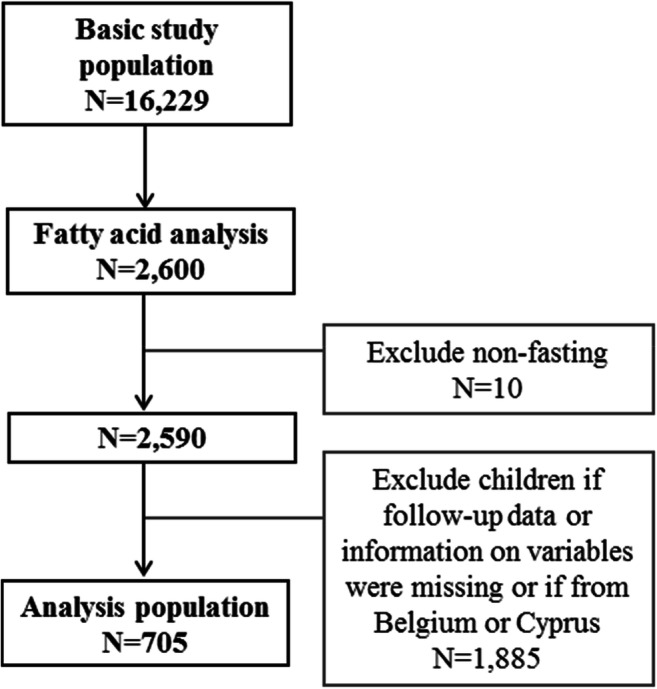
This study aims to examine the association of whole blood n-3 and n-6 polyunsaturated fatty acids (PUFA) with insulin resistance (IR) in children. Whole blood fatty acids were measured in 705 children aged 2-9 years of the European IDEFICS/I.Family cohort using gas chromatography in units of weight percentage of all detected fatty acids (%wt/wt). IR was determined by the Homeostasis Model Assessment for IR (HOMA). Mixed effect models were used to assess the associations between selected baseline PUFA and HOMA z-scores at baseline and after 2- and 6-year follow-ups using models with basic and additional confounder adjustment as well as stratified by sex and weight status. In the basic model, α-linolenic (β = 1.46 SD/%wt/wt, p = 0.006) and eicosapentaenoic acid (β = 1.17 SD/%wt/wt, p = 0.001) were positively associated with baseline HOMA z-score. In the stratified analyses, α-linolenic acid was positively associated with HOMA z-score in girls only (β = 1.98 SD/%wt/wt, p = 0.006) and arachidonic acid was inversely associated with baseline HOMA in thin/normal-weight children (β = - 0.13 SD/%wt/wt, p = 0.0063). In the fully adjusted model, no statistically significant associations were seen.Conclusions: Our overall results do not indicate a protective role of higher blood n-3 PUFA or an adverse role of higher blood arachidonic acid proportion on the risk of IR. What is Known: •Intervention studies reported a beneficial effect of n-3 PUFA supplementation on insulin resistance compared with placebo while observational studies in cildren are inconclusive. •Studies have shown a positive association of n-6 arachidonic acid and insulin resistance indicating an adverse role of arachidonic acid. What is New: •Cross-sectional and longitudinal analyses based on circulating blood fatty acid concentrations in a large cohort of European children and adolescents. •Overall results do not support a protective role of n-3 PUFA or an adverse role of arachidonic acid in insulin resistance.
本研究旨在探讨儿童全血中n-3和n-6多不饱和脂肪酸(PUFA)与胰岛素抵抗(IR)之间的关联。在欧洲IDEFICS/I.Family队列中,对705名2至9岁儿童的全血脂肪酸进行了测量,采用气相色谱法,以所有检测到的脂肪酸的重量百分比(%wt/wt)为单位。通过胰岛素抵抗稳态模型评估(HOMA)来确定IR。使用混合效应模型,通过基本和额外混杂因素调整模型以及按性别和体重状况分层,来评估选定的基线PUFA与基线、2年和6年随访时的HOMA z评分之间的关联。在基本模型中,α-亚麻酸(β = 1.46 SD/%wt/wt,p = 0.006)和二十碳五烯酸(β = 1.17 SD/%wt/wt,p = 0.001)与基线HOMA z评分呈正相关。在分层分析中,α-亚麻酸仅在女孩中与HOMA z评分呈正相关(β = 1.98 SD/%wt/wt,p = 0.006),而花生四烯酸在消瘦/正常体重儿童中与基线HOMA呈负相关(β = -0.13 SD/%wt/wt,p = 0.0063)。在完全调整模型中,未观察到统计学上的显著关联。结论:我们的总体结果并未表明血液中较高的n-3 PUFA具有保护作用,也未表明血液中较高的花生四烯酸比例对IR风险具有不利作用。已知信息:•干预研究报告称,与安慰剂相比,补充n-3 PUFA对胰岛素抵抗有有益作用,而儿童中的观察性研究尚无定论。•研究表明n-6花生四烯酸与胰岛素抵抗呈正相关,表明花生四烯酸具有不利作用。新发现:•基于一大群欧洲儿童和青少年循环血液脂肪酸浓度的横断面和纵向分析。•总体结果不支持n-3 PUFA的保护作用或花生四烯酸在胰岛素抵抗中的不利作用。