Wolters Maike, Dering Carmen, Siani Alfonso, Russo Paola, Kaprio Jaakko, Risé Patrizia, Moreno Luis A, De Henauw Stefaan, Mehlig Kirsten, Veidebaum Toomas, Molnár Denés, Tornaritis Michael, Iacoviello Licia, Pitsiladis Yannis, Galli Claudio, Foraita Ronja, Börnhorst Claudia
Leibniz Institute for Prevention Research and Epidemiology-BIPS, Bremen, Germany.
Epidemiology and Population Genetics, Institute of Food Sciences, National Research Council, Avellino, Italy.
PLoS One. 2017 Jul 21;12(7):e0181485. doi: 10.1371/journal.pone.0181485. eCollection 2017.
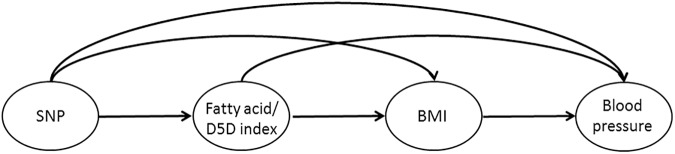
The recent obesity epidemic in children also showed an increase in the prevalence of hypertension. As blood pressure (BP) is associated with (long-chain) polyunsaturated fatty acids (LC PUFA), genetic variation in desaturase enzymes being involved in the synthesis of LC PUFA may be associated with BP. This study aimed to investigate the direct effects (independent of mediating variables) and indirect effects (mediated through intermediate variables) of a common variant in the FADS1 gene, rs174546, known to affect delta-5 desaturase (D5D) activity on PUFA level, body mass index (BMI) and BP.
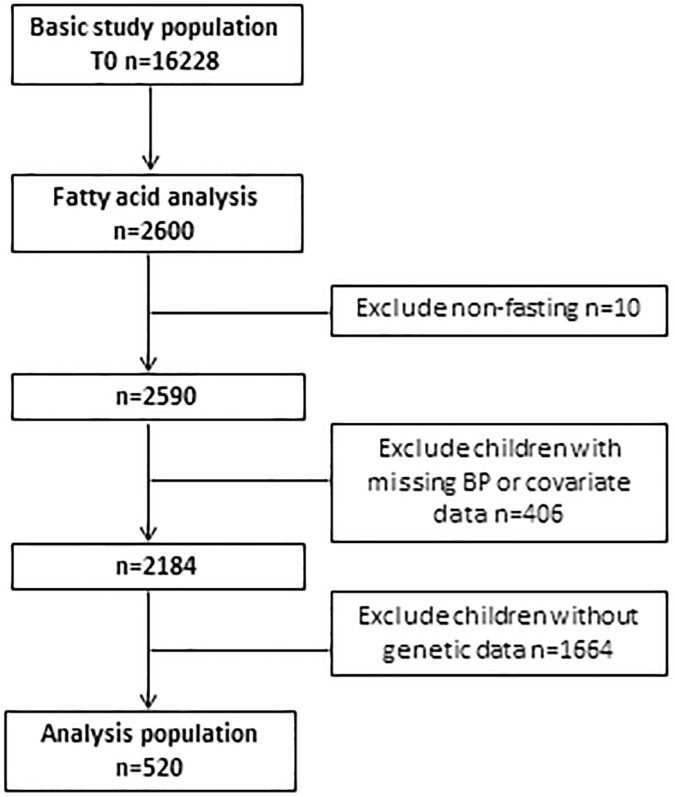
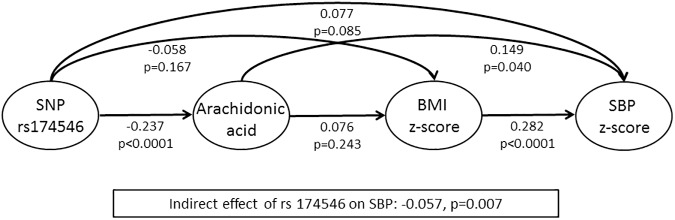
A subsample of the IDEFICS (Identification and prevention of dietary- and lifestyle-induced health effects in children and infants) baseline survey including 520 children aged 2 to <10 years from six European countries was included. The association between rs174546 (T<C) and BP z-score as well as the mediating effects of selected key PUFA levels (dihomo-gamma-linolenic acid, DGLA; arachidonic acid, ARA; eicosapentaenoic acid, EPA) or estimated D5D activity (D5D index) and BMI z-score were investigated through path model analyses, adjusting for sex, age, educational level of parents, family history of hypertension, lifestyle factors and blood levels of saturated and monounsaturated fatty acids, triglycerides and low density lipoprotein cholesterol. Whole blood fatty acids were measured by a validated gas chromatographic method and recorded as percentage of weight of all fatty acids detected.
Minor allele carriers of the SNP rs174546 had significantly higher DGLA and lower ARA and EPA levels as well as a lower D5D index. Via ARA and BMI z-score, the polymorphism had an indirect lowering effect on systolic BP z-score for each additional T allele (standardized effect estimate -0.057, p = 0.007). For DGLA, EPA and D5D index, the indirect effects of rs174546 on systolic BP were also negative but did not reach significance. DGLA and EPA had an increasing indirect effect on systolic BP via BMI. Results for diastolic BP were in general similar but effect estimates were lower compared to systolic BP.
Genetic variation in FADS1 influences BP via ARA and BMI indicating a favorable effect of the minor allele in SNP rs174546. Thus, polymorphisms with an impact on the D5D activity may play a role for the BP level mediated through PUFA and BMI. Therefore, health effects of dietary n-6 and n-3 PUFA may vary depending on genetic FADS1 variants.
近期儿童肥胖流行趋势也显示高血压患病率有所上升。由于血压(BP)与(长链)多不饱和脂肪酸(LC PUFA)相关,参与LC PUFA合成的去饱和酶的基因变异可能与血压有关。本研究旨在调查FADS1基因中一个已知会影响δ-5去饱和酶(D5D)活性的常见变异rs174546对PUFA水平、体重指数(BMI)和血压的直接影响(独立于中介变量)和间接影响(通过中间变量介导)。
纳入了IDEFICS(儿童和婴儿饮食及生活方式引起的健康影响的识别和预防)基线调查的一个子样本,包括来自六个欧洲国家的520名2至<10岁的儿童。通过路径模型分析,研究rs174546(T<C)与血压z评分之间的关联,以及选定的关键PUFA水平(二高-γ-亚麻酸,DGLA;花生四烯酸,ARA;二十碳五烯酸,EPA)或估计的D5D活性(D5D指数)和BMI z评分的中介作用,并对性别、年龄、父母教育水平、高血压家族史、生活方式因素以及饱和脂肪酸、单不饱和脂肪酸、甘油三酯和低密度脂蛋白胆固醇的血液水平进行了调整。全血脂肪酸通过经过验证的气相色谱法进行测量,并记录为所有检测到的脂肪酸重量的百分比。
SNP rs174546的次要等位基因携带者的DGLA水平显著较高,ARA和EPA水平较低,D5D指数也较低。通过ARA和BMI z评分,每增加一个T等位基因,该多态性对收缩压z评分有间接降低作用(标准化效应估计值-0.057,p = 0.007)。对于DGLA、EPA和D5D指数,rs174546对收缩压的间接影响也为负,但未达到显著水平。DGLA和EPA通过BMI对收缩压有增加的间接影响。舒张压的结果总体相似,但效应估计值低于收缩压。
FADS1基因的遗传变异通过ARA和BMI影响血压,表明SNP rs174546中次要等位基因具有有利影响。因此,对D5D活性有影响的多态性可能在通过PUFA和BMI介导的血压水平中起作用。因此,膳食n-6和n-3 PUFA的健康影响可能因FADS1基因变异而异。