Institute of Archaeology, Tel-Aviv University, Tel-Aviv, Israel.
DANTE-Diet and Ancient Technology Laboratory, Department of Oral and Maxillofacial Sciences, Sapienza University of Rome (IT), Rome, Italy.
PLoS One. 2020 Apr 9;15(4):e0230972. doi: 10.1371/journal.pone.0230972. eCollection 2020.
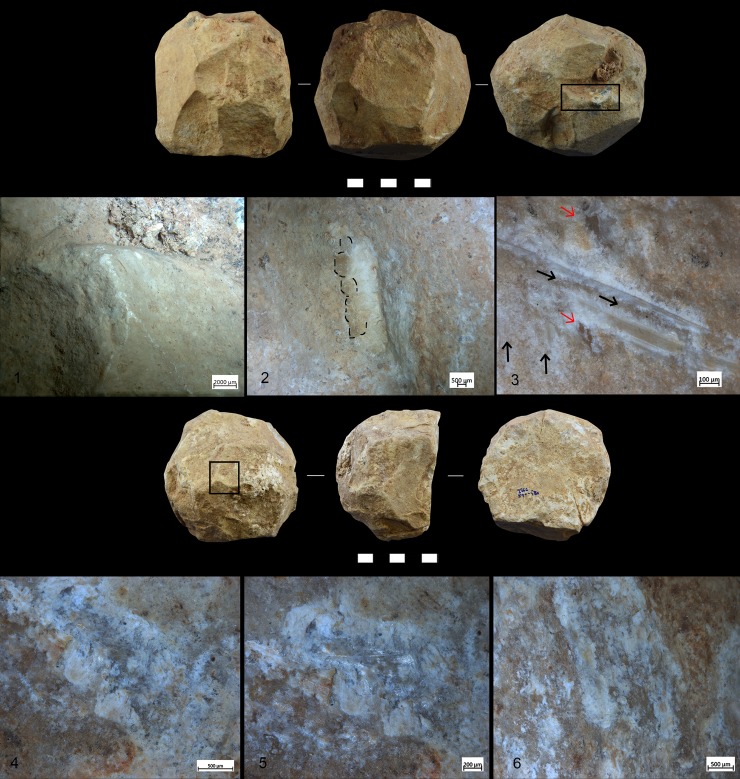
The presence of shaped stone balls at early Paleolithic sites has attracted scholarly attention since the pioneering work of the Leakeys in Olduvai, Tanzania. Despite the persistent presence of these items in the archaeological record over a period of two million years, their function is still debated. We present new results from Middle Pleistocene Qesem Cave on the use of these implements as percussion tools. Use-wear and abundant bone and fat residues found on ten shaped stone balls indicate crushing of fresh bones by thrusting percussion and provide direct evidence for the use of these items to access bone marrow of animal prey at this site. Two experiments conducted to investigate and verify functional aspects proved Qesem Cave shaped stone balls are efficient for bone processing and provide a comfortable grip and useful active areas for repeated use. Notably, the patina observed on the analyzed items precedes their use at the cave, indicating that they were collected by Qesem inhabitants, most probably from older Lower Paleolithic Acheulian sites. Thus, our results refer only to the final phases of the life of the items, and we cannot attest to their original function. As bone marrow played a central role in human nutrition in the Lower Paleolithic, and our experimental results show that the morphology and characteristics of shaped stone ball replicas are well-suited for the extraction of bone marrow, we suggest that these features might have been the reason for their collection and use at Qesem Cave. These results shed light on the function of shaped stone balls and are consistent with the significance of animal fat in the caloric intake of Middle Pleistocene humans as shown by the archeozoological evidence at Qesem Cave and possibly beyond.
自坦桑尼亚奥杜瓦伊的利基夫妇开创性的工作以来,早期旧石器时代遗址中出现的塑形石球一直引起学术界的关注。尽管这些物品在长达两百万年的时间里一直存在于考古记录中,但它们的功能仍存在争议。我们展示了来自中更新世 Qesem 洞穴的新结果,这些结果表明这些工具被用作打击工具。在十个塑形石球上发现的使用痕迹和丰富的骨头和脂肪残留物表明,通过推压冲击来粉碎新鲜的骨头,并为这些物品在该遗址上用于获取动物猎物骨髓提供了直接证据。为了研究和验证功能方面进行了两项实验,证明 Qesem 洞穴的塑形石球非常适合处理骨头,并为重复使用提供了舒适的抓握和有用的活动区域。值得注意的是,在分析的物品上观察到的铜绿先于它们在洞穴中的使用,这表明它们是由 Qesem 居民收集的,很可能是从旧石器时代早期的阿舍利石器时代遗址收集的。因此,我们的结果仅涉及物品生命的最后阶段,我们无法证明其原始功能。由于骨髓在旧石器时代人类营养中起着核心作用,并且我们的实验结果表明,塑形石球的形态和特征非常适合提取骨髓,因此我们认为这些特征可能是它们在 Qesem 洞穴中被收集和使用的原因。这些结果揭示了塑形石球的功能,并与 Qesem 洞穴的考古动物学证据以及可能超出该范围的证据一致,表明动物脂肪在中更新世人的热量摄入中具有重要意义。