Department of Anatomy, School of basic medical sciences, Guangzhou University of Chinese Medicine, 232 Waihuan East Road, Guangzhou, 510006, Guangdong, China.
Department of Pathology, Shenzhen Traditional Chinese Medicine Hospital, The Fourth Clinical Medical College of Guangzhou University of Chinese Medicine, Shenzhen, China.
Stem Cell Res Ther. 2020 Apr 9;11(1):153. doi: 10.1186/s13287-020-01661-3.
To date, it has repeatedly been demonstrated that infusing bone marrow-derived stem cells (BMSCs) into acellular nerve scaffolds can promote and support axon regeneration through a peripheral nerve defect. However, harvesting BMSCs is an invasive and painful process fraught with a low cellular yield.
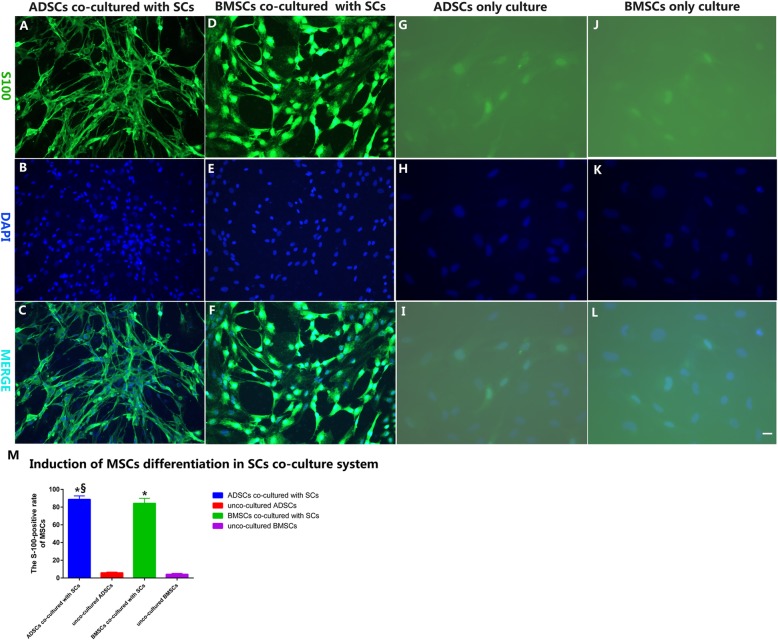
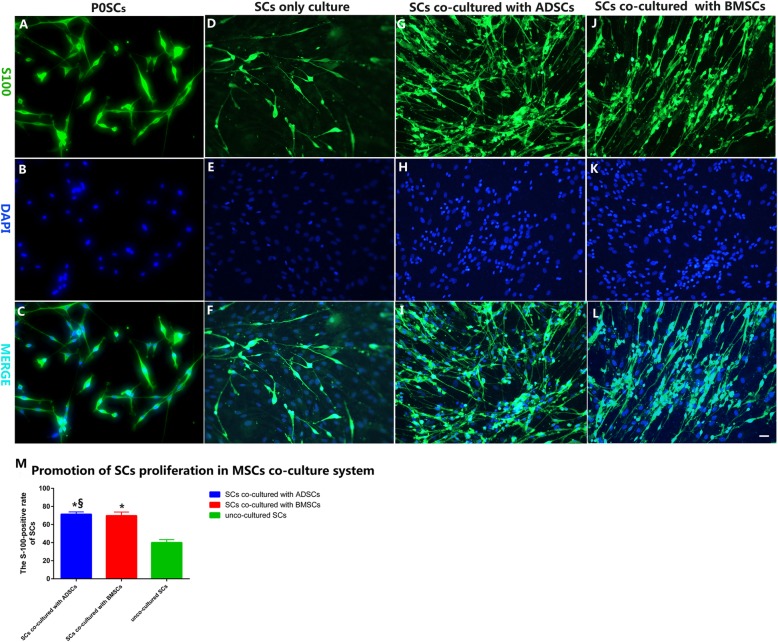
In pursuit of alternative stem cell sources, we isolated stem cells from the inguinal subcutaneous adipose tissue of adult Sprague-Dawley rats (adipose-derived stem cells, ADSCs). We used a co-culture system that allows isolated adult mesenchymal stem cells (MSCs) and Schwann cells (SCs) to grow in the same culture medium but without direct cellular contact. We verified SC phenotype in vitro by cell marker analysis and used red fluorescent protein-tagged ADSCs to detect their fate after being injected into a chemically extracted acellular nerve allograft (CEANA). To compare the regenerative effects of CEANA containing either BMSCs or ADSCs with an autograft and CEANA only on the sciatic nerve defect in vivo, we performed histological and functional assessments up to 16 weeks after grafting.
In vitro, we observed reciprocal beneficial effects of ADSCs and SCs in the ADSC-SC co-culture system. Moreover, ADSCs were able to survive in CEANA for 5 days after in vitro implantation. Sixteen weeks after grafting, all results consistently showed that CEANA infused with BMSCs or ADSCs enhanced injured sciatic nerve repair compared to the acellular CEANA-only treatment. Furthermore, their beneficial effects on sciatic injury regeneration were comparable as histological and functional parameters evaluated showed no statistically significant differences. However, the autograft group was roundly superior to both the BMSC- or ADSC-loaded CEANA groups.
The results of the present study show that ADSCs are a viable alternative stem cell source for treating sciatic nerve injury in lieu of BMSCs.
迄今为止,多项研究表明,将骨髓源性干细胞(BMSCs)注入去细胞神经支架中,可以通过外周神经缺损促进和支持轴突再生。然而,采集 BMSCs 是一个具有侵入性和痛苦的过程,细胞产量低。
为了寻找替代的干细胞来源,我们从成年 Sprague-Dawley 大鼠的腹股沟皮下脂肪组织中分离出干细胞(脂肪源性干细胞,ADSCs)。我们使用共培养系统,使分离的成体间充质干细胞(MSCs)和施万细胞(SCs)在相同的培养基中生长,但没有直接的细胞接触。我们通过细胞标志物分析在体外验证了 SC 表型,并使用红色荧光蛋白标记的 ADSCs 来检测它们在注射到化学提取的去细胞异体神经移植物(CEANA)后的命运。为了比较 CEANA 中含有 BMSCs 或 ADSCs 与自体移植物和仅 CEANA 对体内坐骨神经缺损的再生效果,我们在移植后长达 16 周进行了组织学和功能评估。
在体外,我们观察到 ADSC-SC 共培养系统中 ADSC 和 SC 之间互惠互利的作用。此外,ADSCs 在体外植入后能够在 CEANA 中存活 5 天。移植后 16 周,所有结果均一致表明,与仅 CEANA 处理相比,CEANA 中注入 BMSCs 或 ADSCs 增强了受损坐骨神经的修复。此外,它们对坐骨神经损伤再生的有益作用相当,因为评估的组织学和功能参数没有显示出统计学上的显著差异。然而,自体移植物组明显优于 BMSC 或 ADSC 加载的 CEANA 组。
本研究结果表明,ADSCs 是一种可行的替代干细胞来源,可替代 BMSCs 治疗坐骨神经损伤。