Suor Orsola Benincasa University, Laboratory of Experimental Psychology, Naples, Italy.
Sci Rep. 2020 Apr 9;10(1):6157. doi: 10.1038/s41598-020-63045-0.
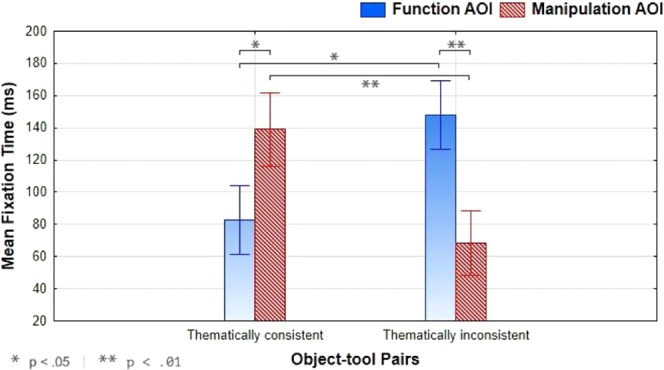
Alongside language and bipedal locomotion, tool use is a characterizing activity of human beings. Current theories in the field embrace two contrasting approaches: "manipulation-based" theories, which are anchored in the embodied-cognition view, explain tool use as deriving from past sensorimotor experiences, whereas "reasoning-based" theories suggest that people reason about object properties to solve everyday-life problems. Here, we present results from two eye-tracking experiments in which we manipulated the visuo-perceptual context (thematically consistent vs. inconsistent object-tool pairs) and the goal of the task (free observation or looking to recognise). We found that participants exhibited reversed tools' visual-exploration patterns, focusing on the tool's manipulation area under thematically consistent conditions and on its functional area under thematically inconsistent conditions. Crucially, looking at the tools with the aim of recognising them produced longer fixations on the tools' functional areas irrespective of thematic consistency. In addition, tools (but not objects) were recognised faster in the thematically consistent conditions. These results strongly support reasoning-based theories of tool use, as they indicate that people primarily process semantic rather than sensorimotor information to interact with the environment in an agent's consistent-with-goal way. Such a pre-eminence of semantic processing challenges the mainstream embodied-cognition view of human tool use.
与语言和两足运动一样,使用工具是人类的一种特征性行为。该领域的现有理论包括两种截然不同的方法:“基于操作”的理论以具身认知观为基础,将工具使用解释为源自过去的感觉运动经验,而“基于推理”的理论则表明人们基于对物体属性的推理来解决日常生活中的问题。在这里,我们呈现了两项眼动追踪实验的结果,我们在这些实验中操纵了视知觉语境(主题一致与不一致的物体-工具对)和任务目标(自由观察或观察以识别)。我们发现,参与者表现出了相反的工具视觉探索模式,在主题一致的条件下,他们将注意力集中在工具的操作区域,而在主题不一致的条件下,他们则将注意力集中在工具的功能区域。至关重要的是,以识别工具为目的观察工具会导致对工具功能区域的注视时间延长,而与主题一致性无关。此外,在主题一致的条件下,工具(而不是物体)的识别速度更快。这些结果强烈支持基于推理的工具使用理论,因为它们表明人们主要处理语义信息而不是感觉运动信息,以符合目标的方式与环境进行交互。这种语义处理的优势挑战了主流的人类工具使用具身认知观。