• 文献检索
  • 文档翻译
  • 深度研究
  • 学术资讯
  • Suppr Zotero 插件Zotero 插件
  • 邀请有礼
  • 套餐&价格
  • 历史记录
应用&插件
Suppr Zotero 插件Zotero 插件浏览器插件Mac 客户端Windows 客户端微信小程序
定价
高级版会员购买积分包购买API积分包
服务
文献检索文档翻译深度研究API 文档MCP 服务
关于我们
关于 Suppr公司介绍联系我们用户协议隐私条款
关注我们

Suppr 超能文献

核心技术专利:CN118964589B侵权必究
粤ICP备2023148730 号-1Suppr @ 2026

文献检索

告别复杂PubMed语法,用中文像聊天一样搜索,搜遍4000万医学文献。AI智能推荐,让科研检索更轻松。

立即免费搜索

文件翻译

保留排版,准确专业,支持PDF/Word/PPT等文件格式,支持 12+语言互译。

免费翻译文档

深度研究

AI帮你快速写综述,25分钟生成高质量综述,智能提取关键信息,辅助科研写作。

立即免费体验

复杂区域疼痛综合征中感知偏差的调查。

An investigation of perceptual biases in complex regional pain syndrome.

作者信息

De Paepe Annick L, Legrain Valéry, Van der Biest Lien, Hollevoet Nadine, Van Tongel Alexander, De Wilde Lieven, Jacobs Herlinde, Crombez Geert

机构信息

Department of Experimental-Clinical and Health Psychology, Faculty of Psychology and Educational Sciences, Ghent University, Ghent, Belgium.

Institute of Neuroscience, Université Catholique de Louvain, Brussels, Belgium.

出版信息

PeerJ. 2020 Apr 2;8:e8819. doi: 10.7717/peerj.8819. eCollection 2020.

DOI:10.7717/peerj.8819
PMID:32274265
原文链接:https://pmc.ncbi.nlm.nih.gov/articles/PMC7130113/
Abstract

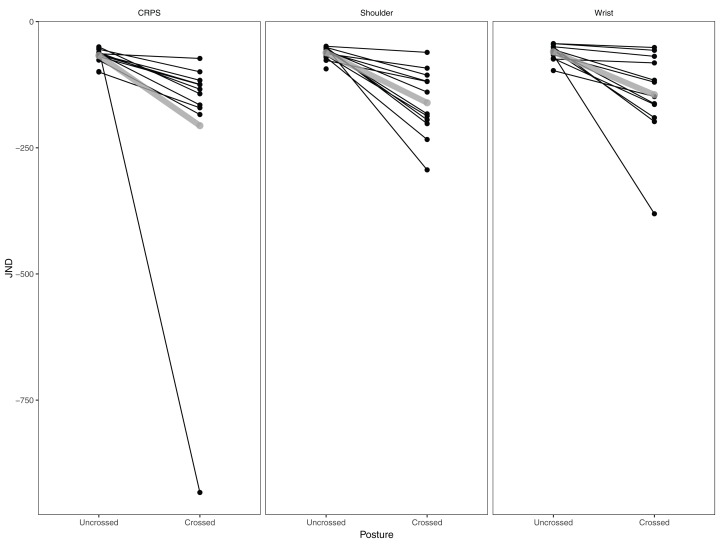
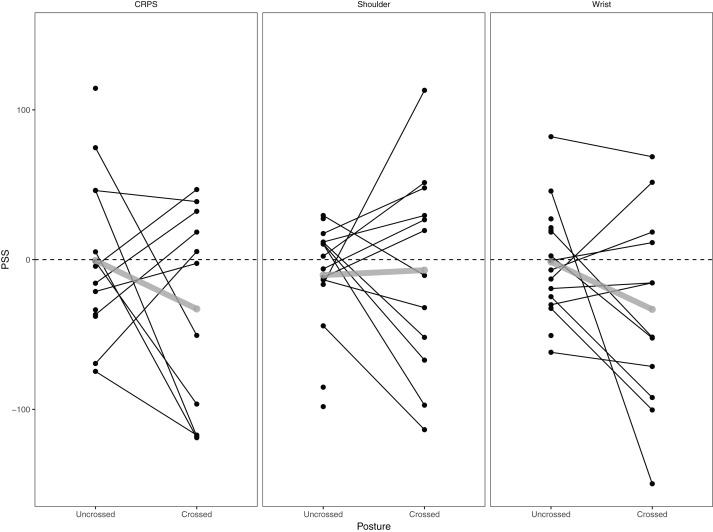
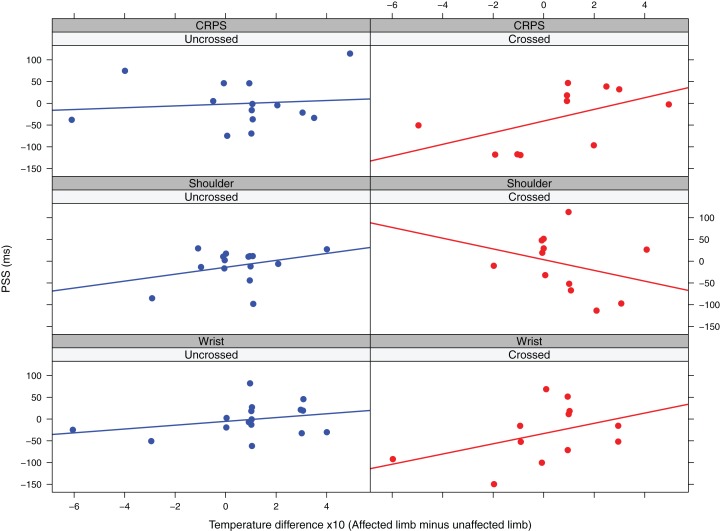
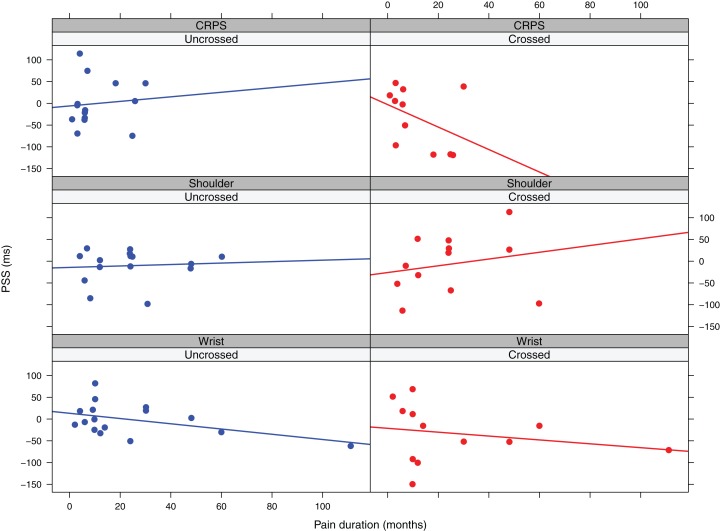
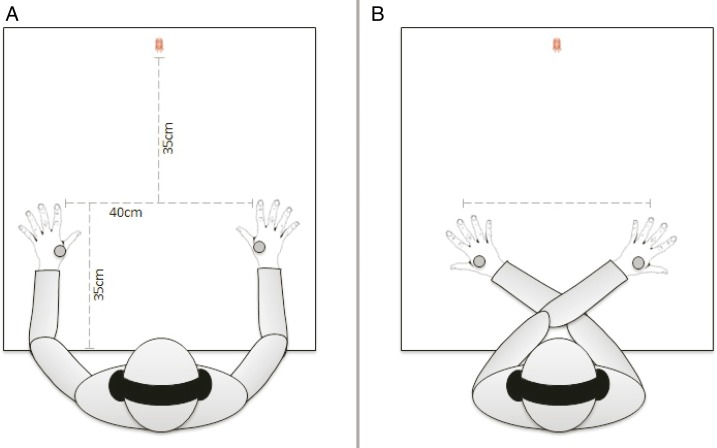
Patients with complex regional pain syndrome (CRPS) report cognitive difficulties, affecting the ability to represent, perceive and use their affected limb. Moseley, Gallace & Spence (2009) observed that CRPS patients tend to bias the perception of tactile stimulation away from the pathological limb. Interestingly, this bias was reversed when CRPS patients were asked to cross their arms, implying that this bias is embedded in a complex representation of the body that takes into account the position of body-parts. Other studies have failed to replicate this finding (Filbrich et al., 2017) or have even found a bias in the opposite direction (Sumitani et al., 2007). Moreover, perceptual biases in CRPS patients have not often been compared to these of other chronic pain patients. Chronic pain patients are often characterized by an excessive focus of attention for bodily sensations. We might therefore expect that non-CRPS pain patients would show a bias towards instead of away from their affected limb. The aim of this study was to replicate the study of Moseley, Gallace & Spence (2009) and to extend it by comparing perceptual biases in a CRPS group with two non-CRPS pain control groups (i.e., chronic unilateral wrist and shoulder pain patients). In a temporal order judgment (TOJ) task, participants reported which of two tactile stimuli, one applied to either hand at various intervals, was perceived as occurring first. TOJs were made, either with the arms in a normal (uncrossed) position, or with the arms crossed over the body midline. We found no consistent perceptual biases in either of the patient groups and in either of the conditions (crossed/uncrossed). Individual differences were large and might, at least partly, be explained by other variables, such as pain duration and temperature differences between the pathological and non-pathological hand. Additional studies need to take these variables into account by, for example, comparing biases in CRPS (and non-CRPS) patients in an acute versus a chronic pain state.

摘要

复杂性区域疼痛综合征(CRPS)患者报告存在认知困难,这影响了他们对患侧肢体的表征、感知和使用能力。莫斯利、加拉塞和斯彭斯(2009年)观察到,CRPS患者倾向于将触觉刺激的感知偏向远离患病肢体的方向。有趣的是,当要求CRPS患者交叉双臂时,这种偏向会反转,这意味着这种偏向嵌入在一个考虑身体各部分位置的复杂身体表征中。其他研究未能重复这一发现(菲尔布里希等人,2017年),甚至发现了相反方向的偏向(苏米塔尼等人,2007年)。此外,CRPS患者的感知偏向很少与其他慢性疼痛患者的感知偏向进行比较。慢性疼痛患者的特点通常是对身体感觉过度关注。因此,我们可能会预期非CRPS疼痛患者会表现出朝向而不是远离患侧肢体的偏向。本研究的目的是重复莫斯利、加拉塞和斯彭斯(2009年)的研究,并通过将CRPS组与两个非CRPS疼痛对照组(即慢性单侧手腕和肩部疼痛患者)的感知偏向进行比较来扩展该研究。在时间顺序判断(TOJ)任务中,参与者报告两个触觉刺激中哪一个(以不同间隔分别施加于两只手)被感知为先出现。TOJ判断是在双臂处于正常(未交叉)位置或双臂交叉于身体中线的情况下进行的。我们在任何一个患者组以及任何一种条件(交叉/未交叉)下都未发现一致的感知偏向。个体差异很大,并且至少部分可以由其他变量解释,例如疼痛持续时间以及患病手和未患病手之间的温度差异。未来的研究需要考虑这些变量,例如,比较CRPS(和非CRPS)患者在急性疼痛状态与慢性疼痛状态下的偏向。
https://cdn.ncbi.nlm.nih.gov/pmc/blobs/5b63/7130113/38493a1ffb56/peerj-08-8819-g005.jpg
https://cdn.ncbi.nlm.nih.gov/pmc/blobs/5b63/7130113/a939d5129e03/peerj-08-8819-g001.jpg
https://cdn.ncbi.nlm.nih.gov/pmc/blobs/5b63/7130113/552b6e4da0dd/peerj-08-8819-g002.jpg
https://cdn.ncbi.nlm.nih.gov/pmc/blobs/5b63/7130113/8899726e61d1/peerj-08-8819-g003.jpg
https://cdn.ncbi.nlm.nih.gov/pmc/blobs/5b63/7130113/31d58fd34130/peerj-08-8819-g004.jpg
https://cdn.ncbi.nlm.nih.gov/pmc/blobs/5b63/7130113/38493a1ffb56/peerj-08-8819-g005.jpg
https://cdn.ncbi.nlm.nih.gov/pmc/blobs/5b63/7130113/a939d5129e03/peerj-08-8819-g001.jpg
https://cdn.ncbi.nlm.nih.gov/pmc/blobs/5b63/7130113/552b6e4da0dd/peerj-08-8819-g002.jpg
https://cdn.ncbi.nlm.nih.gov/pmc/blobs/5b63/7130113/8899726e61d1/peerj-08-8819-g003.jpg
https://cdn.ncbi.nlm.nih.gov/pmc/blobs/5b63/7130113/31d58fd34130/peerj-08-8819-g004.jpg
https://cdn.ncbi.nlm.nih.gov/pmc/blobs/5b63/7130113/38493a1ffb56/peerj-08-8819-g005.jpg

相似文献

1
An investigation of perceptual biases in complex regional pain syndrome.复杂区域疼痛综合征中感知偏差的调查。
PeerJ. 2020 Apr 2;8:e8819. doi: 10.7717/peerj.8819. eCollection 2020.
2
Ignoring space around a painful limb? No evidence for a body-related visuospatial attention bias in complex regional pain syndrome.忽略患肢周围的空间?复杂性区域疼痛综合征中与身体相关的视空间注意偏向并无证据。
Cortex. 2021 Mar;136:89-108. doi: 10.1016/j.cortex.2020.12.007. Epub 2020 Dec 24.
3
Attention upturned: Bias toward and away from the affected side of the body and near space in a case of complex regional pain syndrome.关注转向:一例复杂性区域疼痛综合征中对身体受影响侧和近侧空间的偏向和回避。
Neuropsychologia. 2021 Dec 10;163:108079. doi: 10.1016/j.neuropsychologia.2021.108079. Epub 2021 Nov 3.
4
Space-based bias of covert visual attention in complex regional pain syndrome.基于空间的隐匿视觉注意力偏向与复杂区域疼痛综合征。
Brain. 2017 Sep 1;140(9):2306-2321. doi: 10.1093/brain/awx152.
5
Disputing space-based biases in unilateral complex regional pain syndrome.质疑单侧复杂性区域疼痛综合征中基于空间的偏差。
Cortex. 2020 Jun;127:248-268. doi: 10.1016/j.cortex.2020.02.018. Epub 2020 Mar 13.
6
Biased visuospatial perception in complex regional pain syndrome.复杂区域疼痛综合征中的偏侧视空间感知障碍。
Sci Rep. 2017 Aug 29;7(1):9712. doi: 10.1038/s41598-017-10077-8.
7
Space-based, but not arm-based, shift in tactile processing in complex regional pain syndrome and its relationship to cooling of the affected limb.基于太空的、而非基于手臂的触觉处理在复杂性局部疼痛综合征中的移位及其与受影响肢体冷却的关系。
Brain. 2009 Nov;132(Pt 11):3142-51. doi: 10.1093/brain/awp224. Epub 2009 Sep 14.
8
Intact tactile anisotropy despite altered hand perception in complex regional pain syndrome: rethinking the role of the primary sensory cortex in tactile and perceptual dysfunction.复杂区域疼痛综合征中手部感觉改变但触觉各向异性仍完整:重新思考初级感觉皮层在触觉和感知功能障碍中的作用
PeerJ. 2021 May 3;9:e11156. doi: 10.7717/peerj.11156. eCollection 2021.
9
Characterizing biased visuospatial perception in complex regional pain syndrome.描述复杂区域性疼痛综合征中的偏向性视空间感知。
Eur J Pain. 2023 Aug;27(7):871-883. doi: 10.1002/ejp.2118. Epub 2023 Apr 21.
10
Altered updating of bodily and spatial representations after tool-use in complex regional pain syndrome.复杂区域疼痛综合征患者在使用工具后身体和空间表征更新的改变
Pain. 2020 Jul;161(7):1609-1628. doi: 10.1097/j.pain.0000000000001845.

引用本文的文献

1
Normal manual straight ahead pointing in Complex Regional Pain Syndrome.正常情况下,在复杂性区域疼痛综合征中,手会指向正前方。
PLoS One. 2021 Dec 20;16(12):e0261614. doi: 10.1371/journal.pone.0261614. eCollection 2021.
2
Where is my arm? Investigating the link between complex regional pain syndrome and poor localisation of the affected limb.我的胳膊在哪里?探究复杂性区域疼痛综合征与患肢定位障碍之间的联系。
PeerJ. 2021 Aug 20;9:e11882. doi: 10.7717/peerj.11882. eCollection 2021.

本文引用的文献

1
Testing the exteroceptive function of nociception: The role of visual experience in shaping the spatial representations of nociceptive inputs.测试伤害感受的外感受功能:视觉经验在塑造伤害性输入的空间表征中的作用。
Cortex. 2020 May;126:26-38. doi: 10.1016/j.cortex.2019.12.024. Epub 2020 Jan 22.
2
Reproducible and replicable pain research: a critical review.可重复和可再现的疼痛研究:一项批判性综述。
Pain. 2018 Sep;159(9):1683-1689. doi: 10.1097/j.pain.0000000000001254.
3
Lost in space: do somatic symptoms affect the perception of extra-somatic stimuli?
迷失在空间中:躯体症状会影响对躯体外部刺激的感知吗?
Brain. 2017 Sep 1;140(9):2254-2256. doi: 10.1093/brain/awx188.
4
Space-based bias of covert visual attention in complex regional pain syndrome.基于空间的隐匿视觉注意力偏向与复杂区域疼痛综合征。
Brain. 2017 Sep 1;140(9):2306-2321. doi: 10.1093/brain/awx152.
5
Biased visuospatial perception in complex regional pain syndrome.复杂区域疼痛综合征中的偏侧视空间感知障碍。
Sci Rep. 2017 Aug 29;7(1):9712. doi: 10.1038/s41598-017-10077-8.
6
Spatially-defined motor deficits in people with unilateral complex regional pain syndrome.单侧复杂区域疼痛综合征患者的空间限定运动缺陷。
Cortex. 2018 Jul;104:154-162. doi: 10.1016/j.cortex.2017.06.024. Epub 2017 Jul 14.
7
How visual experience impacts the internal and external spatial mapping of sensorimotor functions.视觉经验如何影响感觉运动功能的内外空间映射。
Sci Rep. 2017 Apr 21;7(1):1022. doi: 10.1038/s41598-017-01158-9.
8
Orienting attention in visual space by nociceptive stimuli: investigation with a temporal order judgment task based on the adaptive PSI method.通过伤害性刺激在视觉空间中定向注意力:基于自适应PSI方法的时间顺序判断任务研究。
Exp Brain Res. 2017 Jul;235(7):2069-2079. doi: 10.1007/s00221-017-4951-2. Epub 2017 Apr 3.
9
A New Kind of Spatial Inattention Associated With Chronic Limb Pain?慢性肢体痛相关的一种新型空间注意缺陷?
Ann Neurol. 2016 Apr;79(4):701-4. doi: 10.1002/ana.24616. Epub 2016 Mar 4.
10
From a Somatotopic to a Spatiotopic Frame of Reference for the Localization of Nociceptive Stimuli.从躯体定位到空间定位的痛觉刺激定位参考框架。
PLoS One. 2015 Aug 28;10(8):e0137120. doi: 10.1371/journal.pone.0137120. eCollection 2015.