Institute of Health and Welfare Policy, School of Medicine, National Yang-Ming University, Taipei, Taiwan.
Department of Industrial Economics, College of Business and Management, Tamkang University, New Taipei City, Taiwan.
PLoS One. 2020 Apr 10;15(4):e0230242. doi: 10.1371/journal.pone.0230242. eCollection 2020.
Sexually explicit media exposure during early adolescence has been found to be associated with risky sexual behavior. However, previous study suffered from methodological issue, such as selection bias. Furthermore, little is known about the effect of multi-modality sexually explicit media exposure on risky sexual behavior, and how this relationship can be applied to non-western societies.
This study aimed to improve upon previous studies by using instrumental variable estimation. In addition, this study also included multi-modality of sexually explicit media and three risky sexual behavior measure from a sample of Taiwanese adolescents.
Participants were recruited from a prospective longitudinal study (Taiwan Youth Project). All were in 7th grade (mean age = 13.3) when the study was initiated in 2000. Sexually explicit media exposure, including ever-exposure and number of modalities exposed to, was measured in wave 2 (8th grade). Risky sexual behavior was measured in waves 8 (mean age = 20.3) and 10 (mean age = 24.3). A two-stage least squares regression was employed, with pubertal timing as the instrumental variable.
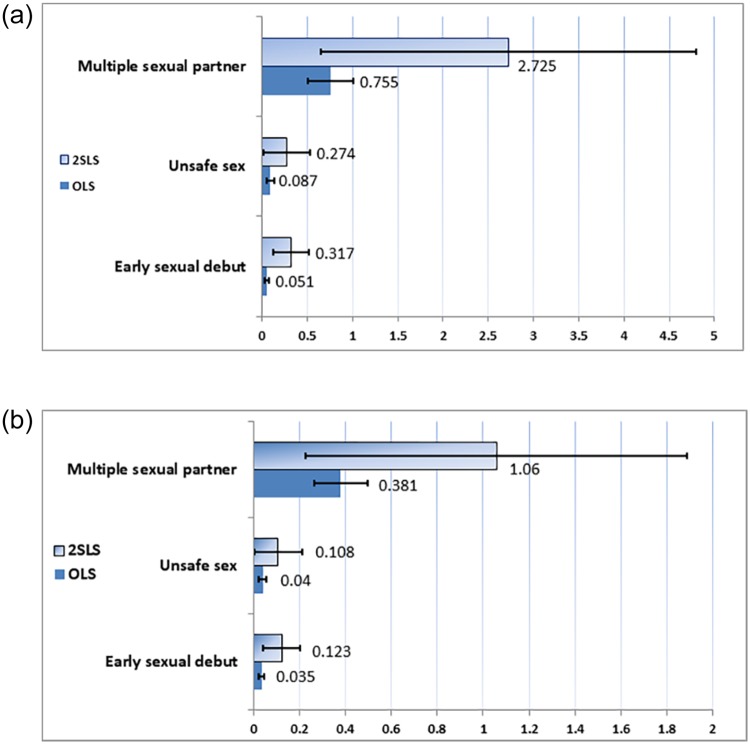
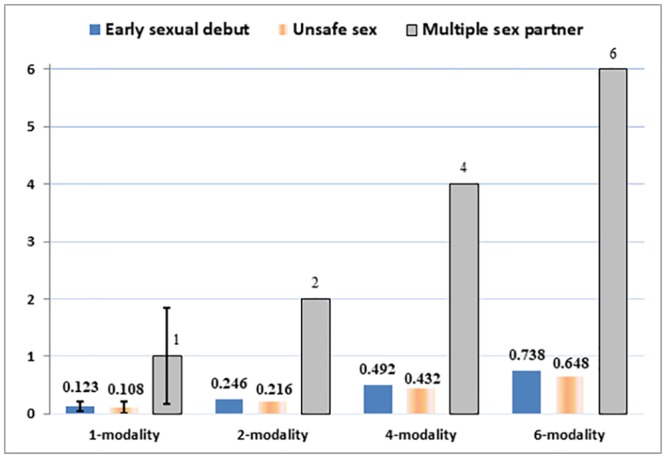
About 50% of participants had been exposed to sexual media content by 8th grade, from an average of one modality. Sexually explicit media exposure predicted early sexual debut, unsafe sex, and multiple sexual partners (all: p < .05). Furthermore, exposure to more media modalities increased the likelihood of risky sexual behaviors. However, only the effect on early sexual debut was gender invariant.
Exposure to sexually explicit media in early adolescence had a substantive relationship with risky sexual behavior in the emerging adulthood. Knowledge of this causal like effect provides a basis for building better preventive programs in early adolescence. One prominent way is early education on media literacy, and physicians themselves may need to be familiar with such content to initiate it.
青春期早期接触色情媒体与危险性行为有关。然而,之前的研究存在方法学问题,如选择偏差。此外,人们对多模态色情媒体接触对危险性行为的影响知之甚少,以及这种关系如何适用于非西方社会。
本研究旨在通过使用工具变量估计来改进之前的研究。此外,本研究还包括来自台湾青少年样本的多模态色情媒体和三种危险性行为测量。
参与者是从一项前瞻性纵向研究(台湾青年项目)中招募的。所有参与者在 2000 年开始研究时都处于 7 年级(平均年龄=13.3 岁)。在第 2 波(8 年级)测量了色情媒体的暴露情况,包括曾经接触过的情况和接触过的模式数量。在第 8 波(平均年龄=20.3 岁)和第 10 波(平均年龄=24.3 岁)测量了危险性行为。采用两阶段最小二乘法回归,以青春期时间作为工具变量。
大约 50%的参与者在 8 年级时已经接触过色情媒体内容,平均接触一种模式。色情媒体的暴露预测了早期的性开始、不安全的性行为和多个性伴侣(均:p<.05)。此外,接触更多的媒体模式增加了危险性行为的可能性。然而,只有对早期性开始的影响是性别不变的。
青春期早期接触色情媒体与成年早期的危险性行为有实质性的关系。这种因果关系的认识为在青春期早期建立更好的预防计划提供了基础。一种突出的方法是早期的媒体素养教育,医生本身可能需要熟悉这些内容来启动它。