Wu Ding-Tao, Liu Wen, Xian Mei-Lin, Du Gang, Liu Xin, He Jing-Jing, Wang Ping, Qin Wen, Zhao Li
College of Food Science, Sichuan Agricultural University, Ya'an 625014, Sichuan, China.
Sichuan Provincial Institute for Food and Drug Control, Chengdu 611731, China.
Foods. 2020 Apr 8;9(4):456. doi: 10.3390/foods9040456.
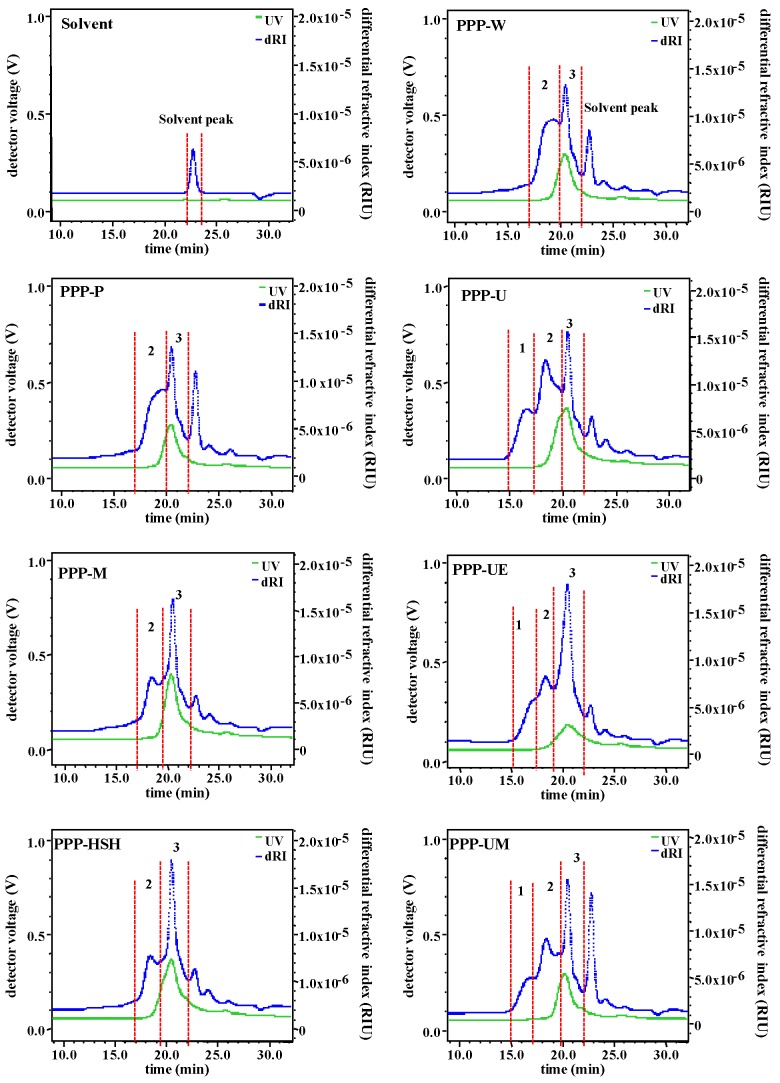
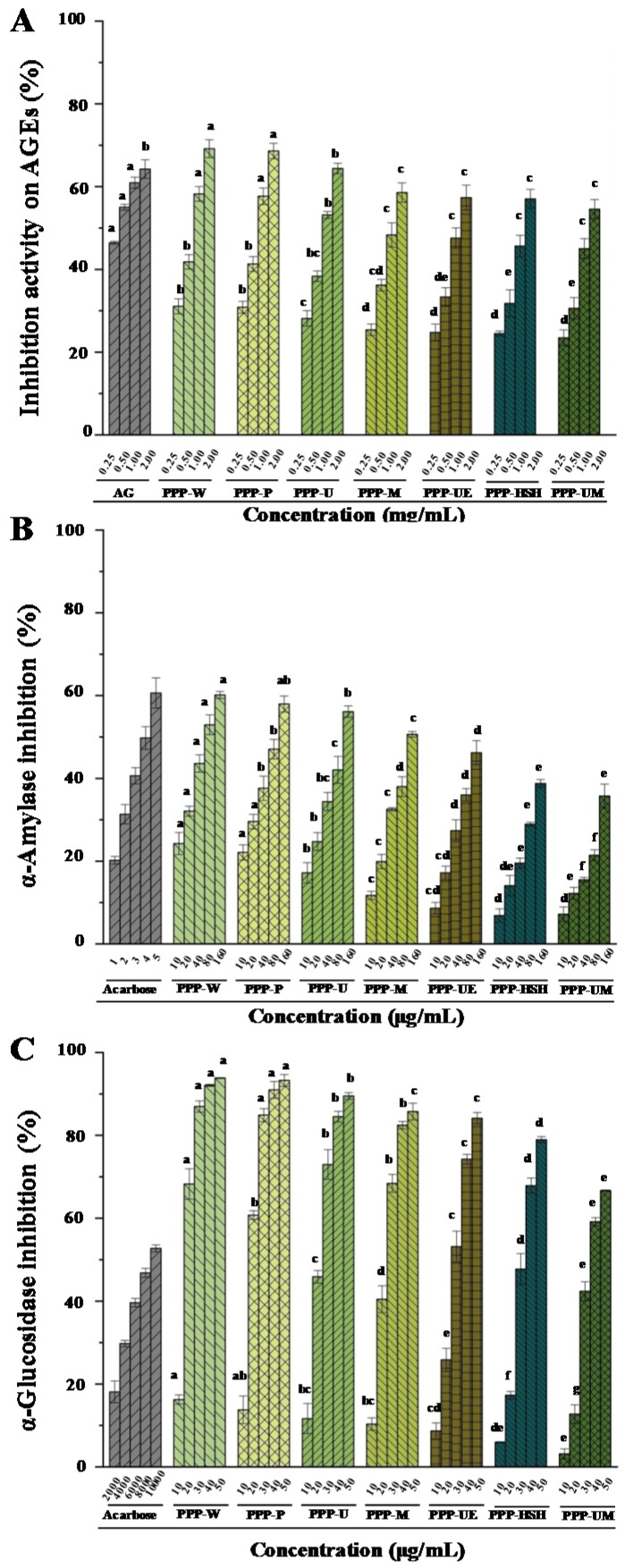
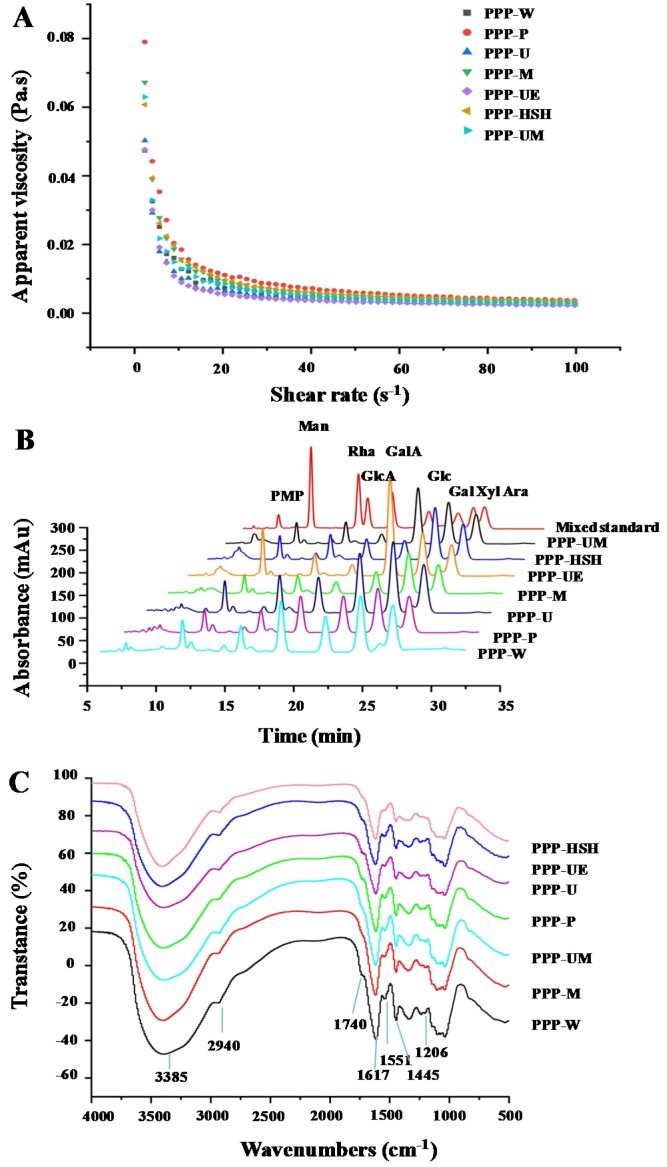
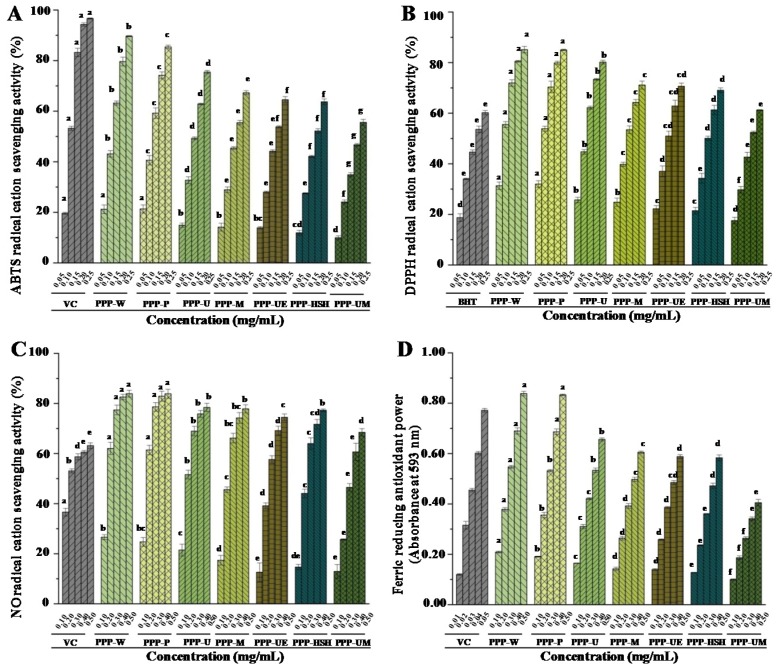
Seven extraction methods, including hot water extraction (HWE), pressurized water extraction (PWE), ultrasound-assisted extraction, microwave-assisted extraction, ultrasound-assisted enzymatic extraction, high-speed shearing homogenization extraction, and ultrasound-microwave-assisted extraction, were utilized to extract polyphenolic-protein-polysaccharide complexes (PPPs) from . Next, their physicochemical properties and in vitro antioxidant activities, antiglycation effects, and inhibition activities on α-glucosidase and α-amylase were studied and compared. The findings from this study indicate that various extraction processes exhibit notable influences on the physicochemical properties and in vitro bioactivities of PPPs. Extraction yields, contents of polyphenolics and flavonoids, apparent viscosities, molecular weights, molar ratios of monosaccharide compositions, and ratios of amino acid compositions in PPPs varied in different extraction methods. Furthermore, 13 phenolic compounds in PPPs, including rutin, myricitrin, myricetin, quercetin, kaempferol, protocatechuic acid, gallocatechin, p-hydroxybenzoic acid, ampelopsin, quercetin-7,4'-diglucoside, dihydroquercetin, 5-methylmyricetin, and naringenin, were identified. The relatively strong in vitro antioxidant activities, antiglycation effects, and inhibition activities on α-glucosidase and α-amylase were determined in both PPP-W and PPP-P obtained by HWE and PWE, respectively. The high content of total polyphenolics may be one of the main contributors to their in vitro bioactivities. The findings have shown that the PWE method can be an appropriate method to prepare PPPs with strong bioactivities for application in the functional food industry.
采用七种提取方法,包括热水提取(HWE)、加压水提取(PWE)、超声辅助提取、微波辅助提取、超声辅助酶提取、高速剪切均质提取和超声-微波辅助提取,从……中提取多酚-蛋白质-多糖复合物(PPPs)。接下来,对它们的理化性质、体外抗氧化活性、抗糖化作用以及对α-葡萄糖苷酶和α-淀粉酶的抑制活性进行了研究和比较。本研究结果表明,不同的提取工艺对PPPs的理化性质和体外生物活性有显著影响。不同提取方法下,PPPs的提取率、多酚和黄酮含量、表观粘度、分子量、单糖组成摩尔比以及氨基酸组成比例各不相同。此外,还鉴定出了PPPs中的13种酚类化合物,包括芦丁、杨梅苷、杨梅素、槲皮素、山奈酚、原儿茶酸、没食子儿茶素、对羟基苯甲酸、白藜芦醇、槲皮素-7,4'-二葡萄糖苷、二氢槲皮素、5-甲基杨梅素和柚皮苷。分别通过HWE和PWE获得的PPPs-W和PPPs-P表现出相对较强的体外抗氧化活性、抗糖化作用以及对α-葡萄糖苷酶和α-淀粉酶的抑制活性。总多酚的高含量可能是其体外生物活性的主要贡献因素之一。研究结果表明,PWE方法可能是一种制备具有强生物活性的PPPs并应用于功能性食品工业的合适方法。