Dereń Katarzyna, Wyszyńska Justyna, Nyankovskyy Serhiy, Nyankovska Olena, Łuszczki Edyta, Sobolewski Marek, Mazur Artur
Institute of Health Sciences, Medical College of Rzeszow University, 35-959 Rzeszow, Poland.
Centre for Innovative Research in Medical and Natural Sciences, University of Rzeszow, 35-310 Rzeszow, Poland.
J Clin Med. 2020 Apr 8;9(4):1060. doi: 10.3390/jcm9041060.
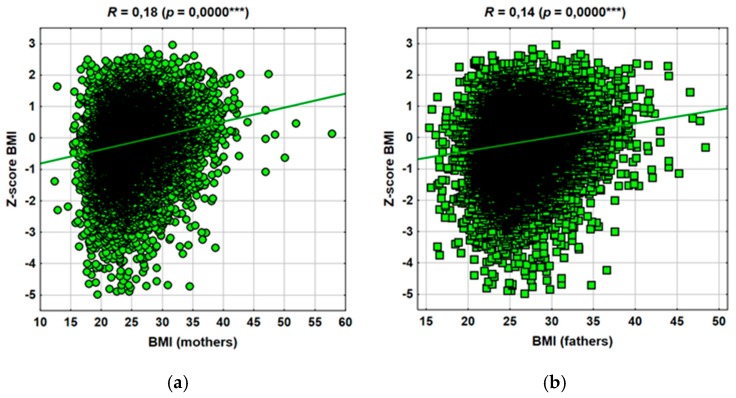
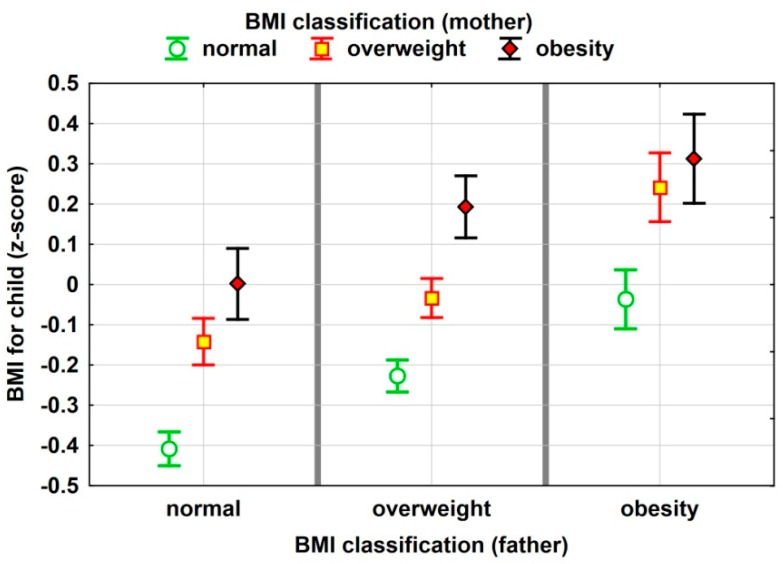
The aim of this study was to assess the impact of parental body mass index (BMI) on the risk of having an overweight or obese child in Ukraine. This study included 22,576 parents (11,288 mothers and fathers) and the same number of children (boys 48%, girls 52%) aged 6.0-18.9 years who live in Ukraine. The study was conducted in randomly selected primary, secondary and high schools of Ukraine. Body weight and height was measured in triplicate. Based on the results obtained, BMI was calculated. The analysis was carried out based on z-score values of children and BMI classification of children. Odds ratios (OR) were calculated using logistic regression analysis. For fathers, 38.1% had normal BMI, 15.9% were obese, and 45.6% were overweight. For mothers, 52.1% of those surveyed had normal BMI, 31.8% were overweight and 13.5% were classified as obese. The vast majority (72.7%) of children had normal weight, 10.2% were overweight, and 15.0% were underweight. Children of overweight fathers had a higher risk of becoming overweight (OR = 1.41). Children of obese fathers had both a greater risk of being overweight (OR = 2.04) and obese (OR = 2.56). The odds ratios indicate that children of overweight mothers had a greater risk of being overweight (OR = 1.45) and obese (OR = 1.76). Children of obese mothers had both a greater risk of becoming overweight (OR = 2.05) and obese (OR = 2.70). More often, overweight and obese parents had children who also had higher BMI.
本研究旨在评估乌克兰父母的体重指数(BMI)对其子女超重或肥胖风险的影响。该研究纳入了22576名父母(11288名母亲和11288名父亲)以及相同数量年龄在6.0至18.9岁的子女(男孩占48%,女孩占52%),这些人均居住在乌克兰。研究在乌克兰随机选取的小学、初中和高中开展。体重和身高测量三次。根据所得结果计算BMI。分析基于儿童的z评分值和儿童的BMI分类进行。使用逻辑回归分析计算比值比(OR)。对于父亲,38.1%的BMI正常,15.9%肥胖,45.6%超重。对于母亲,52.1%的受调查者BMI正常,31.8%超重,13.5%被归类为肥胖。绝大多数(72.7%)儿童体重正常,10.2%超重,15.0%体重过轻。超重父亲的子女超重风险更高(OR = 1.41)。肥胖父亲的子女超重(OR = 2.04)和肥胖(OR = 2.56)的风险均更高。比值比表明,超重母亲的子女超重(OR = 1.45)和肥胖(OR = 1.76)的风险更大。肥胖母亲的子女超重(OR = 2.05)和肥胖(OR = 2.70)的风险均更大。超重和肥胖的父母更常生育BMI也较高的子女。