CETAF, Saint-Etienne, France.
Laboratoire SNA-EPIS, University Jean Monnet, Saint-Etienne, France.
BMC Geriatr. 2020 Apr 10;20(1):132. doi: 10.1186/s12877-020-01538-3.
Physical activity may decrease the risk of dementia; however, previous cohort studies seldom investigated the different types of physical activity and household activities. Our objective was to analyze the links between two physical activity types and dementia in older people.
The study used data from the prospective observational Three-city cohort and included 1550 community-dwelling individuals aged 72 to 87 without dementia at baseline. Physical activity was assessed with the Voorrips questionnaire. Two sub-scores were calculated to assess household/transportation activities and leisure/sport activities. Restricted cubic spline and proportional hazard Cox models were used to estimate the non-linear exposure-response curve for the dementia risk and the appropriate activity level thresholds. Models were adjusted for possible confounders, including socio-demographic variables, comorbidities, depressive symptoms and APOE genotype.
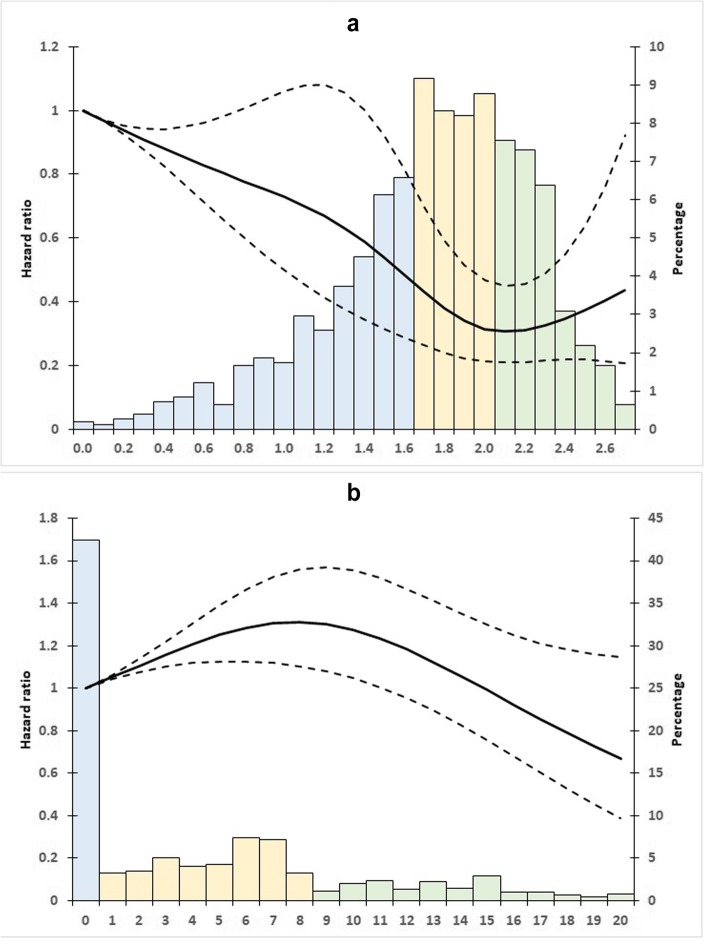
The median age was 80 years, and 63.6% of participants were women. After a median follow-up of 4.6 years, dementia was diagnosed in 117 participants (7.6%). An inverse J-shaped association was found between household/transportation physical activity sub-score and dementia risk, which means that the risk is lowest for the moderately high values and then re-increases slightly for the highest values. The results remained significant when this sub-score was categorized in three classes (low, moderate, and high), with hazard ratios (95% confidence interval) of 0.55 (0.35-0.87) and 0.62 (0.38-1.01) for moderate and high activity levels, respectively. No significant effect was found for leisure/sport activities.
The 5-year risk of dementia was significantly and negatively associated with the household/transportation activity level, but not with the leisure and sport activity sub-score. This highlights the importance of considering all physical activity types in 72 years or older people.
身体活动可能降低痴呆风险;然而,先前的队列研究很少调查不同类型的身体活动和家务活动。我们的目的是分析两种身体活动类型与老年人痴呆的关系。
本研究使用前瞻性观察性三城市队列的数据,纳入了基线时无痴呆的 1550 名年龄在 72 至 87 岁之间的社区居住者。身体活动使用 Voorrips 问卷进行评估。计算了两个子分数来评估家务/交通活动和休闲/运动活动。使用受限立方样条和比例风险 Cox 模型估计痴呆风险的非线性暴露-反应曲线和适当的活动水平阈值。模型调整了可能的混杂因素,包括社会人口统计学变量、合并症、抑郁症状和 APOE 基因型。
中位年龄为 80 岁,63.6%的参与者为女性。中位随访 4.6 年后,117 名参与者(7.6%)被诊断为痴呆。家务/交通身体活动子分数与痴呆风险呈反 J 形关联,这意味着中等偏高值的风险最低,然后略微增加到最高值。当将该子分数分为三个等级(低、中、高)时,结果仍然显著,中度和高度活动水平的危险比(95%置信区间)分别为 0.55(0.35-0.87)和 0.62(0.38-1.01)。休闲/运动活动没有显著影响。
痴呆的 5 年风险与家务/交通活动水平显著负相关,但与休闲和运动活动子分数无关。这强调了在 72 岁及以上人群中考虑所有身体活动类型的重要性。