Department of Neurology, Institute of Clinical Medicine, University of Eastern Finland, P.O. Box 1627, FI-70211, Kuopio, Finland.
Department of Ophthalmology, Institute of Clinical Medicine, University of Eastern Finland, P.O. Box 1627, FI-70211, Kuopio, Finland.
J Mol Med (Berl). 2020 May;98(5):633-650. doi: 10.1007/s00109-020-01904-z. Epub 2020 Apr 11.
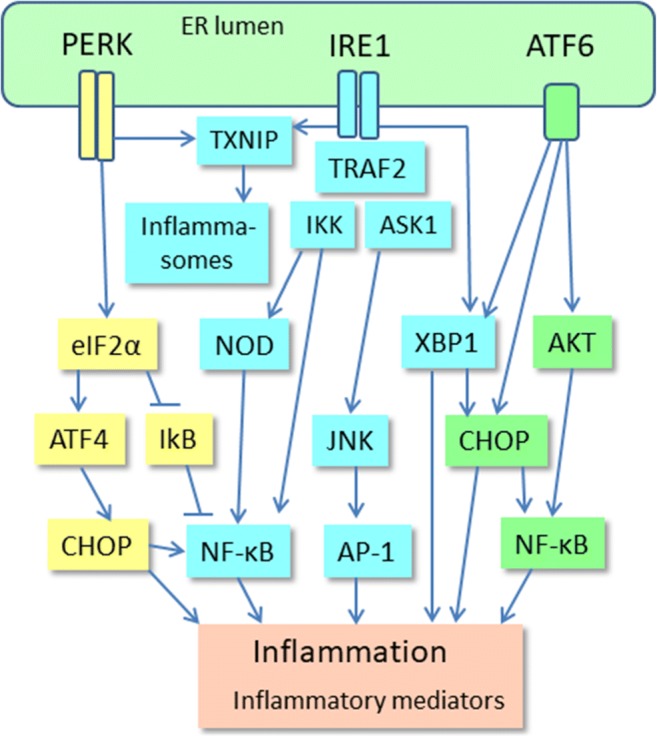
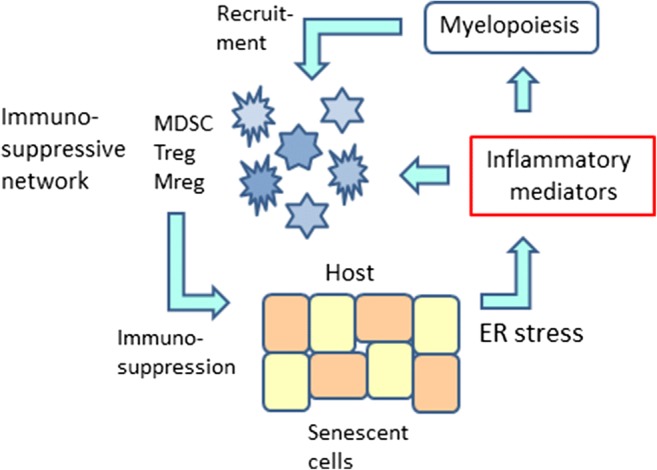
The endoplasmic reticulum (ER) contains stress sensors which recognize the accumulation of unfolded proteins within the lumen of ER, and subsequently these transducers stimulate the unfolded protein response (UPR). The ER sensors include the IRE1, PERK, and ATF6 transducers which activate the UPR in an attempt to restore the quality of protein folding and thus maintain cellular homeostasis. If there is excessive stress, UPR signaling generates alarmins, e.g., chemokines and cytokines, which activate not only tissue-resident immune cells but also recruit myeloid and lymphoid cells into the affected tissues. ER stress is a crucial inducer of inflammation in many pathological conditions. A chronic low-grade inflammation and cellular senescence have been associated with the aging process and many age-related diseases, such as Alzheimer's disease. Currently, it is known that immune cells can exhibit great plasticity, i.e., they are able to display both pro-inflammatory and anti-inflammatory phenotypes in a context-dependent manner. The microenvironment encountered in chronic inflammatory conditions triggers a compensatory immunosuppression which defends tissues from excessive inflammation. Recent studies have revealed that chronic ER stress augments the suppressive phenotypes of immune cells, e.g., in tumors and other inflammatory disorders. The activation of immunosuppressive network, including myeloid-derived suppressor cells (MDSC) and regulatory T cells (Treg), has been involved in the aging process and Alzheimer's disease. We will examine in detail whether the ER stress-related changes found in aging tissues and Alzheimer's disease are associated with the activation of immunosuppressive network, as has been observed in tumors and many chronic inflammatory diseases.
内质网(ER)包含应激传感器,可识别 ER 腔中未折叠蛋白的积累,随后这些传感器会刺激未折叠蛋白反应(UPR)。ER 传感器包括 IRE1、PERK 和 ATF6 传感器,它们会激活 UPR,试图恢复蛋白质折叠的质量,从而维持细胞内稳态。如果应激过大,UPR 信号会产生警报素,例如趋化因子和细胞因子,这些警报素不仅会激活组织驻留免疫细胞,还会招募髓系和淋巴样细胞进入受影响的组织。内质网应激是许多病理条件下炎症的关键诱导因素。慢性低度炎症和细胞衰老与衰老过程和许多与年龄相关的疾病有关,如阿尔茨海默病。目前已知免疫细胞具有很大的可塑性,即它们能够以依赖于上下文的方式表现出促炎和抗炎表型。慢性炎症条件下遇到的微环境会触发代偿性免疫抑制,从而防止组织过度炎症。最近的研究表明,慢性内质网应激会增强免疫细胞的抑制表型,例如在肿瘤和其他炎症性疾病中。抑制性免疫网络的激活,包括髓系来源的抑制细胞(MDSC)和调节性 T 细胞(Treg),与衰老过程和阿尔茨海默病有关。我们将详细研究在衰老组织和阿尔茨海默病中发现的与内质网应激相关的变化是否与在肿瘤和许多慢性炎症性疾病中观察到的抑制性免疫网络的激活有关。