Yang Wen-Chi, Hsu Feng-Ming, Chen Yu-Hsuan, Shih Jin-Yuan, Yu Chong-Jen, Lin Zhong-Zhe, Lu Szu-Huai, Yang James Chih-Hsin, Cheng Ann-Lii, Kuo Sung-Hsin
Division of Radiation Oncology, Department of Oncology, National Taiwan University Hospital, Taipei, Taiwan.
Graduate Institute of Oncology, National Taiwan University College of Medicine, Taipei, Taiwan.
Clin Transl Radiat Oncol. 2020 Mar 23;22:76-82. doi: 10.1016/j.ctro.2020.03.008. eCollection 2020 May.
Thoracic re-irradiation may be an alternative treatment for lung cancer patients who develop intrathoracic locoregional recurrence without systemic progression. This study aimed to retrospectively assess locoregional control, clinical outcomes, and toxicities in lung cancer patients who received thoracic re-irradiation.
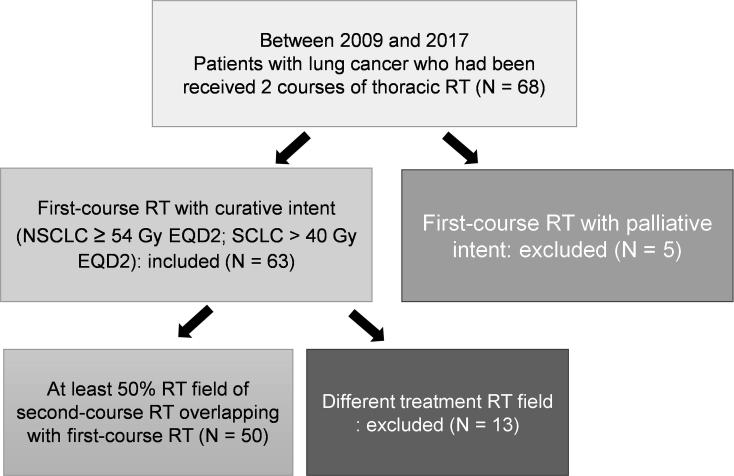
We retrospectively reviewed 50 lung cancer patients who received thoracic re-irradiation using conventional photon radiotherapy (RT) and stereotactic body radiotherapy (SBRT) between 2009 and 2017. The correlations of clinicopathologic factors, treatment factors, and dosimetric factors of RT with time to local progression (TTLP), progression-free survival (PFS), and overall survival (OS) after starting thoracic re-irradiation were calculated using log-rank tests and Cox regression models.
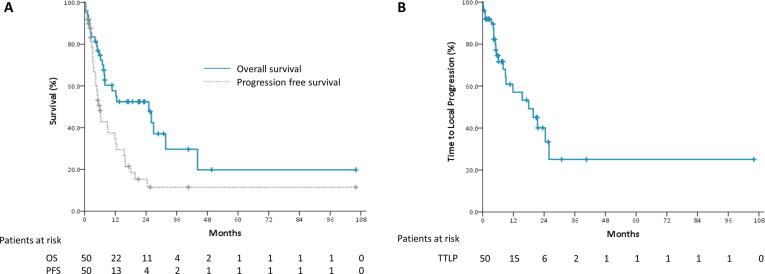
The median re-irradiation dose in equivalent dose in 2-Gy fractions was 51.1 Gy, and the mean re-irradiation planning target volume was 201.58 ml. The median mean lung dose (MLD) was 4.18 Gy, and the total lung volumes receiving a dose of 5 Gy (lung V5) and of 20 Gy (V20) were 19.8% and 5.85%, respectively. The TTLP, PFS, and OS were 18.0, 5.9, and 25.1 months, respectively. Lung V5 ( < 0.001), V20 ( = 0.011), and MLD ( = 0.002) were significantly associated with grade ≥2 lung toxicity. Seven (14%) patients developed lethal lung events. Subsequent chemotherapy following thoracic re-irradiation was significantly correlated with lethal lung events ( = 0.009).
Promising local control can be achieved with thoracic re-irradiation in lung cancer patients with locoregional recurrence. However, unexpected lethal lung events may occur, especially in patients receiving systemic therapy following thoracic re-irradiation.
对于出现胸内局部区域复发但无全身进展的肺癌患者,胸部再次放疗可能是一种替代治疗方法。本研究旨在回顾性评估接受胸部再次放疗的肺癌患者的局部区域控制情况、临床结局及毒性反应。
我们回顾性分析了2009年至2017年间接受传统光子放疗(RT)和立体定向体部放疗(SBRT)进行胸部再次放疗的50例肺癌患者。使用对数秩检验和Cox回归模型计算了RT的临床病理因素、治疗因素和剂量学因素与再次胸部放疗开始后局部进展时间(TTLP)、无进展生存期(PFS)和总生存期(OS)之间的相关性。
2-Gy分次等效剂量下的中位再次放疗剂量为51.1 Gy,再次放疗计划靶体积的平均值为201.58 ml。中位平均肺剂量(MLD)为4.18 Gy,接受5 Gy剂量(肺V5)和20 Gy剂量(V20)的肺总体积分别为19.8%和5.85%。TTLP、PFS和OS分别为18.0个月、5.9个月和25.1个月。肺V5(<0.001)、V20(=0.011)和MLD(=0.002)与≥2级肺部毒性显著相关。7例(14%)患者发生致命性肺部事件。胸部再次放疗后进行后续化疗与致命性肺部事件显著相关(=0.