Gipson Debbie S, Trachtman Howard, Waldo Anne, Gibson Keisha L, Eddy Sean, Dell Katherine M, Srivastava Tarak, Lemley Kevin V, Greenbaum Larry A, Hingorani Sangeeta, Meyers Kevin E, Kaskel Frederick J, Reidy Kimberly J, Sethna Christine B, Tran Cheryl L, Wang Chia-Shi, Tuttle Katherine R, Oh Gia, Neu Alicia M, Brown Elizabeth, Lin Jen-Jar, Yee Jennifer Lai, Roth Therese M, Troost Jonathan P, Gillespie Brenda W, Sampson Matthew G, Kretzler Matthias, Ju Wenjun
Division of Nephrology, Department of Pediatrics, University of Michigan, Ann Arbor, Michigan, USA.
Division of Nephrology, Department of Pediatrics, New York University Langone Health, New York, New York, USA.
Kidney Int Rep. 2019 Dec 5;5(4):414-425. doi: 10.1016/j.ekir.2019.11.018. eCollection 2020 Apr.
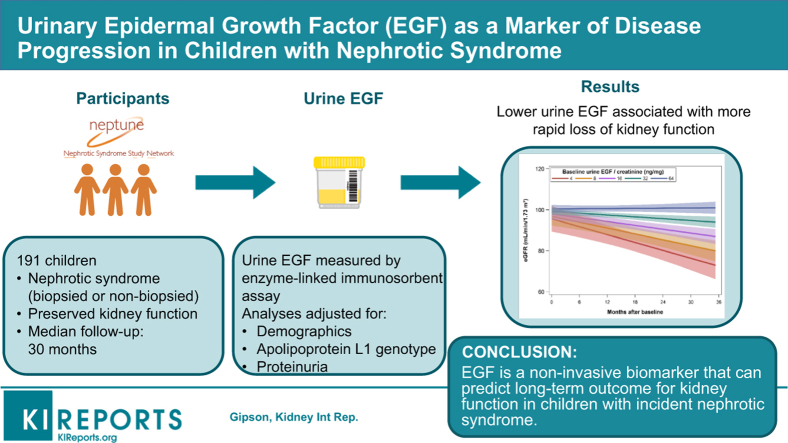
Childhood-onset nephrotic syndrome has a variable clinical course. Improved predictive markers of long-term outcomes in children with nephrotic syndrome are needed. This study tests the association between baseline urinary epidermal growth factor (uEGF) excretion and longitudinal kidney function in children with nephrotic syndrome.
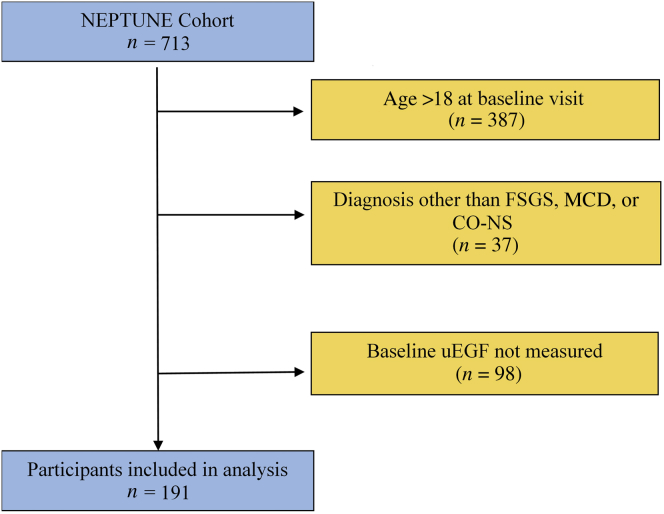
The study evaluated 191 participants younger than 18 years enrolled in the Nephrotic Syndrome Study Network, including 118 with their first clinically indicated kidney biopsy (68 minimal change disease; 50 focal segmental glomerulosclerosis) and 73 with incident nephrotic syndrome without a biopsy. uEGF was measured at baseline for all participants and normalized by the urine creatinine (Cr) concentration. Renal epidermal growth factor (EGF) mRNA was measured in the tubular compartment microdissected from kidney biopsy cores from a subset of patients. Linear mixed models were used to test if baseline uEGF/Cr and EGF mRNA expression were associated with change in estimated glomerular filtration rate (eGFR) over time.
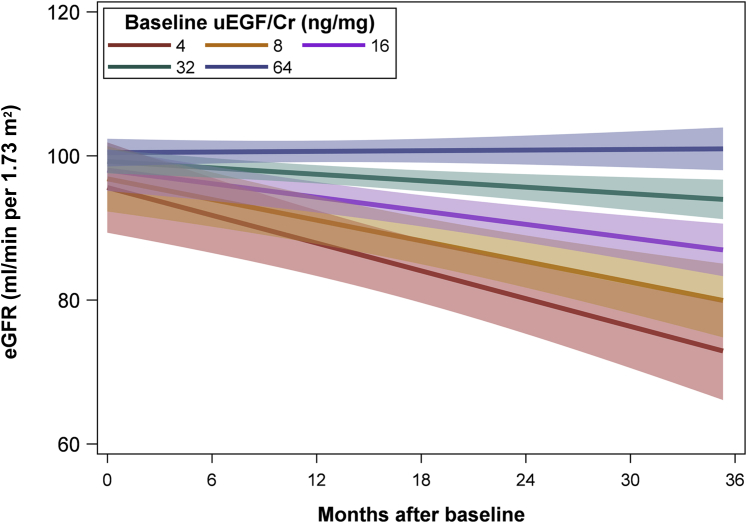
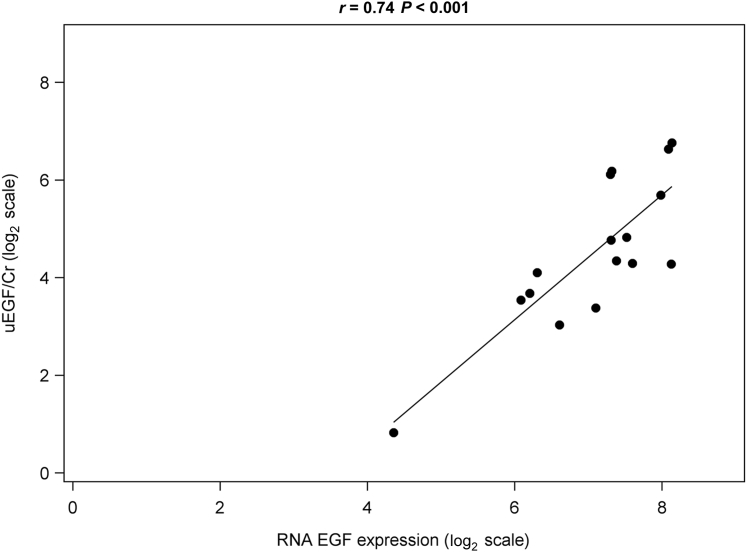
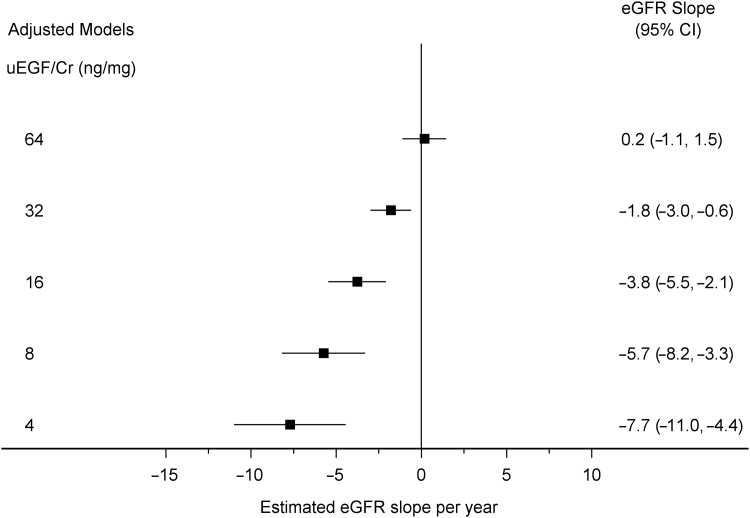
Higher uEGF/Cr at baseline was associated with slower eGFR decline during follow-up (median follow-up = 30 months). Halving of uEGF/Cr was associated with a decrease in eGFR slope of 2.0 ml/min per 1.73 m per year ( < 0.001) adjusted for age, race, diagnosis, baseline eGFR and proteinuria, and APOL1 genotype. In the biopsied subgroup, uEGF/Cr was correlated with EGF mRNA expression ( = 0.74; < 0.001), but uEGF/Cr was retained over mRNA expression as the stronger predictor of eGFR slope after multivariable adjustment (decrease in eGFR slope of 1.7 ml/min per 1.73 m per year per log decrease in uEGF/Cr; < 0.001).
uEGF/Cr may be a useful noninvasive biomarker that can assist in predicting the long-term course of kidney function in children with incident nephrotic syndrome.
儿童期起病的肾病综合征临床病程多变。需要改善肾病综合征患儿长期预后的预测指标。本研究检验了肾病综合征患儿基线尿表皮生长因子(uEGF)排泄与纵向肾功能之间的关联。
本研究评估了191名年龄小于18岁的肾病综合征研究网络参与者,其中118名进行了首次临床指征的肾活检(68例微小病变病;50例局灶节段性肾小球硬化症),73名新发肾病综合征患者未进行活检。对所有参与者在基线时测量uEGF,并通过尿肌酐(Cr)浓度进行标准化。从一部分患者的肾活检组织芯微切割的肾小管部分中测量肾表皮生长因子(EGF)mRNA。使用线性混合模型检验基线uEGF/Cr和EGF mRNA表达是否与估计肾小球滤过率(eGFR)随时间的变化相关。
基线时较高的uEGF/Cr与随访期间eGFR下降较慢相关(中位随访时间 = 30个月)。uEGF/Cr减半与eGFR斜率每年每1.73平方米降低2.0毫升/分钟相关(<0.001),校正了年龄、种族、诊断、基线eGFR和蛋白尿以及APOL1基因型。在活检亚组中,uEGF/Cr与EGF mRNA表达相关(=0.74;<0.001),但在多变量调整后,uEGF/Cr作为eGFR斜率的更强预测因子保留下来,优于mRNA表达(uEGF/Cr每对数下降,eGFR斜率每年每1.73平方米降低1.7毫升/分钟;<0.0