Department of Pediatrics, Peking University First Hospital, No.1 Xi An Men Da Jie, Beijing, 100034, People's Republic of China.
Department of Internal Medicine, University of Michigan, Ann Arbor, MI, 48109, USA.
Pediatr Nephrol. 2018 Oct;33(10):1731-1739. doi: 10.1007/s00467-018-3988-1. Epub 2018 Jun 11.
Alport syndrome is a rare hereditary kidney disease manifested with progressive renal failure. Considerable variation exists in terms of disease progression among patients with Alport syndrome. Identification of patients at high risk of rapid progression remains an unmet need. Urinary epidermal growth factor (uEGF) has been shown to be independently associated with risk of progression to adverse kidney outcome in multiple independent adult chronic kidney disease (CKD) cohorts. In this study, we aim to assess if uEGF is associated with kidney impairment and its prognostic value for children with Alport syndrome.
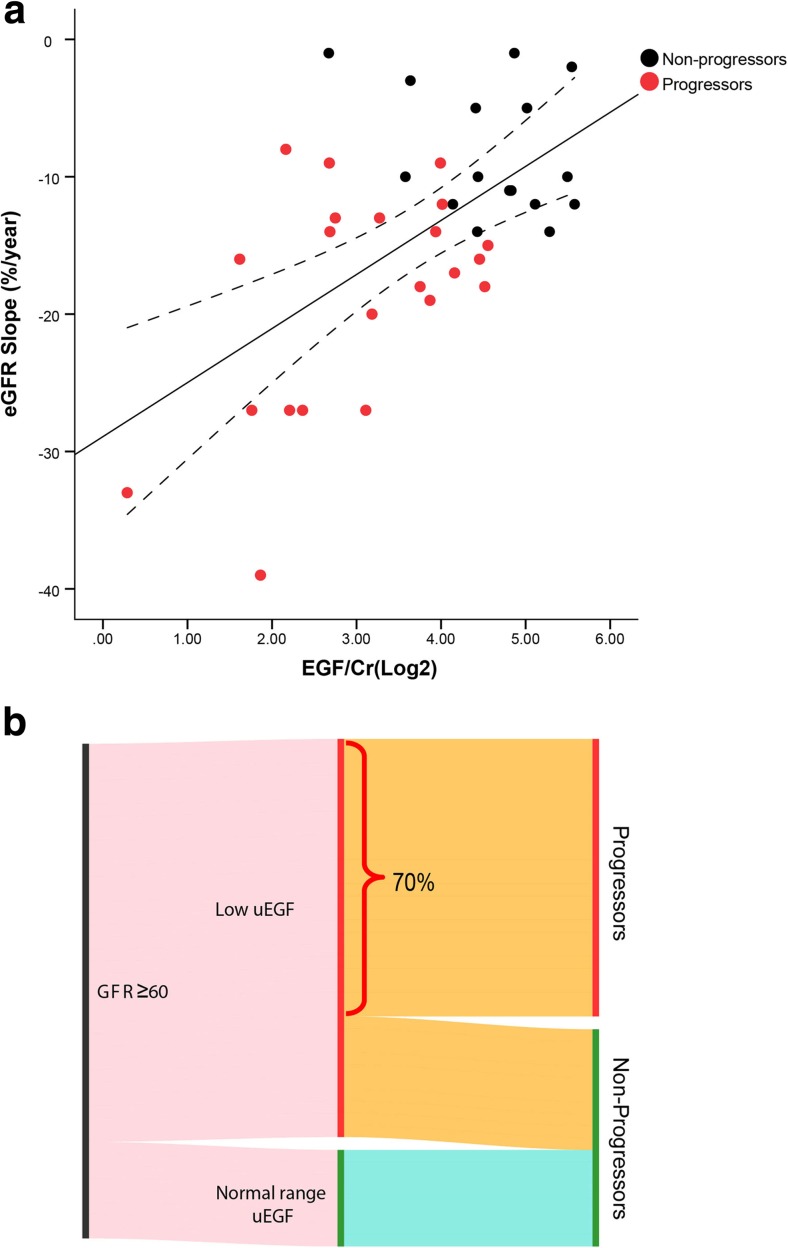
One hundred and seventeen pediatric patients with Alport syndrome and 146 healthy children (3-18 years old) were included in this study. uEGF was measured in duplicates in baseline urine samples using ELISA (R&D) and concentration was normalized by urine creatinine (uEGF/Cr). In patients with longitudinal follow-up data (n = 38), progression was defined as deteriorated kidney function (CKD stage increase) during follow-up period (follow-up length is about 31 months in average). The association of baseline uEGF/Cr level with estimated glomerular filtration rate (eGFR) slope and Alport syndrome patients' progression to a more advanced CKD stage during the follow-up period was used to evaluate the prognostic value of the marker.
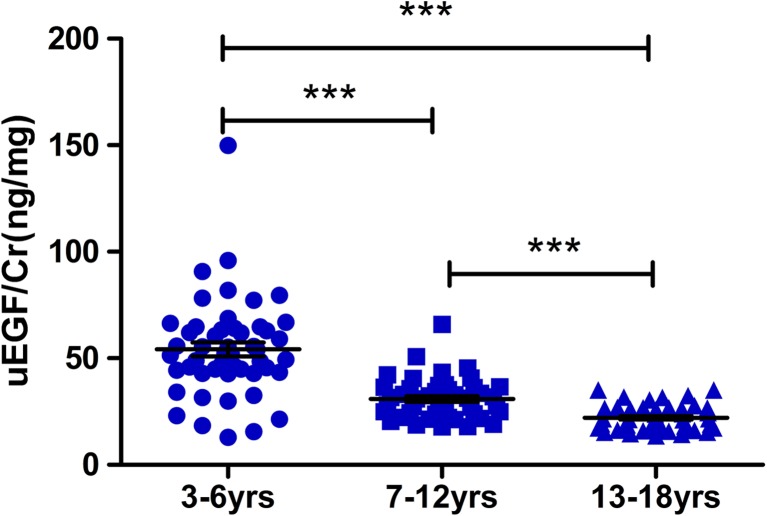
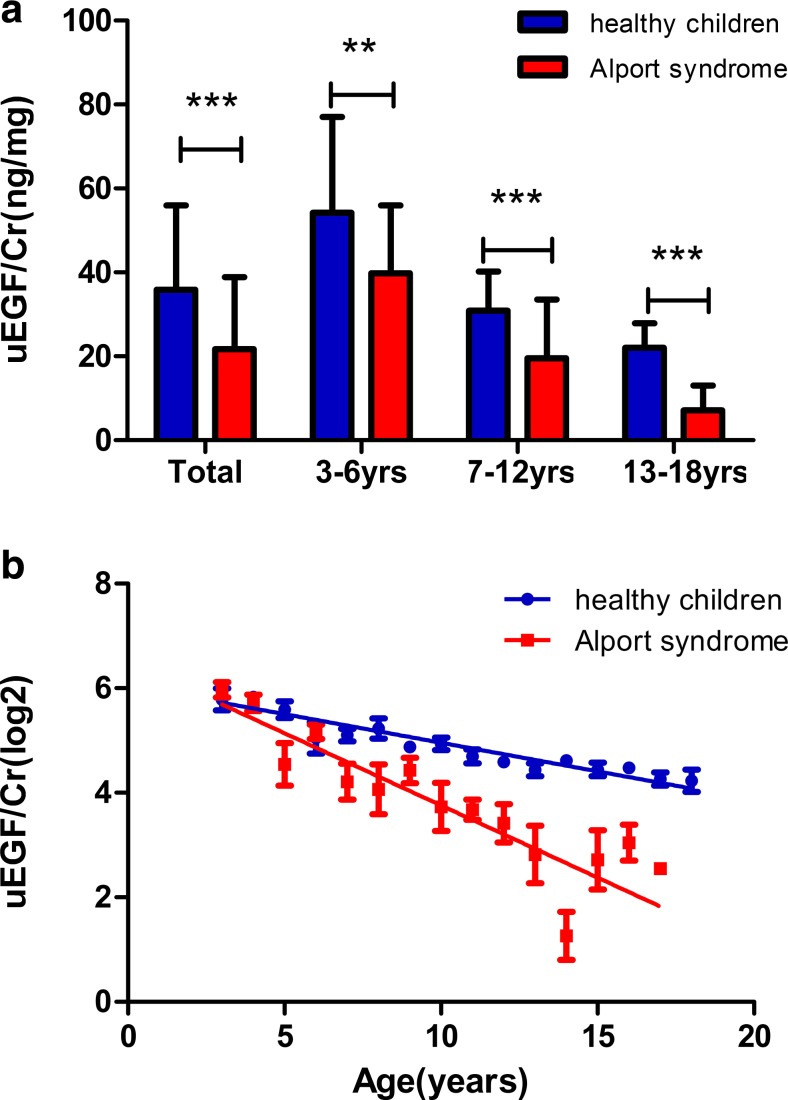
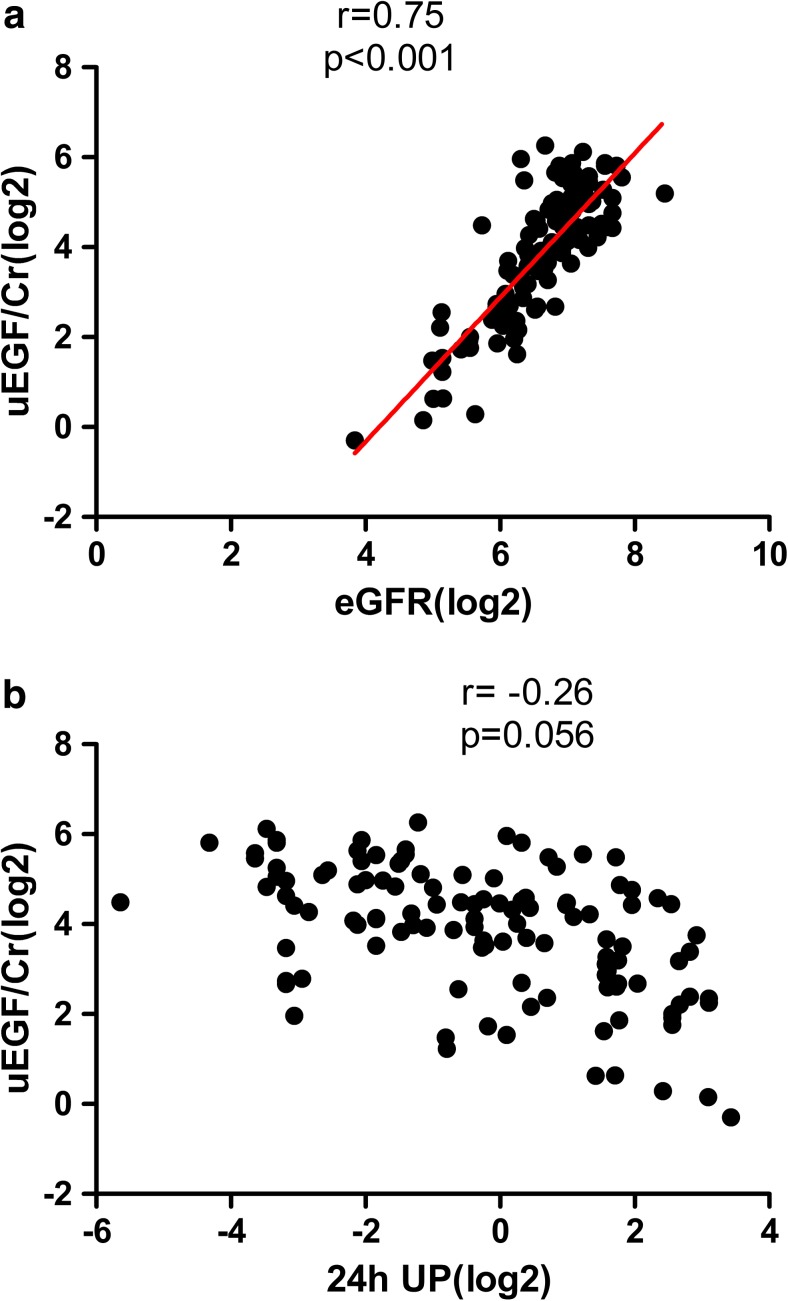
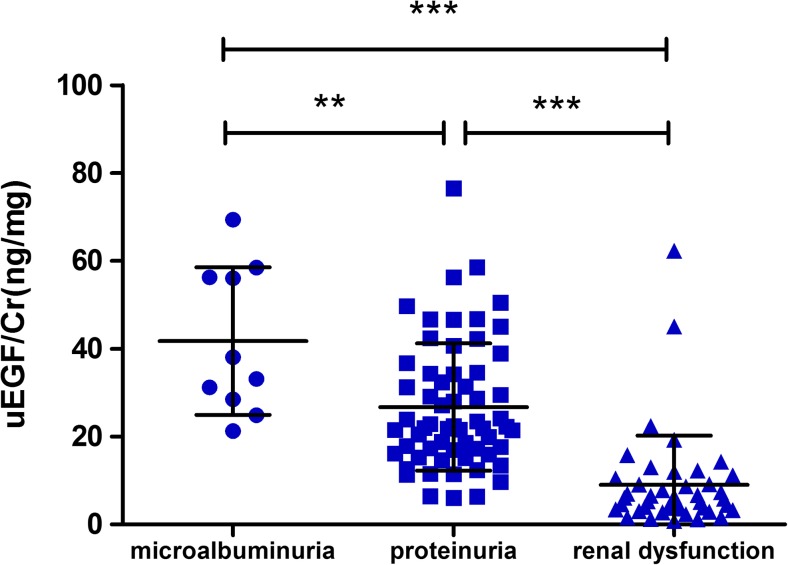
We found that uEGF/creatinine (uEGF/Cr) decreases with age in pediatric patients with Alport syndrome with a significantly faster rate than in healthy children of the same age group. uEGF/Cr is significantly correlated with eGFR (r = 0.75, p < 0.001), after adjustment for age. In 38 patients with longitudinal follow-up, we observed a significant correlation between uEGF/Cr and eGFR slope (r = 0.58, p < 0.001). Patients with lower uEGF/Cr level were at increased risk of progression to a higher CKD stage. uEGF/Cr was able to distinguish progressors from non-progressors with an AUC of 0.88, versus 0.77 by eGFR and 0.81 by 24-h urinary protein (24-h UP).
Our study suggests that uEGF/Cr is a promising biomarker for accelerated kidney function decline in pediatric patients with Alport syndrome. It may help to identify patients at high risk of progression for targeted clinical care and improve the patients' stratification in interventional trials.
Alport 综合征是一种罕见的遗传性肾脏疾病,表现为进行性肾功能衰竭。Alport 综合征患者的疾病进展存在很大差异。确定快速进展的高危患者仍然是一个未满足的需求。尿表皮生长因子(uEGF)已被证明与多个独立的成人慢性肾脏病(CKD)队列中进展为不良肾脏结局的风险独立相关。在这项研究中,我们旨在评估 uEGF 是否与儿童 Alport 综合征的肾脏损害相关,以及其对预后的价值。
本研究纳入了 117 例儿科 Alport 综合征患者和 146 例健康儿童(3-18 岁)。使用 ELISA(R&D)在基线尿液样本中重复测量 uEGF,并通过尿肌酐(uEGF/Cr)进行浓度标准化。在有纵向随访数据的患者(n=38)中,进展定义为随访期间肾功能恶化(CKD 分期增加)(平均随访时间约为 31 个月)。使用基线 uEGF/Cr 水平与估计肾小球滤过率(eGFR)斜率的相关性以及 Alport 综合征患者在随访期间进展为更晚期 CKD 阶段的相关性来评估该标志物的预后价值。
我们发现,在 Alport 综合征患儿中,uEGF/Cr 随年龄增长而下降,其下降速度明显快于同年龄组的健康儿童。uEGF/Cr 与 eGFR 显著相关(r=0.75,p<0.001),调整年龄后仍相关。在 38 例有纵向随访的患者中,我们观察到 uEGF/Cr 与 eGFR 斜率之间存在显著相关性(r=0.58,p<0.001)。uEGF/Cr 水平较低的患者进展为更高 CKD 阶段的风险增加。uEGF/Cr 可以以 AUC 为 0.88 区分进展者和非进展者,而 eGFR 为 0.77,24 小时尿蛋白(24-h UP)为 0.81。
我们的研究表明,uEGF/Cr 是预测儿科 Alport 综合征患者肾功能快速下降的有前途的生物标志物。它可能有助于识别进展风险较高的患者,以便进行针对性的临床护理,并改善患者在干预性试验中的分层。