Paudel Pradeep, Seong Su Hui, Fauzi Fazlin Mohd, Bender Andreas, Jung Hyun Ah, Choi Jae Sue
Department of Food and Life Science, Pukyong National University, Busan 48513, Republic of Korea.
Department of Pharmacology and Chemistry, Faculty of Pharmacy, Universiti Teknologi MARA, Selangor Branch, Puncak Alam Campus, 42300 Bandar Puncak Alam, Selangor, Malaysia.
ACS Omega. 2020 Mar 25;5(13):7705-7715. doi: 10.1021/acsomega.0c00684. eCollection 2020 Apr 7.
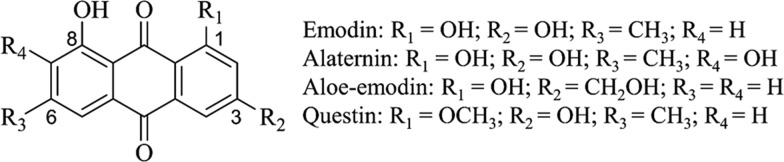
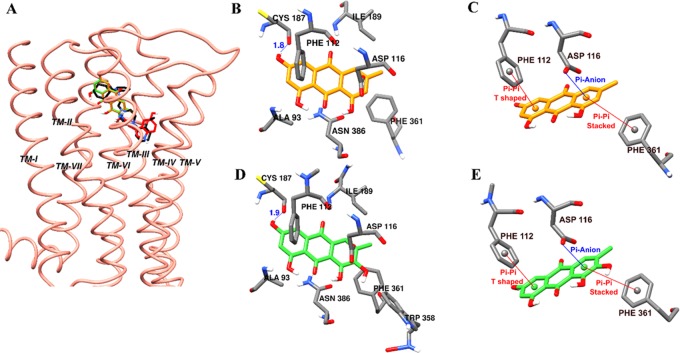
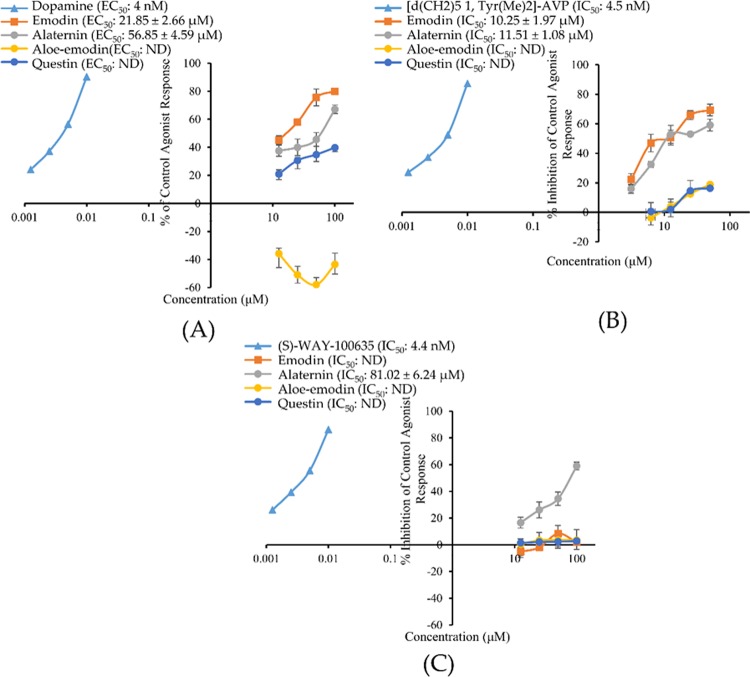
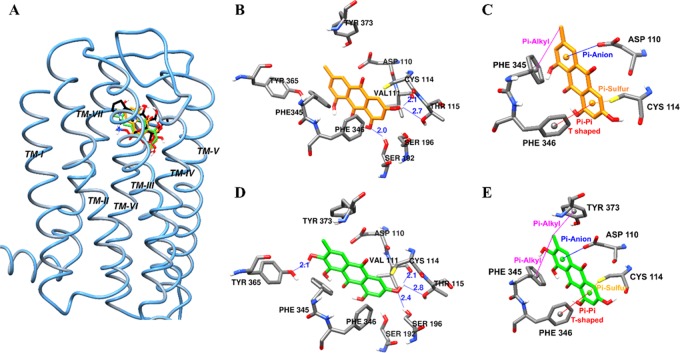
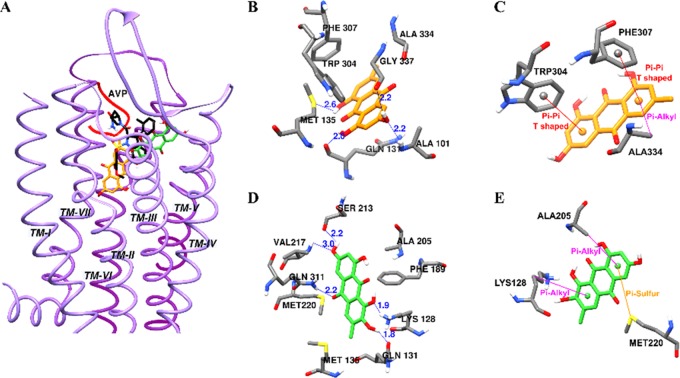
The present study examines the effect of human monoamine oxidase active anthraquinones emodin, alaternin (=7-hydroxyemodin), aloe-emodin, and questin from Linn seeds in modulating human dopamine (hDR, hDR, and hDR), serotonin (h5-HTR), and vasopressin (hVR) receptors that were predicted as prime targets from proteocheminformatics modeling cell-based functional assays, and explores the possible mechanisms of action modeling. Emodin and alaternin showed a concentration-dependent agonist effect on hDR with EC values of 21.85 ± 2.66 and 56.85 ± 4.59 μM, respectively. On hVR, emodin and alaternin showed an antagonist effect with IC values of 10.25 ± 1.97 and 11.51 ± 1.08 μM, respectively. Interestingly, questin and aloe-emodin did not have any observable effect on hVR. Only alaternin was effective in antagonizing h5-HTR (IC: 84.23 ± 4.12 μM). studies revealed that a hydroxyl group at C1, C3, and C8 and a methyl group at C6 of anthraquinone structure are essential for hDR agonist and hVR antagonist effects, as well as for the H-bond interaction of 1-OH group with Ser192 at a proximity of 2.0 Å. Thus, based on and results, hVR, hDR, and h5-HTR appear to be prime targets of the tested anthraquinones.
本研究考察了从蓼蓝种子中提取的具有人类单胺氧化酶活性的蒽醌类化合物大黄素、芦荟大黄素甲醚(=7-羟基大黄素)、芦荟大黄素和奎斯汀对人类多巴胺(hDR、hDR和hDR)、5-羟色胺(h5-HTR)和血管加压素(hVR)受体的调节作用,这些受体是通过蛋白质化学信息学建模细胞功能测定预测的主要靶点,并探索其可能的作用机制。大黄素和芦荟大黄素甲醚对hDR表现出浓度依赖性激动剂效应,其EC值分别为21.85±2.66和56.85±4.59μM。在hVR上,大黄素和芦荟大黄素甲醚表现出拮抗剂效应,其IC值分别为10.25±1.97和11.51±1.08μM。有趣的是,奎斯汀和芦荟大黄素对hVR没有任何可观察到的影响。只有芦荟大黄素甲醚能有效拮抗h5-HTR(IC:84.23±4.12μM)。研究表明,蒽醌结构中C1、C3和C8位的羟基以及C6位的甲基对于hDR激动剂和hVR拮抗剂效应以及1-OH基团与距离2.0Å处的Ser192形成氢键相互作用至关重要。因此,基于上述结果,hVR、hDR和h5-HTR似乎是所测试蒽醌类化合物的主要靶点。