Li Yan, Xu Qing-Qing, Shan Chun-Shuo, Shi Yi-Hua, Wang Yong, Zheng Guo-Qing
Department of Neurology, The Second Affiliated Hospital and Yuying Children's Hospital of Wenzhou Medical University, Wenzhou, China.
Front Pharmacol. 2018 Aug 28;9:943. doi: 10.3389/fphar.2018.00943. eCollection 2018.
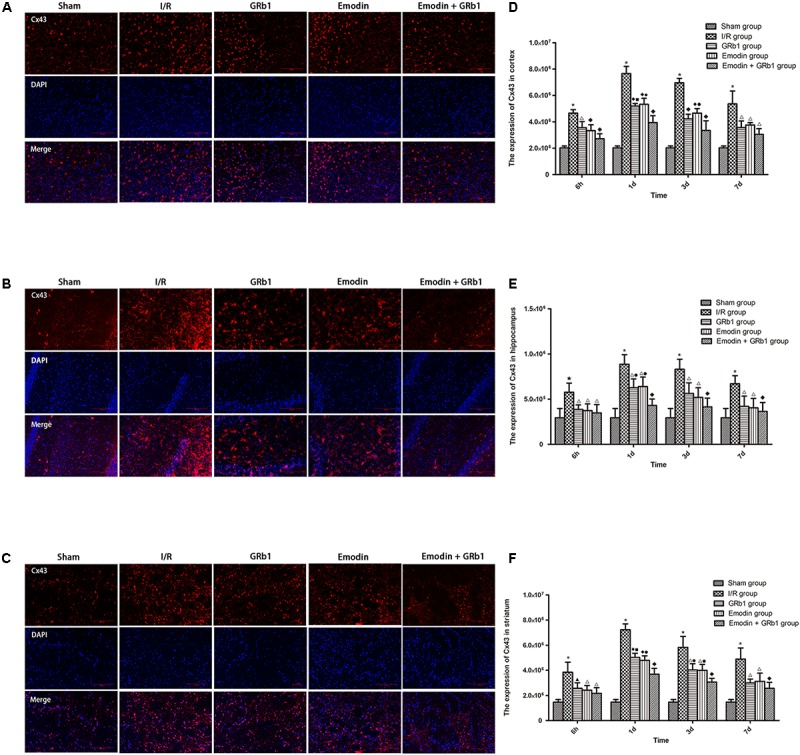
Acute ischemic stroke (AIS) generally causes neurological dysfunction and poses a serious threat to public health. Here, we aimed to assess the independent and combined effects of ginsenoside Rb1 (GRb1) and Emodin on neuroprotection through regulating Connexin 43 (Cx43) and Aquaporin 4 (AQP4) expression in cerebral ischemia/reperfusion (I/R) model rats. Adult male Sprague-Dawley (SD) rats were randomly divided into five groups: sham group, I/R group, Emodin group, GRb1 group and Emodin+GRb1 group. They were further allocated to four subgroups according to the 6h, 1d, 3d, and 7d time points except the sham group. Based on the modified Longa suture method, the focal cerebral I/R model was established by middle cerebral artery occlusion (MCAO). The neurological deficit scores (NDS), blood brain barrier (BBB) permeability and cerebral infarction area were assessed at each corresponding time point. Cx43 and AQP4 levels were assessed by Real-time PCR and Immunofluorescence. Compared with I/R group, both the independent and combined use of GRb1 and Emodin could alleviate NDS, reduce the BBB permeability, reduce the infarction area and down-regulate Cx43 and AQP4 expression at 6h, 1d, 3d, and 7d after I/R ( < 0.05). The Emodin+GRb1 group had more significant effects than Emodin group and GRb1 group ( < 0.05). In conclusion, the combination of Emodin and GRb1 exerts synergistically neuroprotective functions through regulating AQP4 and Cx43 after I/R.
急性缺血性脑卒中(AIS)通常会导致神经功能障碍,对公众健康构成严重威胁。在此,我们旨在通过调节脑缺血/再灌注(I/R)模型大鼠中连接蛋白43(Cx43)和水通道蛋白4(AQP4)的表达,评估人参皂苷Rb1(GRb1)和大黄素对神经保护的独立及联合作用。成年雄性Sprague-Dawley(SD)大鼠随机分为五组:假手术组、I/R组、大黄素组、GRb1组和大黄素+GRb1组。除假手术组外,其余各组根据6小时、1天、3天和7天的时间点进一步分为四个亚组。基于改良的Longa缝线法,通过大脑中动脉闭塞(MCAO)建立局灶性脑I/R模型。在每个相应时间点评估神经功能缺损评分(NDS)、血脑屏障(BBB)通透性和脑梗死面积。通过实时荧光定量PCR和免疫荧光评估Cx43和AQP4水平。与I/R组相比,GRb1和大黄素单独及联合使用均可在I/R后6小时、1天、3天和7天减轻NDS,降低BBB通透性,减小梗死面积并下调Cx43和AQP4表达(P<0.05)。大黄素+GRb1组的效果比大黄素组和GRb1组更显著(P<0.05)。总之,大黄素和GRb1联合使用通过调节I/R后的AQP4和Cx43发挥协同神经保护作用。