Faculty of Chemistry and Chemical Technology, University of Ljubljana, Večna pot 113, 1000 Ljubljana, Slovenia.
Biotechnical Faculty, University of Ljubljana, Jamnikarjeva 101, 1000 Ljubljana, Slovenia.
Molecules. 2021 Nov 11;26(22):6825. doi: 10.3390/molecules26226825.
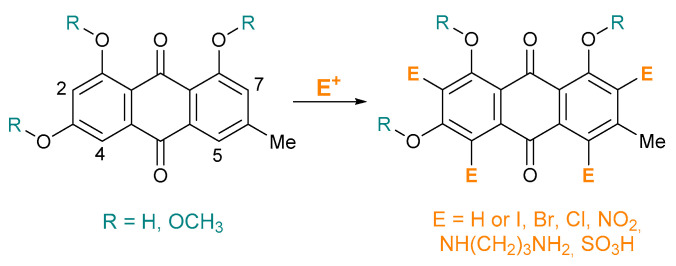
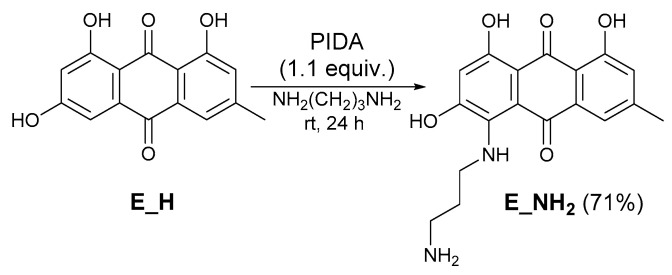
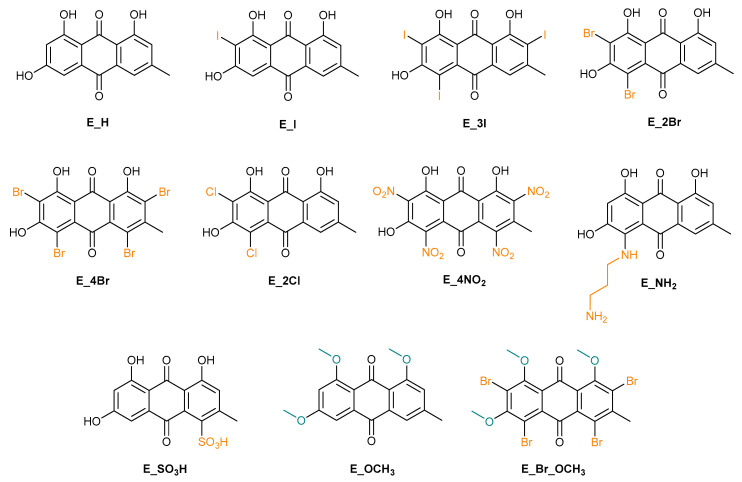
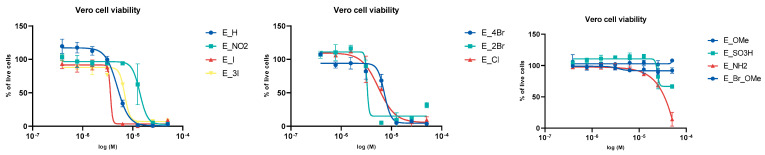
The current COVID-19 outbreak has highlighted the need for the development of new vaccines and drugs to combat Severe Acute Respiratory Syndrome-Coronavirus-2 (SARS-CoV-2). Recently, various drugs have been proposed as potentially effective against COVID-19, such as remdesivir, infliximab and imatinib. Natural plants have been used as an alternative source of drugs for thousands of years, and some of them are effective for the treatment of various viral diseases. Emodin (1,3,8-trihydroxy-6-methylanthracene-9,10-dione) is a biologically active anthraquinone with antiviral activity that is found in various plants. We studied the selectivity of electrophilic aromatic substitution reactions on an emodin core (halogenation, nitration and sulfonation), which resulted in a library of emodin derivatives. The main aim of this work was to carry out an initial evaluation of the potential to improve the activity of emodin against human coronavirus NL63 (HCoV-NL63) and also to generate a set of initial SAR guidelines. We have prepared emodin derivatives which displayed significant anti-HCoV-NL63 activity. We observed that halogenation of emodin can improve its antiviral activity. The most active compound in this study was the iodinated emodin analogue whose anti-HCoV-NL63 activity was comparable to that of remdesivir. Evaluation of the emodin analogues also revealed some unwanted toxicity to Vero cells. Since new synthetic routes are now available that allow modification of the emodin structure, it is reasonable to expect that analogues with significantly improved anti-HCoV-NL63 activity and lowered toxicity may thus be generated.
当前的 COVID-19 疫情凸显了开发新疫苗和药物以对抗严重急性呼吸系统综合症冠状病毒 2 型(SARS-CoV-2)的必要性。最近,各种药物被提出可能对 COVID-19 有效,如瑞德西韦、英夫利昔单抗和伊马替尼。天然植物作为药物的替代来源已经使用了数千年,其中一些对治疗各种病毒性疾病有效。大黄素(1,3,8-三羟基-6-甲基蒽醌-9,10-二酮)是一种具有抗病毒活性的生物活性蒽醌,存在于各种植物中。我们研究了大黄素核心的亲电芳香取代反应的选择性(卤化、硝化和磺化),由此产生了大黄素衍生物文库。这项工作的主要目的是对提高大黄素对人类冠状病毒 NL63(HCoV-NL63)的活性的潜力进行初步评估,并生成一组初始 SAR 指南。我们已经制备了显示出对 HCoV-NL63 显著活性的大黄素衍生物。我们观察到大黄素的卤化可以提高其抗病毒活性。在这项研究中最活跃的化合物是碘化大黄素类似物,其抗 HCoV-NL63 活性与瑞德西韦相当。对大黄素类似物的评估还显示出对 Vero 细胞的一些不良毒性。由于现在有新的合成途径可以修饰大黄素的结构,因此可以预期,可能会产生具有显著提高的抗 HCoV-NL63 活性和降低毒性的类似物。