Business Economics Group, Wageningen University, 6700 EW, Wageningen, Netherlands;
Centre for Crop Systems Analysis, Wageningen University, 6700 AK, Wageningen, Netherlands.
Proc Natl Acad Sci U S A. 2020 Apr 28;117(17):9250-9259. doi: 10.1073/pnas.1912206117. Epub 2020 Apr 13.
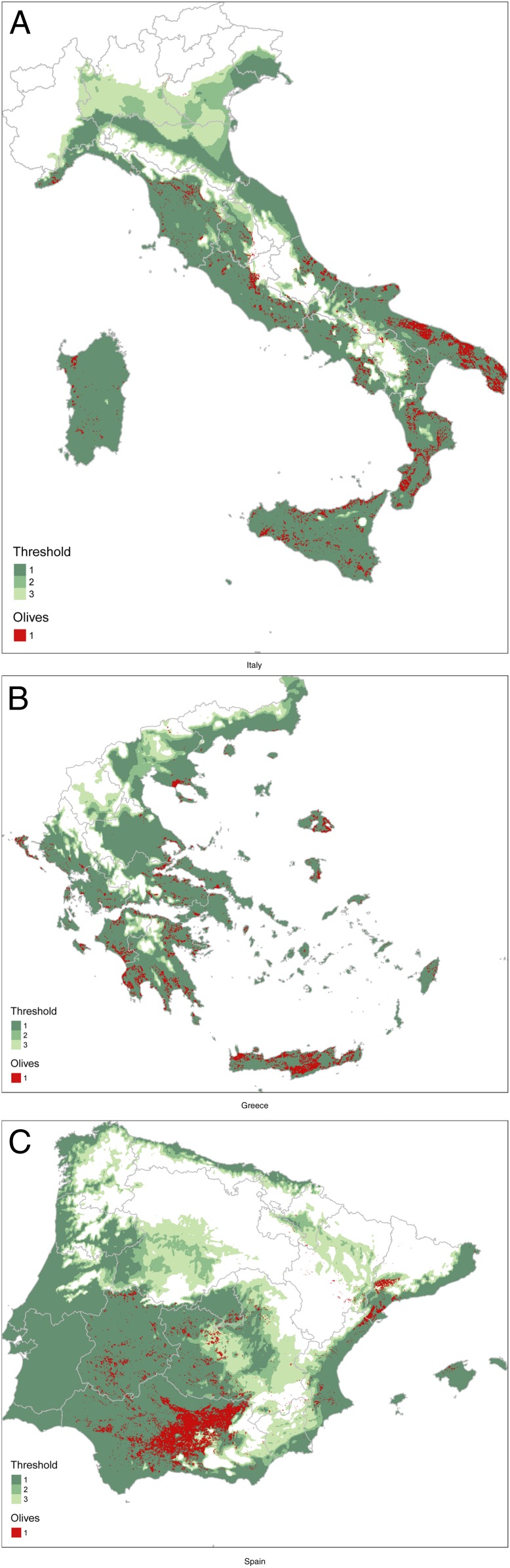
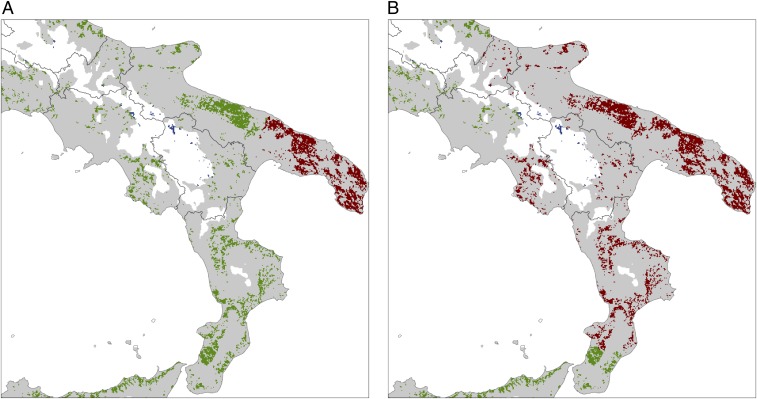
is the causal agent of plant diseases that cause massive economic damage. In 2013, a strain of the bacterium was, for the first time, detected in the European territory (Italy), causing the Olive Quick Decline Syndrome. We simulate future spread of the disease based on climatic-suitability modeling and radial expansion of the invaded territory. An economic model is developed to compute impact based on discounted foregone profits and losses in investment. The model projects impact for Italy, Greece, and Spain, as these countries account for around 95% of the European olive oil production. Climatic suitability modeling indicates that, depending on the suitability threshold, 95.5 to 98.9%, 99.2 to 99.8%, and 84.6 to 99.1% of the national areas of production fall into suitable territory in Italy, Greece, and Spain, respectively. For Italy, across the considered rates of radial range expansion the potential economic impact over 50 y ranges from 1.9 billion to 5.2 billion Euros for the economic worst-case scenario, in which production ceases after orchards die off. If replanting with resistant varieties is feasible, the impact ranges from 0.6 billion to 1.6 billion Euros. Depending on whether replanting is feasible, between 0.5 billion and 1.3 billion Euros can be saved over the course of 50 y if disease spread is reduced from 5.18 to 1.1 km per year. The analysis stresses the necessity to strengthen the ongoing research on cultivar resistance traits and application of phytosanitary measures, including vector control and inoculum suppression, by removing host plants.
是引起植物病害的病原体,这些病害会造成巨大的经济损失。2013 年,首次在欧洲领土(意大利)检测到这种细菌,导致橄榄快速衰退综合征。我们基于气候适宜性建模和受感染领土的径向扩展来模拟未来疾病的传播。开发了一个经济模型来根据贴现的预期利润和投资损失来计算影响。该模型预测了意大利、希腊和西班牙的影响,因为这三个国家占欧洲橄榄油产量的 95%左右。气候适宜性建模表明,根据适宜性阈值,意大利、希腊和西班牙的国家生产区域中有 95.5%至 98.9%、99.2%至 99.8%和 84.6%至 99.1%分别属于适宜领土。对于意大利,在所考虑的径向扩展率下,在经济最严重的情况下,50 年内的潜在经济影响范围从 19 亿欧元到 52 亿欧元,在这种情况下,果园死亡后生产将停止。如果可以用抗性品种进行重新种植,那么影响范围将在 6 亿欧元至 16 亿欧元之间。如果重新种植是可行的,那么如果将病害的传播速度从每年 5.18 公里降低到 1.1 公里,那么在 50 年内可以节省 5 亿至 13 亿欧元。该分析强调了必须加强正在进行的有关品种抗性特征的研究,并采取植物检疫措施,包括控制媒介和抑制接种体,以去除寄主植物。