Biomedical Research Institute, NeoRegen Biotech Co., Ltd., Gyeonggi-do 16614, Korea.
Cellular Reprogramming and Embryo Biotechnology Laboratory, Dental Research Institute, Seoul National University School of Dentistry, Seoul 08826, Korea.
Int J Mol Sci. 2020 Jan 10;21(2):442. doi: 10.3390/ijms21020442.
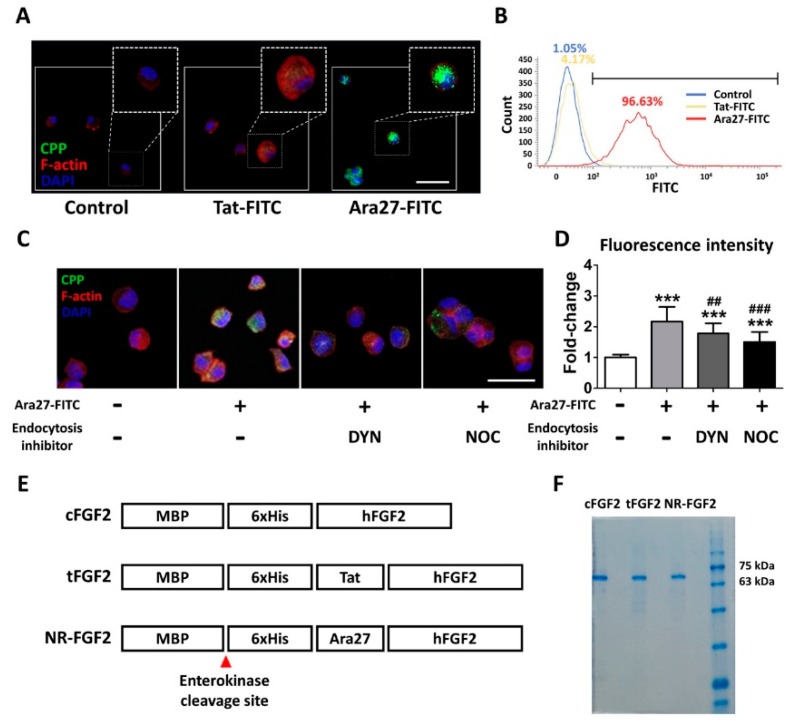
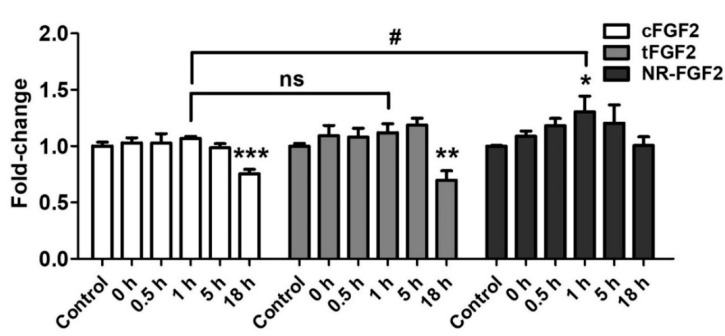
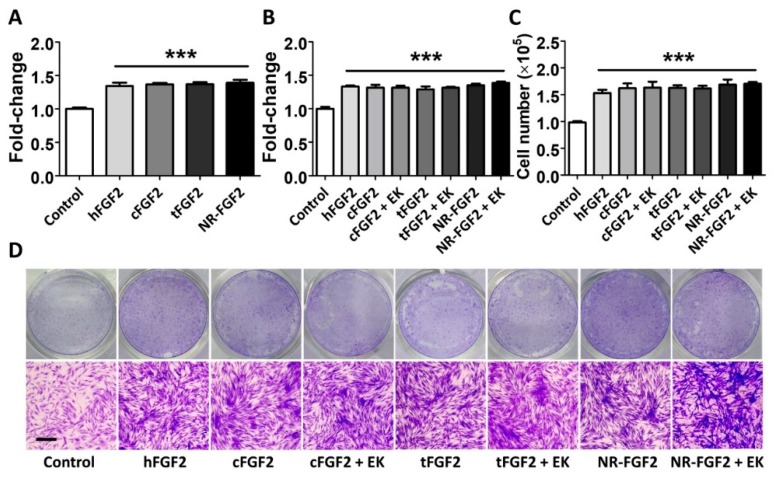
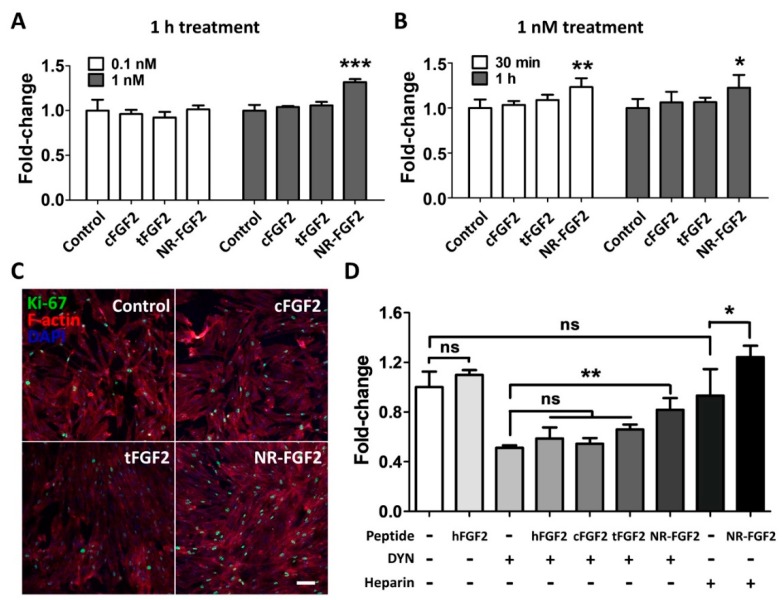
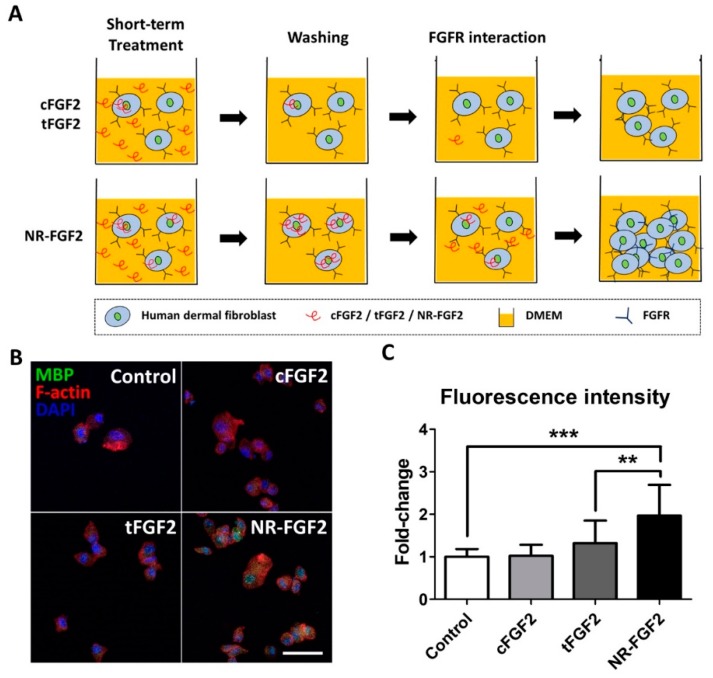
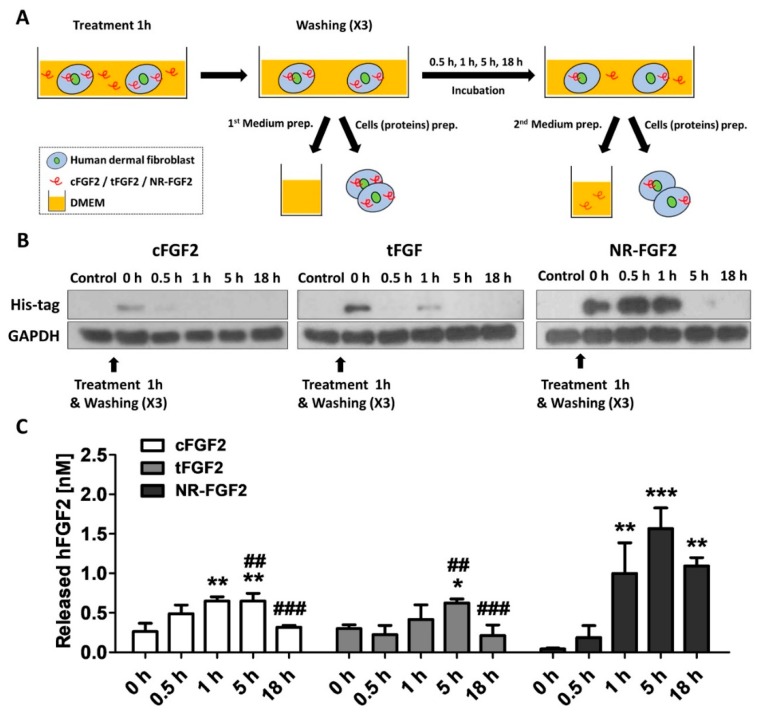
Cell-penetrating peptides (CPPs) are defined by their ability to deliver cargo into cells and have been studied and developed as a promising drug-delivery system (DDS). However, the issue of whether the CPPs that have already entered the cells can be re-released or reused has not been studied. The purpose of this research was to construct CPP-conjugated human fibroblast growth factor 2 (hFGF2) and investigate whether they can be re-released from the cell membrane for reuse. This study combined hFGF2 with Tat or Ara27, a newly developed CPP derived from the zinc knuckle (CCHC-type) family protein of . Human dermal fibroblast (HDF) was treated with Tat-conjugated hFGF2 (tFGF2) and Ara27-conjugated hFGF2 (NR-FGF2) for both long and short durations, and the effects on cell growth were compared. Furthermore, tFGF2 and NR-FGF2 re-released from the cells were quantified and the effects were evaluated by culturing HDF in a conditioned medium. Interestingly, the proliferation of HDF increased only when NR-FGF2 was treated for 1 h in endocytosis-independent manner. After 1 h, NR-FGF2 was significantly re-released, reaching a maximum concentration at 5 h. Furthermore, increased proliferation of HDF cultured in the conditioned medium containing re-released NR-FGF2 was discovered. While previous studies have focused on the delivery of cargo and its associated applications, this study has revealed that combinations of superior CPPs and therapeutics can be expected to prolong both the retention time and the cell-penetrating capacity, even in the presence of external factors. Therefore, CPPs can be applied in the context of topical drugs and cosmetics as a new DDS approach.
细胞穿透肽(CPPs)的定义是其将货物递送到细胞中的能力,并且已被研究和开发为有前途的药物递送系统(DDS)。然而,尚未研究已经进入细胞的 CPP 是否可以被重新释放或再利用。本研究构建了 CPP 缀合的人成纤维细胞生长因子 2(hFGF2),并研究了它们是否可以从细胞膜上重新释放以供再利用。这项研究将 hFGF2 与 Tat 或 Ara27 结合,后者是一种新开发的 CPP,源自锌指(CCHC 型)家族蛋白。用人真皮成纤维细胞(HDF)用 Tat 缀合的 hFGF2(tFGF2)和 Ara27 缀合的 hFGF2(NR-FGF2)处理长或短时间,比较对细胞生长的影响。此外,从细胞中重新释放的 tFGF2 和 NR-FGF2 进行了定量,并通过在条件培养基中培养 HDF 来评估其效果。有趣的是,只有在非网格蛋白依赖的方式下用 NR-FGF2 处理 1 h 时,HDF 的增殖才增加。1 小时后,NR-FGF2 被明显重新释放,在 5 小时时达到最大浓度。此外,发现培养在含有重新释放的 NR-FGF2 的条件培养基中的 HDF 的增殖增加。虽然以前的研究集中于货物的递送及其相关应用,但是这项研究表明,与优越的 CPP 组合和治疗剂可以期望延长保留时间和细胞穿透能力,即使存在外部因素。因此,CPP 可作为一种新的 DDS 方法应用于局部药物和化妆品领域。