Xiang Hongjiao, Lu Yifei, Shao Mingmei, Wu Tao
Center of Chinese Medical Therapy and Systems Biology, Institute of Interdisciplinary Integrative Medicine Research, Shanghai University of Traditional Chinese Medicine, Shanghai 201203, China.
J Cancer. 2020 Mar 15;11(12):3519-3535. doi: 10.7150/jca.41841. eCollection 2020.
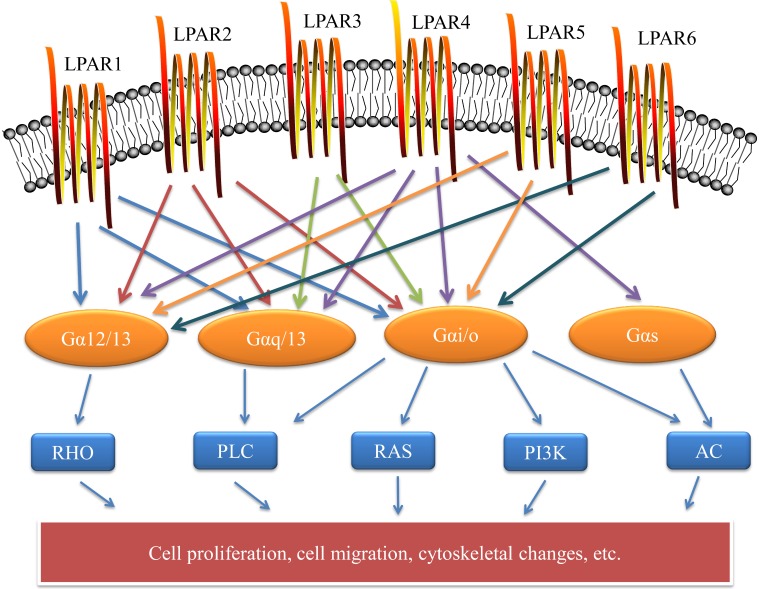
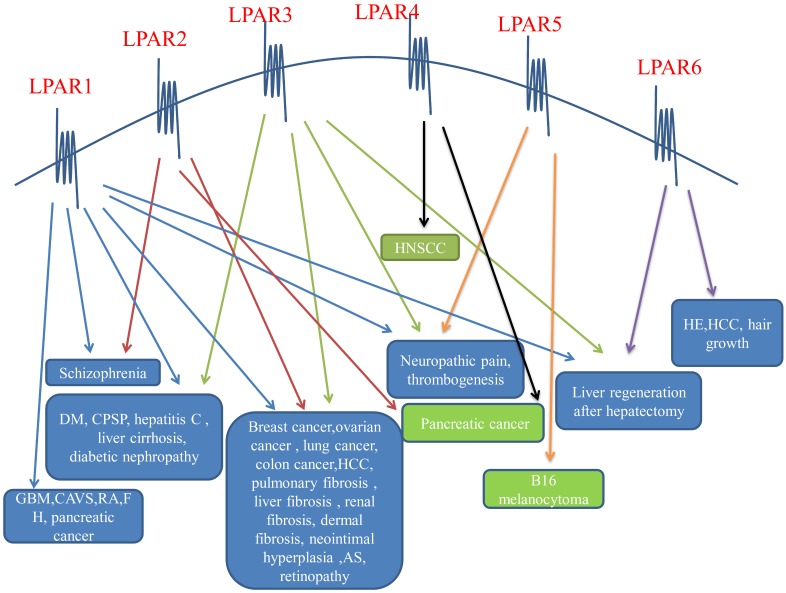
Lysophosphatidic acid (LPA, 1-acyl-2-hemolytic-sn-glycerol-3-phosphate) extracted from membrane phospholipid is a kind of simple bioactive glycophospholipid, which has many biological functions such as stimulating cell multiplication, cytoskeleton recombination, cell survival, drug-fast, synthesis of DNA and ion transport. Current studies have shown that six G-coupled protein receptors (LPAR1-6) can be activated by LPA. They stimulate a variety of signal transduction pathways through heterotrimeric G-proteins (such as Gα12/13, Gαq/11, Gαi/o and GαS). LPA and its receptors play vital roles in cancers, nervous system diseases, cardiovascular diseases, liver diseases, metabolic diseases, etc. In this article, we discussed the structure of LPA receptors and elucidated their functions in various diseases, in order to better understand them and point out new therapeutic schemes for them.
从膜磷脂中提取的溶血磷脂酸(LPA,1-酰基-2-溶血-sn-甘油-3-磷酸)是一种简单的生物活性糖磷脂,具有多种生物学功能,如刺激细胞增殖、细胞骨架重组、细胞存活、抗药性、DNA合成和离子转运。目前的研究表明,六种G蛋白偶联受体(LPAR1-6)可被LPA激活。它们通过异源三聚体G蛋白(如Gα12/13、Gαq/11、Gαi/o和GαS)刺激多种信号转导途径。LPA及其受体在癌症、神经系统疾病、心血管疾病、肝脏疾病、代谢疾病等中发挥着至关重要的作用。在本文中,我们讨论了LPA受体的结构,并阐明了它们在各种疾病中的功能,以便更好地了解它们并指出针对它们的新治疗方案。