Mehdizadefar Vida, Ghassemi Fanaz, Fallah Ali
Department of Biomedical Engineering, School of Electrical, Computer & Biomedical Engineering, Amirkabir University of Technology, Tehran, Iran.
Basic Clin Neurosci. 2019 Sep-Oct;10(5):409-417. doi: 10.32598/bcn.9.10.375. Epub 2019 Sep 1.
Many theories have been proposed about the etiology of autism. One is related to brain connectivity in patients with autism. Several studies have reported brain connectivity changes in autism disease. This study was performed on Electroencephalogram (EEG) studies that evaluated patients with autism, using functional brain connectivity, and compared them with typically-developing individuals.
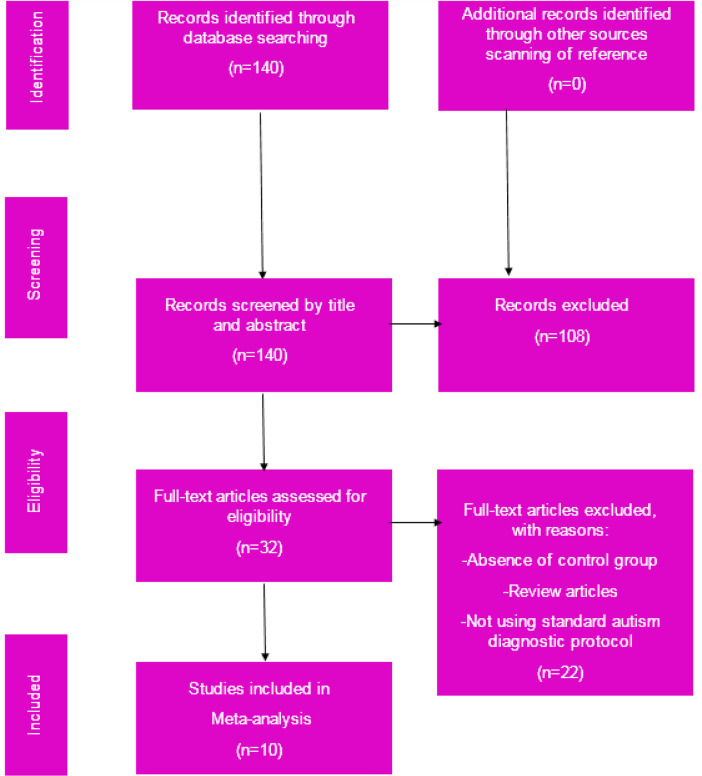
Three scientific databases of ScienceDirect, Medline (PubMed), and BioMed Central were systematically searched through their online search engines. Comprehensive Meta-analysis software analyzed the obtained data.
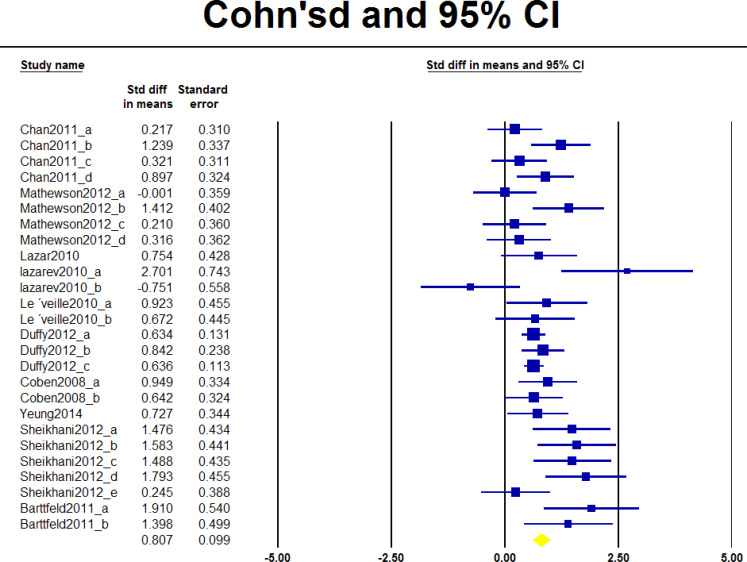
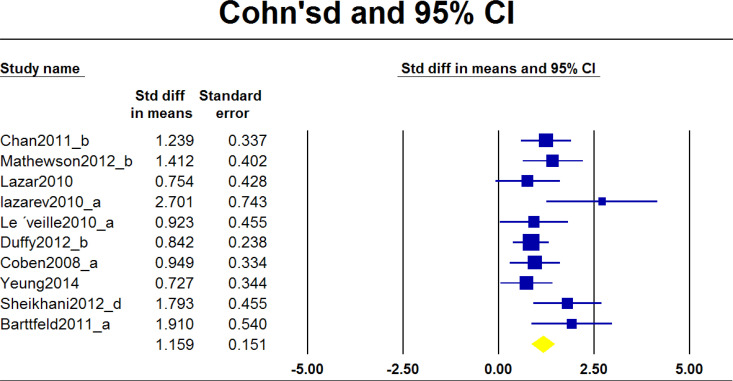
The systematic search led to 10 papers, in which EEG coherence was used to obtain the brain connectivity of people with autism. To determine the effect size, Cohen's d parameter was used. In the first meta-analysis, the study of the maximum effect size was considered, and all significant effect sizes were evaluated in the second meta-analysis. The effect size was assessed using a random-effects model in both meta-analyses. The results of the first meta-analysis indicated that heterogeneity was not present among the studies (Q=13.345, P>0.1). The evaluation of all effect sizes in the second meta-analysis showed a significant lack of homogeneity among the studies (Q=56.984, P=0.0001).
On the whole, autism was found to be related to neural connectivity, and the present research showed the difference in the EEG coherence of people with autism and healthy people. These conclusions require further studies with more extensive data, considering different brain regions, and novel analysis techniques for assessing brain connectivity.
关于自闭症的病因已经提出了许多理论。其中之一与自闭症患者的大脑连接性有关。多项研究报告了自闭症疾病中大脑连接性的变化。本研究针对使用功能性大脑连接性评估自闭症患者的脑电图(EEG)研究进行,并将其与发育正常的个体进行比较。
通过ScienceDirect、Medline(PubMed)和BioMed Central这三个科学数据库的在线搜索引擎进行系统检索。使用综合荟萃分析软件对获得的数据进行分析。
系统检索得到10篇论文,其中使用EEG相干性来获取自闭症患者的大脑连接性。为了确定效应大小,使用了科恩d参数。在第一次荟萃分析中,考虑了最大效应大小的研究,并在第二次荟萃分析中评估了所有显著的效应大小。在两次荟萃分析中均使用随机效应模型评估效应大小。第一次荟萃分析的结果表明,各研究之间不存在异质性(Q = 13.345,P>0.1)。第二次荟萃分析中对所有效应大小的评估显示,各研究之间存在显著的同质性不足(Q = 56.984,P = 0.0001)。
总体而言,发现自闭症与神经连接性有关,并且本研究表明自闭症患者与健康人在EEG相干性方面存在差异。考虑到不同的脑区以及用于评估大脑连接性的新颖分析技术,这些结论需要通过更广泛的数据进行进一步研究。