The John Curtin School of Medical Research, Australian National University, Canberra, ACT, 2601, Australia.
EMBL Australia Partner Laboratory Network at the Australian National University, Canberra, ACT, 2601, Australia.
Nat Commun. 2020 Apr 14;11(1):1768. doi: 10.1038/s41467-020-15634-w.
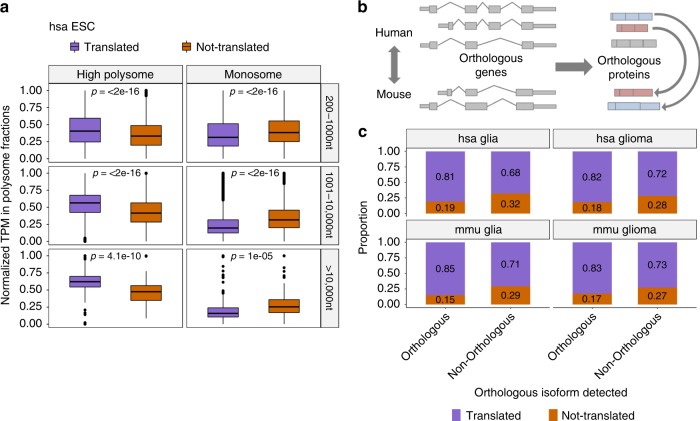
The differential production of transcript isoforms from gene loci is a key cellular mechanism. Yet, its impact in protein production remains an open question. Here, we describe ORQAS (ORF quantification pipeline for alternative splicing), a pipeline for the translation quantification of individual transcript isoforms using ribosome-protected mRNA fragments (ribosome profiling). We find evidence of translation for 40-50% of the expressed isoforms in human and mouse, with 53% of the expressed genes having more than one translated isoform in human, and 33% in mouse. Differential splicing analysis revealed that about 40% of the splicing changes at RNA level are concordant with changes in translation. Furthermore, orthologous cassette exons between human and mouse preserve the directionality of the change, and are enriched in microexons in a comparison between glia and glioma. ORQAS leverages ribosome profiling to uncover a widespread and evolutionarily conserved impact of differential splicing on translation, particularly of microexon-containing isoforms.
基因座中转录本异构体的差异产生是一种关键的细胞机制。然而,其对蛋白质产生的影响仍是一个悬而未决的问题。在这里,我们描述了 ORQAS(选择性剪接的开放阅读框定量分析流水线),这是一种使用核糖体保护的 mRNA 片段(核糖体谱)对单个转录本异构体进行翻译定量的流水线。我们在人类和小鼠中发现了 40-50%表达的异构体进行翻译的证据,人类中有 53%的表达基因具有不止一种翻译的异构体,而在小鼠中则有 33%。差异剪接分析表明,在 RNA 水平上大约 40%的剪接变化与翻译变化一致。此外,人类和小鼠之间的同源盒式外显子保留了变化的方向性,并且在神经胶质和神经胶质瘤之间的比较中,微外显子丰富。ORQAS 利用核糖体谱来揭示差异剪接对翻译的广泛而进化上保守的影响,特别是对含有微外显子的异构体。