Department of Obstetrics and Gynaecology School of Medicine, Makerere University College of Health Sciences, Kampala, Uganda.
Department of Health Policy Planning and Management, Makerere University School of Public Health, Kampala, Uganda.
PLoS One. 2020 Apr 14;15(4):e0231557. doi: 10.1371/journal.pone.0231557. eCollection 2020.
Information on repeat adolescent birth remains scarce in sub-Sahara Africa. We investigated the prevalence and time trends in repeat adolescent birth in Uganda, and associated factors.
We analyzed Uganda Demographic and Health Survey data of women age 20-24 years collected on 6 surveys (1988/89-2016) to estimate repeat adolescent birth (first live birth <18 years of age followed by another live birth(s) <20 years). Further, we estimated the wantedness of the second order birth and the prevalence of short birth intervals birth (<13 months) between the first and second such birth. On the 2016 survey, we examined factors associated with repeat adolescent birth using bivariate and multivariate modified Poisson regression.
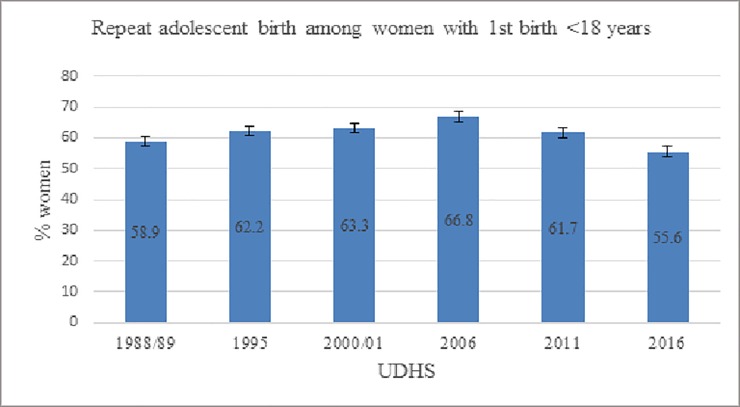
At the 1988/89 survey, 58.9% of women with first birth <18 years reported a repeat adolescent birth. This percentage increased to 66.8% in 2006 (+7.9 percentage points [pp], p = 0.010) and thereafter declined to 55.6% by 2016 (-11.2 pp, p<0.001), nevertheless, no change occurred between 1988/89 and 2016 (-3.3pp, p = 0.251). Among women with repeat adolescent births, the mean number of live births by exact age 20 years (2.2 births) and prevalence of short birth intervals (3.5% in 1988/89, 5.4% in 2016) (+1.9pp, p = 0.245) did not change. Increasingly more women with repeat adolescent births preferred to have had the second child later, 22.5% in 1995 and 43.1% in 2016 (+20.6pp, p = <0.001). On the 2016 survey, women from poorer households and those of younger age at first birth were significantly more likely to report repeat adolescent birth.
Following a first birth <18 years, more than half of the women report a repeat adolescent birth (<20 years), with no decline observed in 30 years. Increasingly more women wanted the second adolescent pregnancy later, highlighting the need to support adolescents with improved family planning services at each contact.
撒哈拉以南非洲地区关于青少年重复生育的信息仍然很少。我们调查了乌干达青少年重复生育的流行率和时间趋势,并分析了相关因素。
我们分析了在 6 次调查(1988/89-2016 年)中收集的年龄在 20-24 岁的乌干达女性的乌干达人口与健康调查数据,以估计青少年重复生育(首次活产年龄<18 岁,随后又有一次活产年龄<20 岁)。此外,我们还估计了第二次生育的意愿和首次与第二次此类生育之间的短生育间隔(<13 个月)的流行率。在 2016 年的调查中,我们使用双变量和多变量修正泊松回归分析了与青少年重复生育相关的因素。
在 1988/89 年的调查中,58.9%的首次生育年龄<18 岁的女性报告再次生育。这一比例在 2006 年增加到 66.8%(增加了 7.9 个百分点,p = 0.010),此后在 2016 年下降到 55.6%(减少了 11.2 个百分点,p<0.001),尽管如此,1988/89 年与 2016 年之间没有变化(减少了 3.3 个百分点,p = 0.251)。在有青少年重复生育的女性中,20 岁时的平均活产数(2.2 个)和短生育间隔的流行率(1988/89 年为 3.5%,2016 年为 5.4%)(增加了 1.9 个百分点,p = 0.245)没有变化。越来越多的有青少年重复生育的女性更希望第二次生育时间较晚,1995 年为 22.5%,2016 年为 43.1%(增加了 20.6 个百分点,p<0.001)。在 2016 年的调查中,来自较贫困家庭和首次生育年龄较小的女性报告青少年重复生育的可能性明显更高。
在首次生育年龄<18 岁之后,超过一半的女性报告再次生育(<20 岁),30 年来没有下降。越来越多的女性希望第二次青少年怀孕时间较晚,这突显了需要通过改善家庭计划服务来支持青少年的必要性。