Yunnan Provincial Center of Arbovirus Research, Pu'er, Yunnan, China.
Yunnan Institute of Parasitic Diseases, Pu'er, Yunnan, China.
PLoS One. 2020 Apr 14;15(4):e0231661. doi: 10.1371/journal.pone.0231661. eCollection 2020.
Japanese encephalitis (JE) is a vector-borne disease with a high prevalence in Yunnan Province, China. However, there has been a lack of a JE epidemic systematic analysis, which is urgently needed to guide control and prevention efforts.
This study explored and described the spatiotemporal distribution of JE cases observed among two different age groups in Yunnan Province from 2007 to 2017. The epidemiological features and spatial features were analyzed according to basic statistics, ArcGIS software (version 9.3; ESRI, Redlands, CA) and SPSS software (version 20; IBM Corp., Armonk, New York).
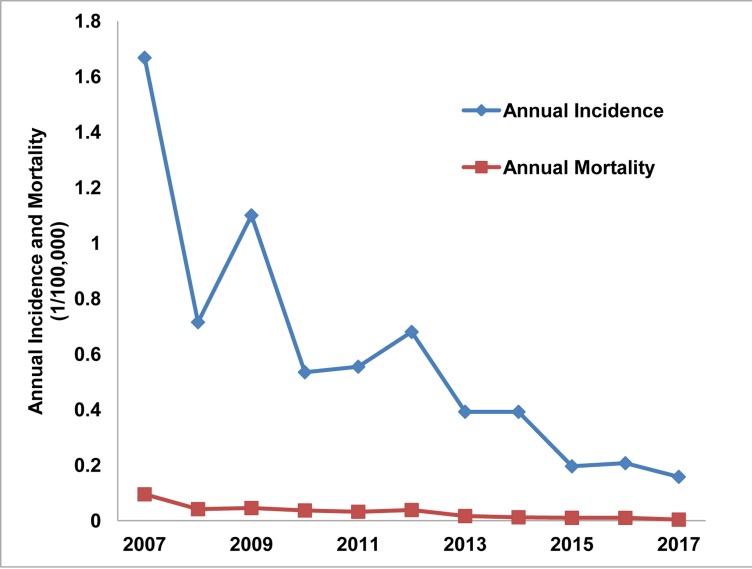
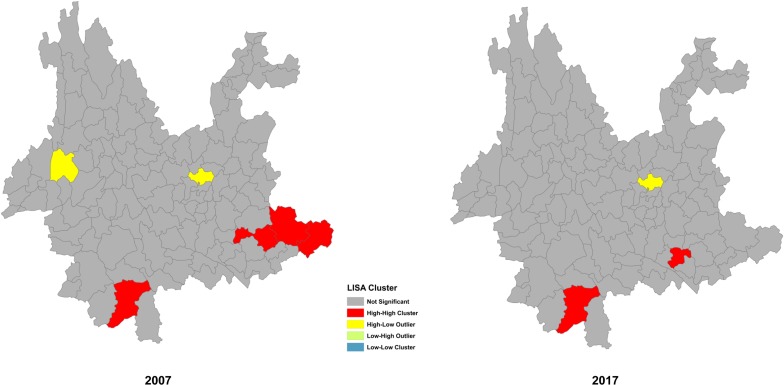
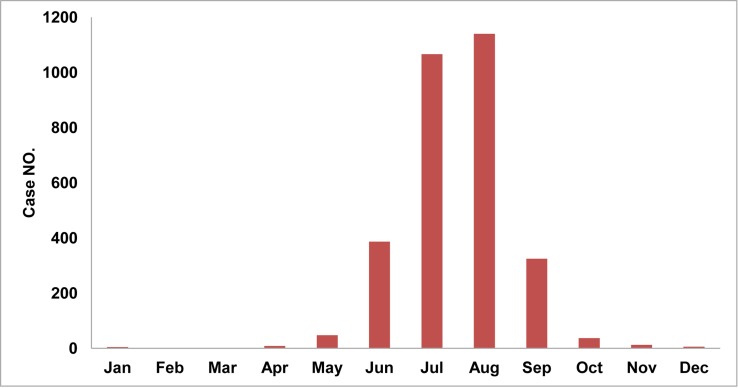
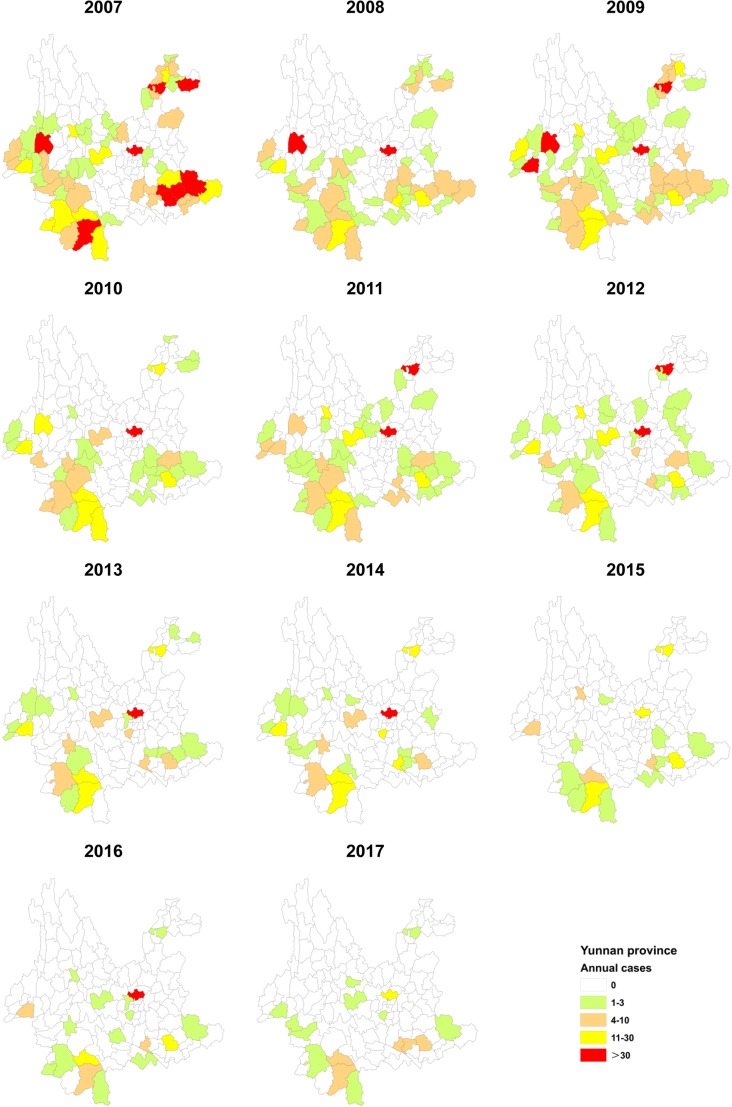
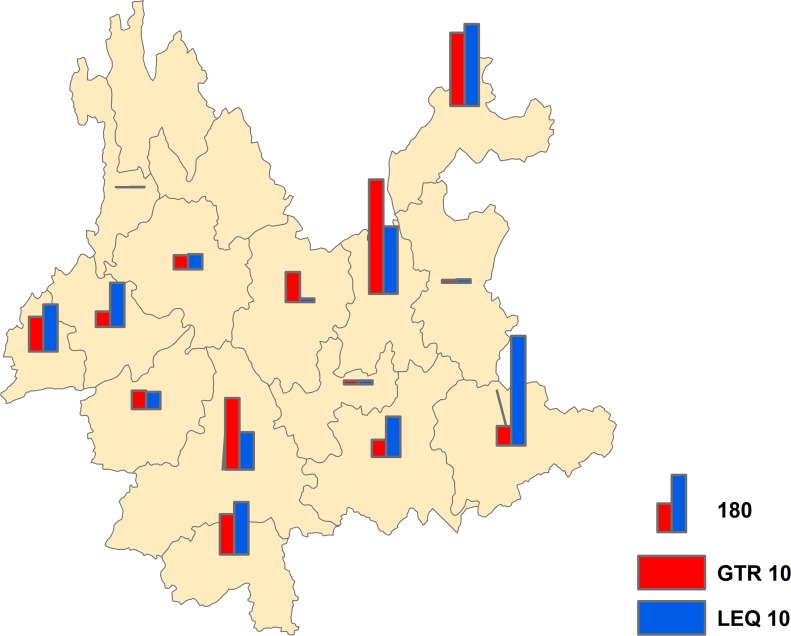
Overall, the whole province had a high incidence of JE. The annual incidence rates in 2007 and 2017 were 1.668/100,000 and 0.158/100,000, respectively. The annual mortality was under 0.095/100,000 for these years. Although the whole province was in danger of JE, the Diqing autonomous prefecture and the Lijiang autonomous prefecture had no JE cases recorded for over 10 years. The JE cases were reported by hospitals located in 60 counties of 14 municipalities. The top ten areas with the most JE cases were Kunming City, Zhaotong City, Jinghong City, Wenshan City, Mangshi City, Pu'er City, Baoshan City, Dali City, Chuxiong City, and Gejiu City. The incidence declined smoothly, with a peak occurring from June to September, which accounted for 96.1% of the total cases. Children whose age was equal or less than 10 years old (LEQ10) still maintained a high frequency of JEV infection, and a large number of cases were reported in August, despite the Expanded Program on Immunization (EPI), which was established in April 2008. There was no difference in the quantity of cases between the two groups (t = -0.411, P>0.05); additionally, the number of JE cases among patients LEQ10 were significantly greater than those among patients older than 10 years (GTR10). Further analysis using local indicators of spatial association (LISA) revealed that the distribution of JE exhibited a high-high cluster characteristic (Z = 2.06, P<0.05), which showed that Jinghong City, Guangnan County, Yanshan County, Funing County, and Mengzi City were hot spots for the JE epidemic.
Although the EPI was established in 2008 and the incidence of JE declined smoothly in Yunnan Province, there was no difference in the number of cases between the two age groups, which reveals that the EPI has been conducted with a low level success. In the context of limited vaccine supply capacity, we should strengthen the implementation of the children's immunization program before strengthening other immunization programs.
乙型脑炎(JE)是一种在中国云南省流行的虫媒疾病。然而,一直缺乏对 JE 流行的系统分析,这迫切需要指导控制和预防工作。
本研究对云南省 2007 年至 2017 年两个不同年龄组的 JE 病例进行了时空分布的探索和描述。根据基本统计、ArcGIS 软件(版本 9.3;ESRI,雷德兰兹,加利福尼亚州)和 SPSS 软件(版本 20;IBM 公司,阿蒙克,纽约州)对流行病学特征和空间特征进行了分析。
总体而言,全省 JE 发病率较高。2007 年和 2017 年的年发病率分别为 1.668/100000 和 0.158/100000,每年的死亡率均低于 0.095/100000。尽管全省都有 JE 的危险,但迪庆藏族自治州和丽江市 10 多年来没有 JE 病例记录。JE 病例由 14 个市的 60 个县的医院报告。报告 JE 病例最多的前 10 个地区是昆明市、昭通市、景洪市、文山州、芒市、普洱市、保山市、大理市、楚雄市和个旧市。发病率呈平稳下降趋势,峰值出现在 6 月至 9 月,占总病例的 96.1%。年龄等于或小于 10 岁的儿童(LEQ10)仍保持着较高的 JEV 感染频率,尽管在 2008 年 4 月建立了扩大免疫规划(EPI),但 8 月仍有大量病例报告。两组病例数量无差异(t=-0.411,P>0.05);此外,LEQ10 患者的 JE 病例数量明显多于 10 岁以上患者(GTR10)。使用局部空间关联指标(LISA)进行进一步分析表明,JE 的分布具有高-高聚类特征(Z=2.06,P<0.05),表明景洪市、广南县、砚山县、富宁县和蒙自市是 JE 流行的热点地区。
尽管 2008 年建立了 EPI,云南省 JE 的发病率呈平稳下降趋势,但两个年龄组的病例数量没有差异,这表明 EPI 的实施效果较低。在疫苗供应能力有限的情况下,我们应该在加强其他免疫规划之前,加强儿童免疫规划的实施。