Zhao Xing, Cao Mingqin, Feng Hai-Huan, Fan Heng, Chen Fei, Feng Zijian, Li Xiaosong, Zhou Xiao-Hua
West China School of Public Health, Sichuan University, Chengdu 610041, China.
School of Public Health, Xinjiang Medical University, Urumqi 830011, China.
Int J Environ Res Public Health. 2014 Apr 15;11(4):4201-17. doi: 10.3390/ijerph110404201.
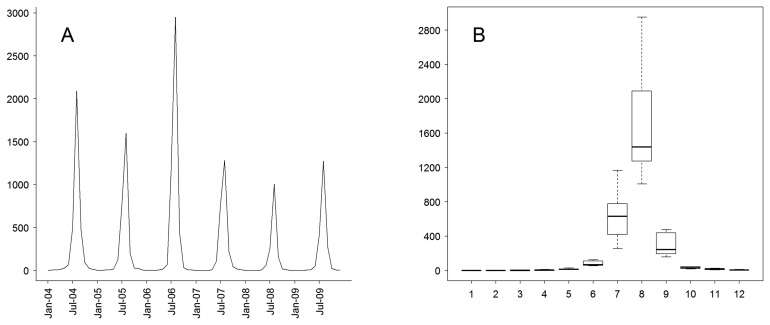
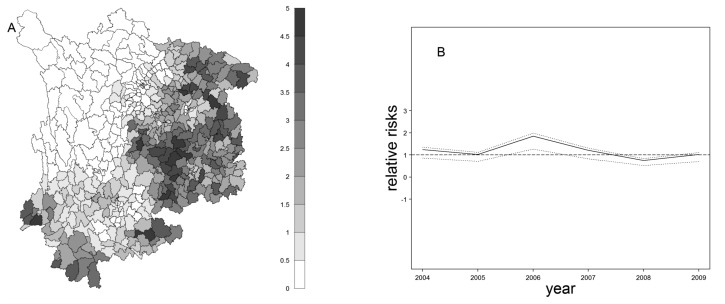
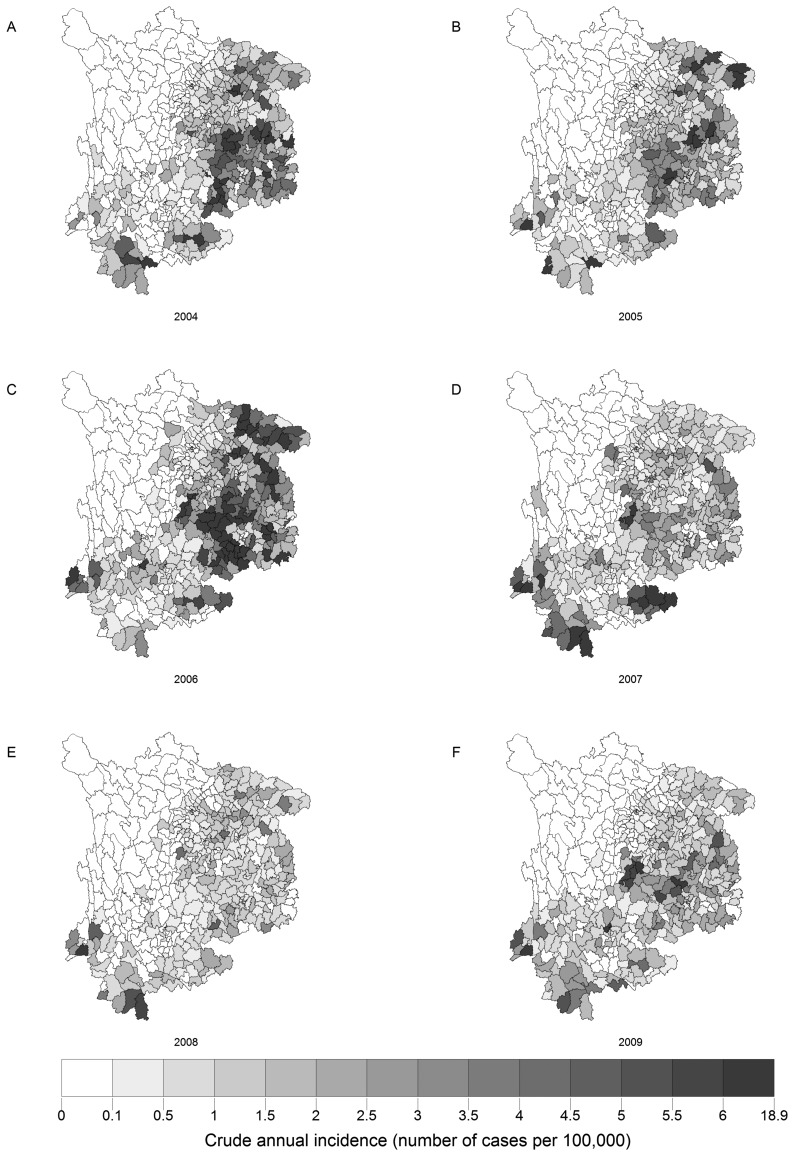
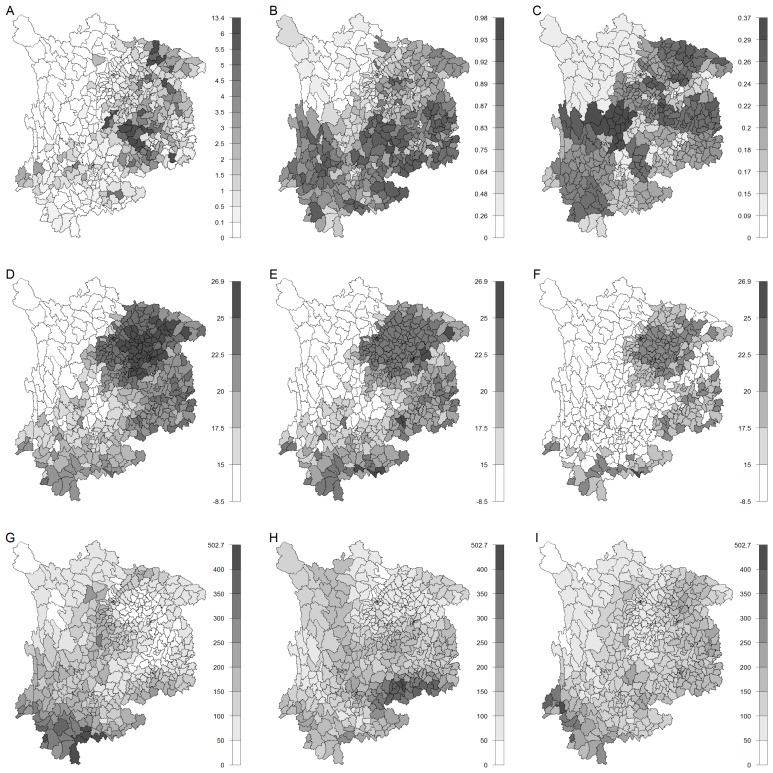
It is valuable to study the spatiotemporal pattern of Japanese encephalitis (JE) and its association with the contextual risk factors in southwest China, which is the most endemic area in China. Using data from 2004 to 2009, we applied GISmapping and spatial autocorrelation analysis to analyze reported incidence data of JE in 438 counties in southwest China, finding that JE cases were not randomly distributed, and a Bayesian hierarchical spatiotemporal model identified the east part of southwest China as a high risk area. Meanwhile, the Bayesian hierarchical spatial model in 2006 demonstrated a statistically significant association between JE and the agricultural and climatic variables, including the proportion of rural population, the pig-to-human ratio, the monthly precipitation and the monthly mean minimum and maximum temperatures. Particular emphasis was placed on the time-lagged effect for climatic factors. The regression method and the Spearman correlation analysis both identified a two-month lag for the precipitation, while the regression method found a one-month lag for temperature. The results show that the high risk area in the east part of southwest China may be connected to the agricultural and climatic factors. The routine surveillance and the allocation of health resources should be given more attention in this area. Moreover, the meteorological variables might be considered as possible predictors of JE in southwest China.
研究中国西南部地区(中国日本脑炎最流行的地区)日本脑炎(JE)的时空模式及其与环境风险因素的关联具有重要价值。利用2004年至2009年的数据,我们应用地理信息系统(GIS)绘图和空间自相关分析,对中国西南部438个县的JE报告发病数据进行分析,发现JE病例并非随机分布,贝叶斯分层时空模型确定中国西南部东部为高风险地区。同时,2006年的贝叶斯分层空间模型表明,JE与农业和气候变量之间存在统计学上的显著关联,这些变量包括农村人口比例、猪与人的比例、月降水量以及月平均最低和最高气温。特别强调了气候因素的时间滞后效应。回归方法和斯皮尔曼相关分析均确定降水量有两个月的滞后,而回归方法发现气温有一个月的滞后。结果表明,中国西南部东部的高风险地区可能与农业和气候因素有关。该地区应更加重视常规监测和卫生资源的分配。此外,气象变量可被视为中国西南部地区JE的可能预测指标。