Chang I-Chiu, Hwang Hsin-Ginn, Hung Ming-Chien, Lin Ming-Hui, Yen David C
Department of Information Management, National Chung Cheng University, No. 168, University Rd. Min-Hsiung Chia-Yi, Taiwan, ROC.
Department of E-Business, WuFeng Institute of Technology, No.117, Sec. 2, Jianguo Rd., Min-Hsiung Chia-Yi, Taiwan, ROC.
Decis Support Syst. 2007 Nov;44(1):350-359. doi: 10.1016/j.dss.2007.04.006. Epub 2007 May 5.
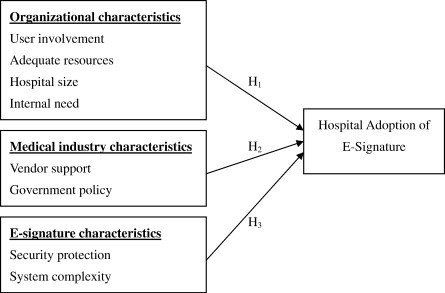
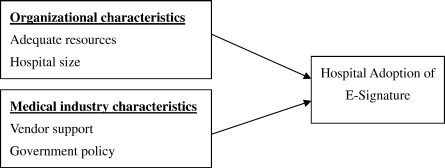
The healthcare industry is experiencing a major transformation towards e-healthcare, which delivers and enhances related information through the Internet among healthcare stakeholders and makes the electronic signature (e-signature) more and more important. This paper uses a mature framework, Technology-Organization-Environment (TEO), in information system discipline to identify factors that affect hospitals in adopting e-signature. A survey was conducted on regional hospitals and medical centers in Taiwan to verify the validity of the research framework. The results show that TEO framework is useful in distinguishing hospitals as adopters and non-adopters of e-signature. Based on the research findings, implications and limitations are discussed.
医疗行业正在经历向电子医疗的重大转变,电子医疗通过互联网在医疗利益相关者之间传递和增强相关信息,并使电子签名变得越来越重要。本文运用信息系统学科中一个成熟的框架——技术-组织-环境(TEO),来识别影响医院采用电子签名的因素。对台湾地区的医院和医疗中心进行了一项调查,以验证研究框架的有效性。结果表明,TEO框架有助于区分采用和未采用电子签名的医院。基于研究结果,讨论了研究的启示和局限性。