Ji Henry, Yan Ying, Ding Beibei, Guo Wenzhong, Brunswick Mark, Niethammer Andreas, SooHoo Williams, Smith Robin, Nahama Alexis, Zhang Yanliang
Sorrento Therapeutics, Inc., 4955 Directors Place, San Diego, CA 92121, United States of America.
Department of Medicine, Rutgers New Jersey Medical School, Newark, NJ 07102, United States of America.
Med Drug Discov. 2020 Mar;5:100026. doi: 10.1016/j.medidd.2020.100026. Epub 2020 Mar 25.
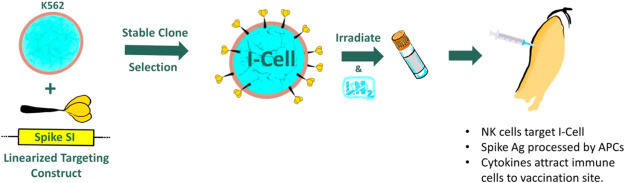
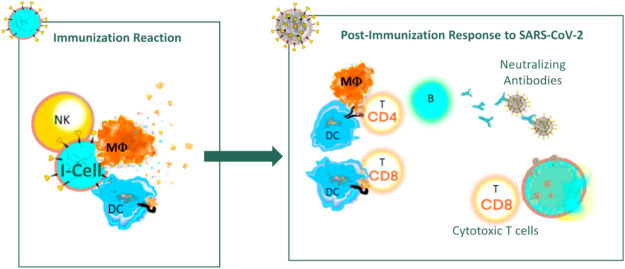
A novel approach modifying cells to express viral markers to elicit protective immunity responses (decoy cellular vaccination) in the prevention of COVID-19 disease is currently being explored. Our approach entails utilizing SARS-CoV-2 Spike antigen-expressing, non-replicating cells as carriers and presenters of immunogenic antigens, so called "I-cells". By using irradiated cells as presenting vehicles of SARS-CoV-2 viral antigens(s) in a cellular context, these presented viral proteins can be recognized by the host immune system, thus, an efficient protective immune response might be elicited. Another advantage of this strategy is that the manufacturing process is scalable and yields uniform cell products allowing for "off-the-shelf" frozen supply availability. To prevent engraftment and proliferation of the cells after administration, the cells will be irradiated post-harvesting abolishing in vivo replication potential. Specifically, immunoreactive Spike-1 proteins from SARS-CoV-2 are expressed on the surface of irradiated target I-cells. Utilizing this innovative strategy, these viral antigen-displaying decoy cells will be developed as a vaccine to protect against COVID-19 disease.
目前正在探索一种新方法,即修饰细胞以表达病毒标记物,从而在预防新冠疾病中引发保护性免疫反应(诱饵细胞疫苗接种)。我们的方法需要利用表达严重急性呼吸综合征冠状病毒2(SARS-CoV-2)刺突抗原的非复制细胞作为免疫原性抗原的载体和呈递者,即所谓的“I细胞”。通过在细胞环境中使用经辐照的细胞作为SARS-CoV-2病毒抗原的呈递载体,这些呈递的病毒蛋白可被宿主免疫系统识别,因此,可能引发有效的保护性免疫反应。该策略的另一个优点是制造过程具有可扩展性,可产生均匀的细胞产品,从而实现“现货”冷冻供应。为防止给药后细胞植入和增殖,收获后的细胞将进行辐照,消除其体内复制潜力。具体而言,来自SARS-CoV-2的免疫反应性刺突1蛋白在经辐照的靶I细胞表面表达。利用这一创新策略,这些展示病毒抗原的诱饵细胞将被开发成一种疫苗,以预防新冠疾病。