Division of Gastroenterology and Hepatology, Department of Internal Medicine, University of Michigan Health System, Ann Arbor, Michigan.
Division of Gastroenterology and Hepatology, Department of Internal Medicine, University of Michigan Health System, Ann Arbor, Michigan.
Clin Gastroenterol Hepatol. 2020 Dec;18(13):2879-2902.e9. doi: 10.1016/j.cgh.2020.04.019. Epub 2020 Apr 11.
BACKGROUND & AIMS: Liquid biopsies, or blood samples, can be analyzed to detect circulating tumor cells (CTCs), cell-free DNA (cfDNA), and extracellular vesicles, which might identify patients with hepatocellular carcinoma (HCC) or help determine their prognoses. We performed a systematic review of studies of analyses of liquid biopsies from patients with HCC and their comparisons with other biomarkers.
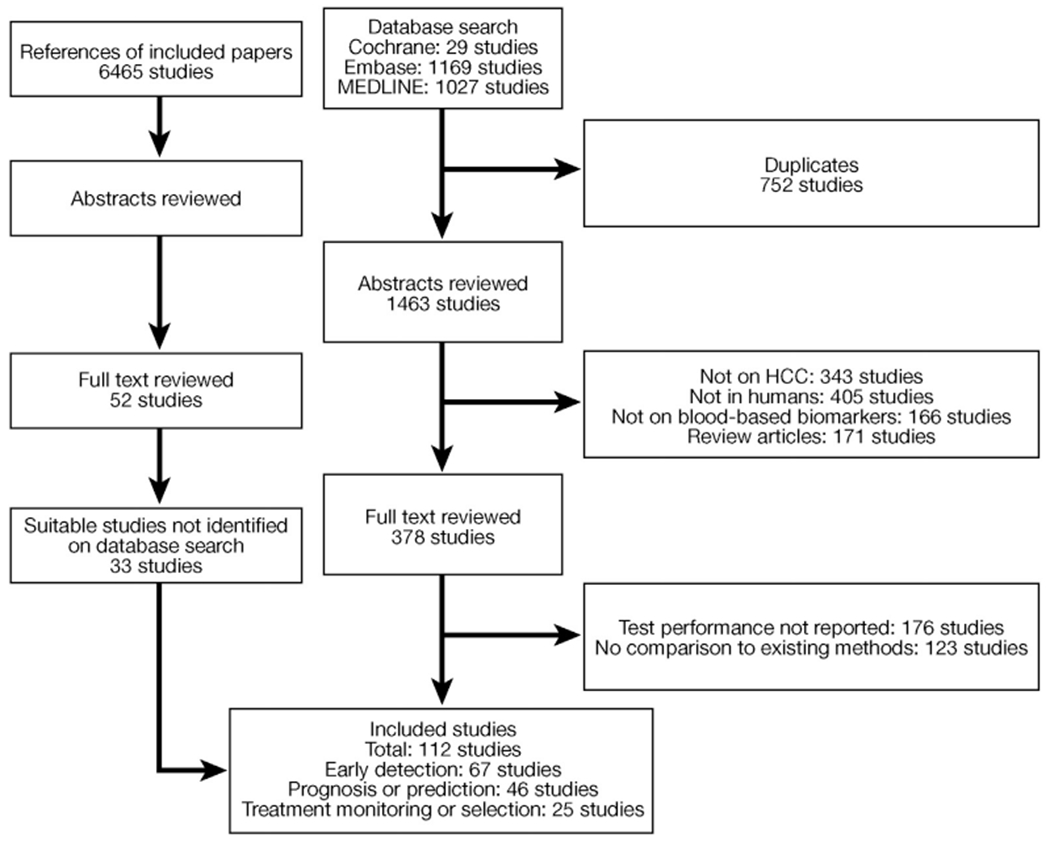
We performed a systematic review of original studies published before December 1, 2019. We included studies that compared liquid biopsies alone and in combination with other biomarkers for the detection of HCC, performed multivariate analyses of the accuracy of liquid biopsy analysis in determining patient prognoses, or evaluated the utility of liquid biopsy analysis in monitoring treatment response.
Our final analysis included 112 studies: 67 on detection, 46 on determining prognosis, and 25 on treatment monitoring or selection. Ten studies evaluated assays that characterized cfDNA for detection of HCC in combination with measurement of α-fetoprotein (AFP)-these studies found that the combined measurement of cfDNA and AFP more accurately identified patients with HCC than measurement of AFP alone. Six studies evaluated assays for extracellular vesicles and 2 studies evaluated assays for CTC in detection of HCC, with and without other biomarkers-most of these studies found that detection of CTCs or extracellular vesicles with AFP more accurately identified patients with HCC than measurement of AFP alone. Detection of CTCs before surgery was associated with HCC recurrence after resection in 13 of 14 studies; cfDNA and extracellular vesicles have been studied less frequently as prognostic factors. Changes in CTC numbers before vs after treatment more accurately identify patients with HCC recurrence than pretreatment counts alone, and measurements of cfDNA can identify patients with disease recurrence or progression before changes can be detected by imaging. We found little evidence that analyses of liquid biopsies can aid in the selection of treatment for HCC. Quality assessment showed risk of bias in studies of HCC detection and determination of prognosis.
In a systematic review of 112 studies of the accuracy of liquid biopsy analysis, we found that assays for CTCs and cfDNA might aid in determining patient prognoses and monitoring HCC, and assays for cfDNA might aid in HCC detection, but there is a risk of bias in these studies. Studies must be standardized before we can assess the clinical utility of liquid biopsy analysis in the detection and management of patients with HCC.
液体活检,即血液样本分析,可以检测循环肿瘤细胞(CTCs)、无细胞 DNA(cfDNA)和细胞外囊泡,这些可能有助于识别肝细胞癌(HCC)患者或帮助确定其预后。我们对 HCC 患者液体活检分析的研究进行了系统评价,并与其他生物标志物进行了比较。
我们对截至 2019 年 12 月 1 日之前发表的原始研究进行了系统评价。我们纳入了单独比较和联合其他生物标志物检测 HCC 的液体活检分析的研究,对液体活检分析确定患者预后的准确性进行了多变量分析,或评估了液体活检分析在监测治疗反应中的效用。
我们的最终分析纳入了 112 项研究:67 项用于检测,46 项用于确定预后,25 项用于监测或选择治疗。10 项研究评估了联合检测 cfDNA 和 AFP 用于 HCC 检测的方法-这些研究发现,联合检测 cfDNA 和 AFP 比单独检测 AFP 更能准确识别 HCC 患者。6 项研究评估了细胞外囊泡的检测方法,2 项研究评估了 CTC 在 HCC 检测中的检测方法,包括与 AFP 联合检测或不联合 AFP 检测-这些研究大多发现,与单独检测 AFP 相比,检测 CTCs 或细胞外囊泡与 AFP 联合检测更能准确识别 HCC 患者。14 项研究中有 13 项发现,手术前 CTCs 的检测与 HCC 切除后的复发相关;cfDNA 和细胞外囊泡作为预后因素的研究较少。与术前计数相比,治疗前后 CTC 数量的变化更能准确识别 HCC 复发患者,cfDNA 的测量可在影像学检测到疾病复发或进展之前识别出复发或进展的患者。我们发现很少有证据表明液体活检分析可以帮助选择 HCC 的治疗方法。质量评估显示,在 HCC 检测和预后确定的研究中存在偏倚风险。
在对 112 项液体活检分析准确性的研究进行系统评价后,我们发现 CTCs 和 cfDNA 的检测方法可能有助于确定患者的预后和监测 HCC,cfDNA 的检测方法可能有助于 HCC 的检测,但这些研究存在偏倚风险。在评估液体活检分析在 HCC 患者的检测和管理中的临床效用之前,必须对这些研究进行标准化。