Institute of Neuroscience, Université catholique de Louvain, Avenue Mounier 53 box B1.53.04, 1200, Brussels, Belgium.
Division of Child Development and Growth, Department of Pediatrics, University of Geneva, Geneva, Switzerland.
BMC Neurol. 2020 Apr 14;20(1):133. doi: 10.1186/s12883-020-01705-4.
Cerebral palsy (CP) causes motor, cognitive and sensory impairment at different extents. Many recent rehabilitation developments (therapies) have focused solely on the upper extremities (UE), although the lower extremities (LE) are commonly affected. Hand-arm Bimanual Intensive Therapy Including Lower Extremities (HABIT-ILE) applies the concepts of motor skill learning and intensive training to both the UE and LE. It involves constant stimulation of the UE and LE, for several hours each day over a 2-week period. The effects of HABIT-ILE have never been evaluated in a large sample of young children. Furthermore, understanding of functional, neuroplastic and biomechanical changes in infants with CP is lacking. The aim of this study is to carry out a multi-center randomized controlled trial (RCT) to evaluate the effects of HABIT-ILE in pre-school children with unilateral CP on functional, neuroplastic and biomechanical parameters.
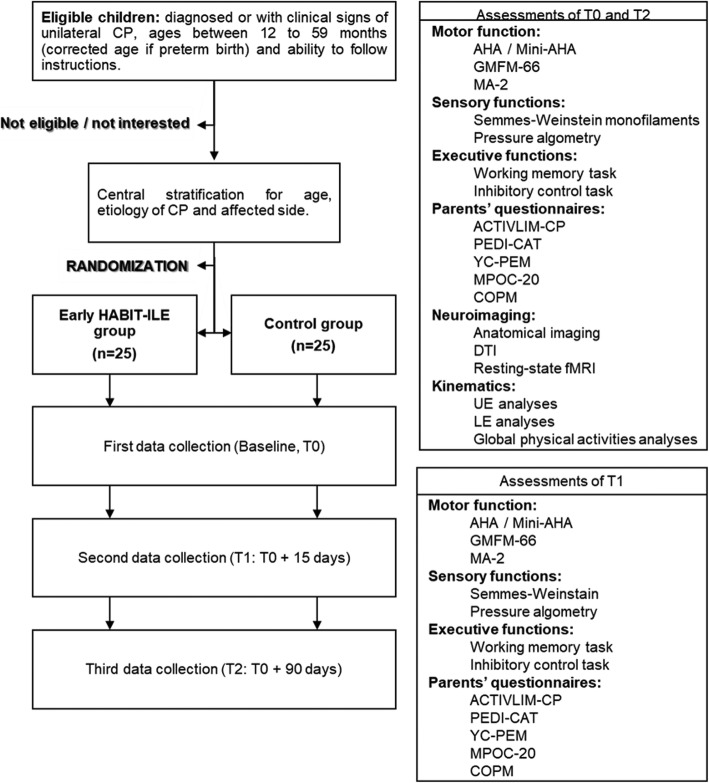
This multi-center, 3-country study will include 50 pre-school children with CP aged 1-4 years. The RCT will compare the effect of 50 h (two weeks) of HABIT-ILE versus usual motor activity, including regular rehabilitation. HABIT-ILE will be delivered in a day-camp setting, with structured activities and functional tasks that will be continuously progressed in terms of difficulty. Assessments will be performed at 3 intervals: baseline (T0), two weeks later and 3 months later. Primary outcomes will be the Assisting Hand Assessment; secondary outcomes include the Melbourne Assessment-2, executive function assessments, questionnaires ACTIVLIM-CP, Pediatric Evaluation of Disability Inventory, Young Children's Participation and Environment Measure, Measure of the Process of Care, Canadian Occupational Performance Measure, as well as neuroimaging and kinematics measures.
We expect that HABIT-ILE will induce functional, neuroplastic and biomechanical changes as a result of the intense, activity-based rehabilitation process and these changes will impact the whole developmental curve of each child, improving functional ability, activity and participation in the short-, mid- and long-term. Name of the registry: Changes Induced by Early HABIT-ILE in Pre-school Children With Uni- and Bilateral Cerebral Palsy (EarlyHABIT-ILE).
Trial registration number: NCT04020354-Registration date on the International Clinical Trials Registry Platform (ICTRP): November 20th, 2018; Registration date on NIH Clinical Trials Registry: July 16th, 2019.
脑瘫(CP)会导致不同程度的运动、认知和感觉障碍。许多最近的康复发展(疗法)仅专注于上肢(UE),尽管下肢(LE)通常也会受到影响。手-臂双手密集治疗包括下肢(HABIT-ILE)将运动技能学习和密集训练的概念应用于 UE 和 LE。它包括每天数小时持续刺激 UE 和 LE,持续两周。HABIT-ILE 的效果从未在大量幼儿中进行过评估。此外,对于 CP 婴儿的功能、神经可塑性和生物力学变化的理解也很缺乏。本研究的目的是进行一项多中心随机对照试验(RCT),以评估 HABIT-ILE 对学龄前单侧 CP 儿童功能、神经可塑性和生物力学参数的影响。
这项多中心、三国研究将包括 50 名 1-4 岁患有 CP 的学龄前儿童。RCT 将比较 50 小时(两周)的 HABIT-ILE 与常规运动活动的效果,包括定期康复。HABIT-ILE 将在日间营地环境中进行,采用结构化活动和功能性任务,这些任务将在难度上不断推进。评估将在三个时间点进行:基线(T0)、两周后和三个月后。主要结局指标是辅助手评估;次要结局指标包括墨尔本评估-2、执行功能评估、调查问卷 ACTIVLIM-CP、小儿残疾评估量表、幼儿参与和环境测量、护理过程测量、加拿大职业表现测量,以及神经影像学和运动学测量。
我们预计 HABIT-ILE 将通过强烈的基于活动的康复过程引起功能、神经可塑性和生物力学变化,这些变化将影响每个孩子整个发育曲线,在短期、中期和长期内提高功能能力、活动和参与度。注册表名称:早期 HABIT-ILE 在单侧和双侧脑瘫学龄前儿童中引起的变化(EarlyHABIT-ILE)。
试验注册号:NCT04020354-在国际临床试验注册平台(ICTRP)上的注册日期:2018 年 11 月 20 日;在 NIH 临床试验注册处的注册日期:2019 年 7 月 16 日。