Global Drug Discovery, Novo Nordisk A/S, Novo Nordisk Park 1, 2760, Maaloev, Denmark.
Veterinary and Animal Sciences, University of Copenhagen, Frederiksberg, Denmark.
BMC Musculoskelet Disord. 2020 Apr 14;21(1):241. doi: 10.1186/s12891-020-03267-5.
Haemophilic arthropathy is a chronic and debilitating joint disease caused by recurrent spontaneous joint bleeds in patients with haemophilia. Understanding how characteristics of individual joint bleeds relate to the subsequent development of arthropathy could improve management and prevention of this joint disease. Here, we aimed to explore relations between joint bleed characteristics and development of bone pathology in a mouse model of haemophilic arthropathy by using novel in vivo imaging methodology.
We characterised induced knee bleeds in a murine model of haemophilic arthropathy by quantitative in vivo fluorescence molecular tomography (FMT) and by measurements of changes in the diameter of the injured knee. Wild-type mice and non-injured haemophilic mice acted as controls. Development of arthropathy was characterised by post mortem evaluation of bone pathology by micro-CT 14 days after bleed-induction. In an in vitro study, we assessed the effect of blood on the quantification of fluorescent signal with FMT.
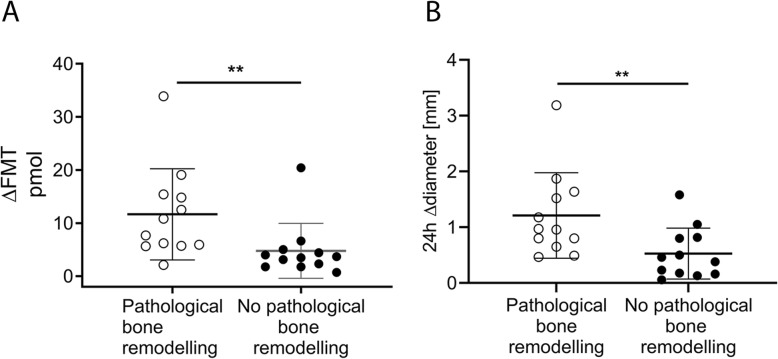
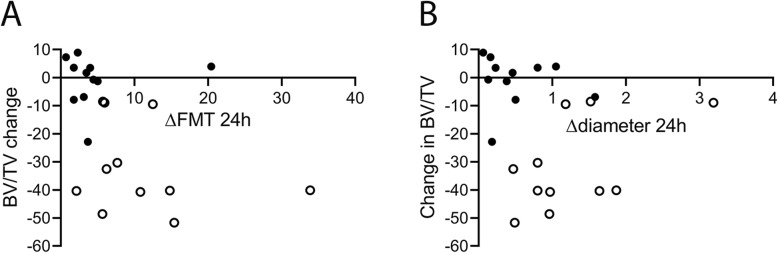
In most injured haemophilic mice, we observed significant loss of trabecular bone, and half of the mice developed pathological bone remodelling. Development of pathological bone remodelling was associated with significantly increased fluorescent signal and diameter of the injured knee just 1 day after induction of the bleed. Further, a correlation between the fluorescent signal 1 day after induction of the bleed and loss of trabecular bone reached borderline significance. In the in vitro study, we found that high concentrations of blood significantly decreased the fluorescent signal.
Our results add novel insights on the pathogenesis of haemophilic arthropathy and underline the importance of the acute phase of joint bleeds for the subsequent development of arthropathy.
血友病性关节病是一种由血友病患者反复自发性关节出血引起的慢性、使人虚弱的关节疾病。了解单个关节出血的特征与关节病的后续发展之间的关系,可以改善这种关节疾病的管理和预防。在这里,我们旨在通过使用新型体内成像方法,探索血友病性关节病小鼠模型中关节出血特征与骨病理学发展之间的关系。
我们通过定量活体荧光分子断层扫描(FMT)和测量受伤膝关节直径的变化,对血友病性关节病小鼠模型中的诱导膝关节出血进行了特征描述。野生型小鼠和未受伤的血友病小鼠作为对照。在出血诱导后 14 天,通过对死后的骨病理学进行微 CT 评估,来描述关节病的发展。在体外研究中,我们评估了血液对 FMT 定量荧光信号的影响。
在大多数受伤的血友病小鼠中,我们观察到明显的骨小梁丢失,一半的小鼠发生了病理性骨重塑。病理性骨重塑的发展与出血诱导后 1 天膝关节的荧光信号和直径显著增加相关。此外,出血诱导后 1 天的荧光信号与骨小梁丢失之间的相关性具有显著意义。在体外研究中,我们发现高浓度的血液显著降低了荧光信号。
我们的结果为血友病性关节病的发病机制提供了新的见解,并强调了关节出血的急性期对关节病后续发展的重要性。