Department of Chemical and Biomolecular Engineering, University of Delaware, Newark, Delaware, USA.
Department of Pathology, Anatomy, and Cell Biology, Thomas Jefferson University, Philadelphia, PA, USA.
Theor Biol Med Model. 2020 Apr 15;17(1):5. doi: 10.1186/s12976-020-00123-w.
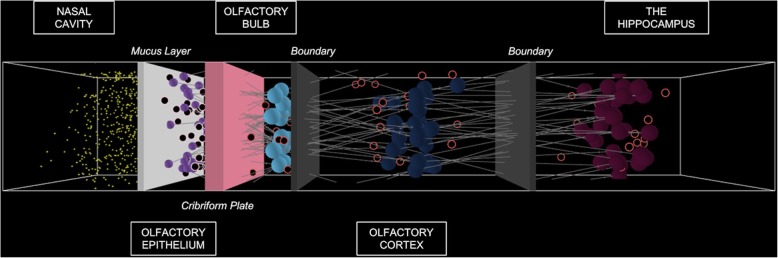
Alzheimer's disease (AD) is a degenerative brain disease. A novel agent-based modelling framework was developed in NetLogo 3D to provide fundamental insights into the potential mechanisms by which a microbe (eg. Chlamydia pneumoniae) may play a role in late-onset AD. The objective of our initial model is to simulate one possible spatial and temporal pathway of bacterial propagation via the olfactory system, which may then lead to AD symptoms. The model maps the bacteria infecting cells from the nasal cavity and the olfactory epithelium, through the olfactory bulb and into the olfactory cortex and hippocampus regions of the brain.
Based on the set of biological rules, simulated randomized infection by the microbe led to the formation of beta-amyloid (Aβ) plaque and neurofibrillary (NF) tangles as well as caused immune responses. Our initial simulations demonstrated that breathing in C. pneumoniae can result in infection propagation and significant buildup of Aβ plaque and NF tangles in the olfactory cortex and hippocampus. Our model also indicated how mucosal and neural immunity can play a significant role in the pathway considered. Lower immunities, correlated with elderly individuals, had quicker and more Aβ plaque and NF tangle formation counts. In contrast, higher immunities, correlated with younger individuals, demonstrated little to no such formation.
The modelling framework provides an organized visual representation of how AD progression may occur via the olfactory system to better understand disease pathogenesis. The model confirms current conclusions in available research but can be easily adjusted to match future evidence and be used by researchers for their own individual purposes. The goal of our initial model is to ultimately guide further hypothesis refinement and experimental testing to better understand the dynamic system interactions present in the etiology and pathogenesis of AD.
阿尔茨海默病(AD)是一种退行性脑疾病。为了深入了解微生物(如肺炎衣原体)在迟发性 AD 中可能发挥作用的潜在机制,我们在 NetLogo 3D 中开发了一种新的基于代理的建模框架。我们最初模型的目的是模拟一种通过嗅觉系统传播细菌的可能的时空途径,这可能导致 AD 症状。该模型将感染鼻腔和嗅上皮细胞的细菌映射到嗅球,并进入大脑的嗅皮质和海马区。
基于一系列生物学规则,模拟的微生物随机感染导致β-淀粉样蛋白(Aβ)斑块和神经原纤维缠结(NF)的形成,并引发免疫反应。我们的初步模拟表明,吸入肺炎衣原体可导致感染传播,并在嗅皮质和海马区大量积聚 Aβ斑块和 NF 缠结。我们的模型还表明黏膜和神经免疫在考虑的途径中可以发挥重要作用。与老年人相关的较低免疫力会更快地形成更多的 Aβ斑块和 NF 缠结计数。相比之下,与年轻人相关的较高免疫力几乎没有形成这种物质。
该建模框架提供了一种有组织的视觉表示,说明 AD 如何通过嗅觉系统进展,从而更好地理解疾病的发病机制。该模型证实了现有研究中的现有结论,但可以轻松调整以匹配未来的证据,并供研究人员用于自己的目的。我们最初模型的目标是最终指导进一步的假设完善和实验测试,以更好地了解 AD 病因和发病机制中存在的动态系统相互作用。