Vohra Fahim, Altwaim Manea, Alshuwaier Abdulaziz S, Deeb Modhi Al, Alfawaz Yasser, Alrabiah Mohammed, Abduljabbar Tariq
Fahim Vohra, Department of Prosthetic Dental Science, College of Dentistry, King Saud University, Riyadh 11545, Saudi Arabia.
Manea Altwaim, Intern, Department of General Dentistry, College of Dentistry, King Saud University, Riyadh 11545, Saudi Arabia.
Pak J Med Sci. 2020 Mar-Apr;36(3):416-421. doi: 10.12669/pjms.36.3.1946.
To investigate the failure loads of dentin bonded all-ceramic crowns when luted with Bioactive, resin and glass ionomer cements (GIC) in an in-vitro setting.
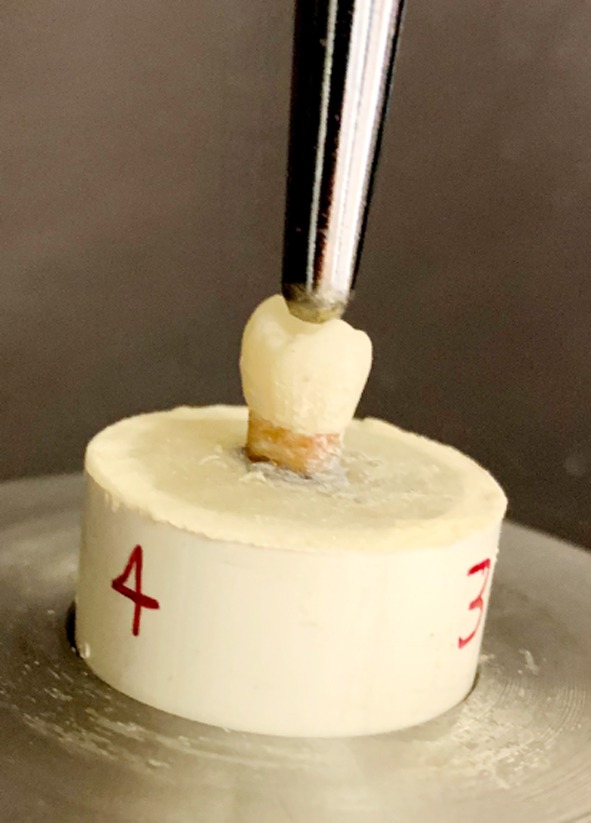
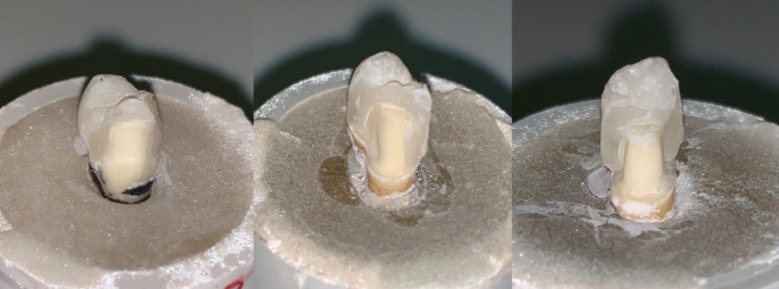
This study was conducted at King Saud University, Saudi Arabia, from Nov.2018 to March 2019. In this study, 60 premolar teeth were prepared for dentin-bonded ceramic crowns. Lithium disilicate ceramic crowns fabricated using CAD-CAM technique were cemented to teeth using Bioactive (ACITVA), Resin (Nexus 3 Gen) and GIC (Ketac Cem- Maxicap). Half of the bonded specimens in each group were thermocycled (50000 cycles), however the remaining half were not aged (n=10). Fracture loads of bonded crowns were assessed by exposing them to static axial occlusal loads (1mm/min) using a round ended metal probe in a Universal testing machine. Means and standard deviations among the study groups were compared with ANOVA and Tukey-Kramer multiple comparisons test.
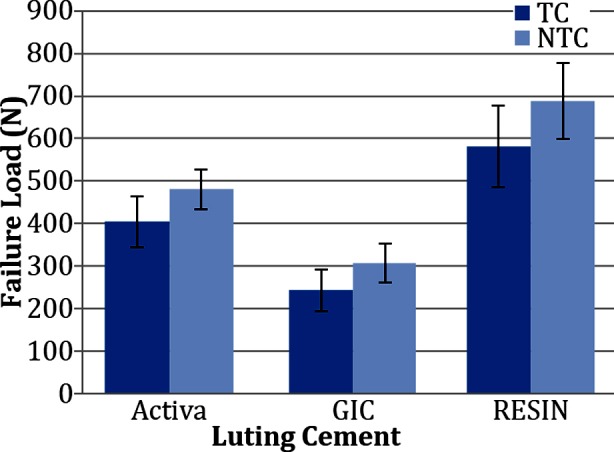
Highest failure loads were observed in resin group without ageing (thermocycling) (689.13±89.41 N), however, the lowest loads were observed in GIC specimens with ageing (243.16±49.03 N). Among non-aged samples, failure loads for Bioactive (480.30±47.26 N) group were less than Resin (689.13±89.41 N) samples but higher than GIC (307.51±45.29 N) specimens respectively. Among the aged specimens, Bioactive (404.42±60.43 N) showed significantly higher failure loads than GIC (243.16±49.03 N), however lower failure loads than Resin (582.33±95.95 N) samples.
Dentin boned crowns with resin cementation showed higher failure loads than Bioactive and GIC luted crowns. Crowns luted with Bioactive cement showed acceptable failure loads for use as restoration on anterior teeth.
在体外环境下,研究使用生物活性、树脂和玻璃离子粘固剂(GIC)粘结时,牙本质粘结全瓷冠的破坏载荷。
本研究于2018年11月至2019年3月在沙特阿拉伯的沙特国王大学进行。在本研究中,为牙本质粘结瓷冠制备了60颗前磨牙。使用CAD-CAM技术制作的二硅酸锂陶瓷冠,分别用生物活性粘固剂(ACITVA)、树脂粘固剂(Nexus 3 Gen)和GIC(Ketac Cem - Maxicap)粘结到牙齿上。每组中一半的粘结试件进行热循环(50000次循环),而另一半不进行老化处理(n = 10)。使用万能试验机中的圆头金属探针,通过对粘结冠施加静态轴向咬合载荷(1mm/分钟)来评估其断裂载荷。研究组之间的均值和标准差采用方差分析和Tukey-Kramer多重比较检验进行比较。
在未老化(未热循环)的树脂组中观察到最高破坏载荷(689.13±89.41 N),然而,在老化的GIC试件中观察到最低载荷(243.16±49.03 N)。在未老化样本中,生物活性组(480.30±47.26 N)的破坏载荷分别低于树脂组(689.13±89.41 N)样本,但高于GIC组(307.51±45.29 N)试件。在老化试件中,生物活性组(404.42±60.43 N)的破坏载荷显著高于GIC组(243.16±49.03 N),然而低于树脂组(582.33±95.95 N)样本。
树脂粘结的牙本质粘结冠比生物活性和GIC粘结的冠具有更高的破坏载荷。用生物活性粘固剂粘结的冠作为前牙修复体时,显示出可接受的破坏载荷。