Zhang Zi-Mei, Tan Jiu-Xin, Wang Fang, Dao Fu-Ying, Zhang Zhao-Yue, Lin Hao
Key Laboratory for Neuro-Information of Ministry of Education, School of Life Sciences and Technology, Center for Informational Biology, University of Electronic Science and Technology of China, Chengdu, China.
Front Bioeng Biotechnol. 2020 Mar 27;8:254. doi: 10.3389/fbioe.2020.00254. eCollection 2020.
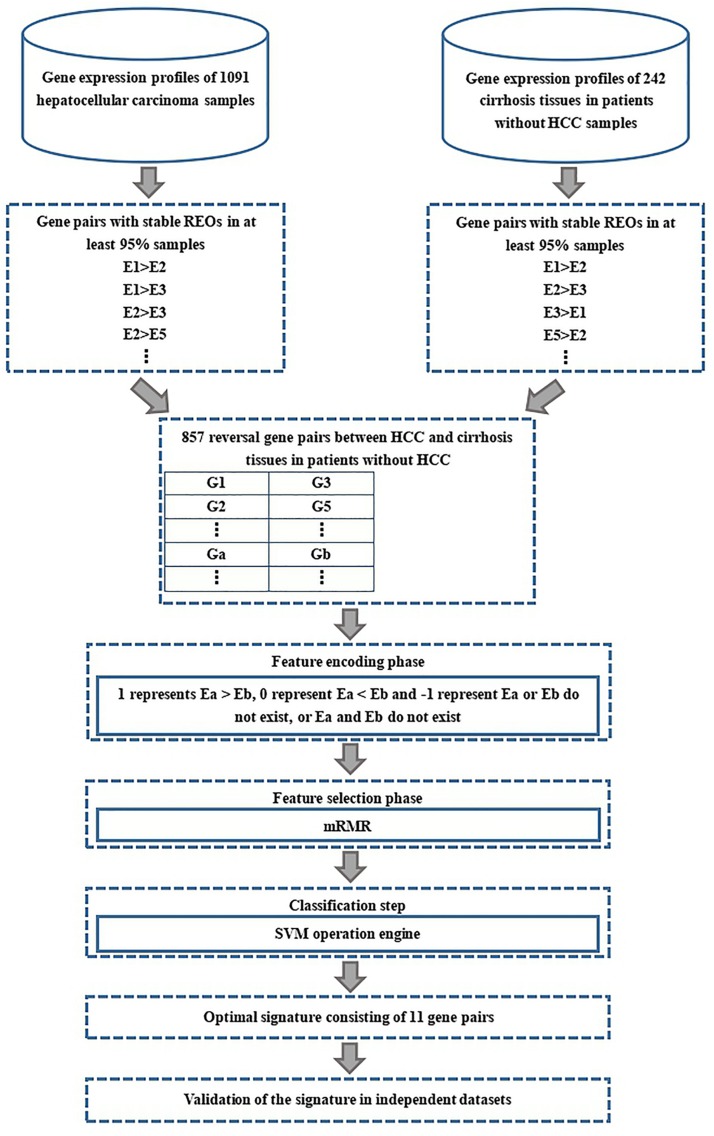
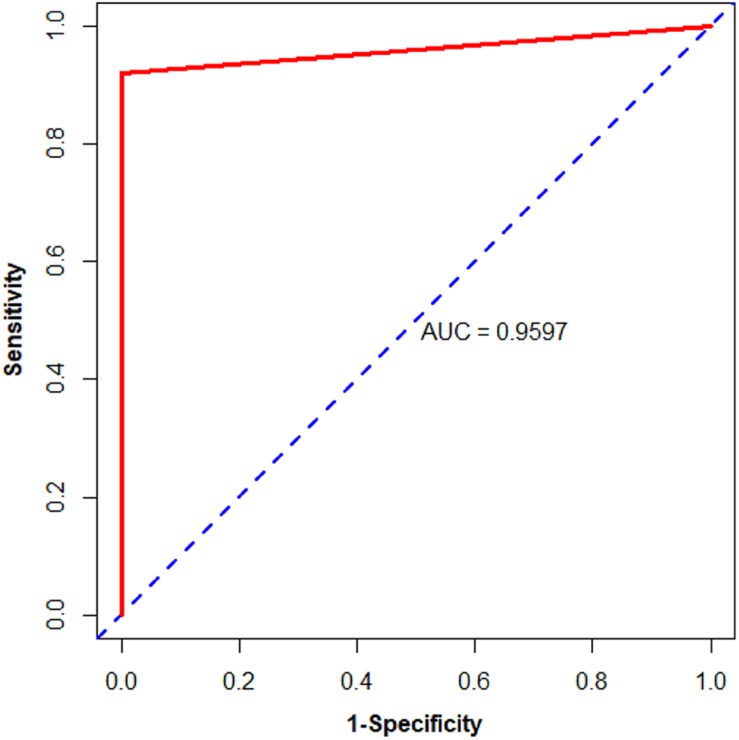
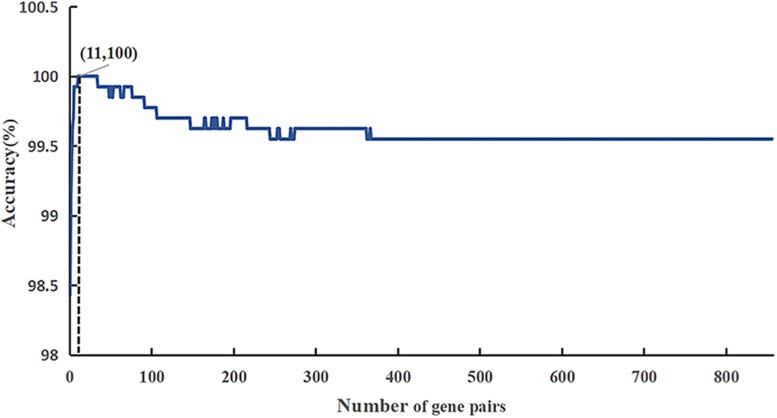
Hepatocellular carcinoma (HCC) is a serious cancer which ranked the fourth in cancer-related death worldwide. Hence, more accurate diagnostic models are urgently needed to aid the early HCC diagnosis under clinical scenarios and thus improve HCC treatment and survival. Several conventional methods have been used for discriminating HCC from cirrhosis tissues in patients without HCC (CwoHCC). However, the recognition successful rates are still far from satisfactory. In this study, we applied a computational approach that based on machine learning method to a set of microarray data generated from 1091 HCC samples and 242 CwoHCC samples. The within-sample relative expression orderings (REOs) method was used to extract numerical descriptors from gene expression profiles datasets. After removing the unrelated features by using maximum redundancy minimum relevance (mRMR) with incremental feature selection, we achieved "11-gene-pair" which could produce outstanding results. We further investigated the discriminate capability of the "11-gene-pair" for HCC recognition on several independent datasets. The wonderful results were obtained, demonstrating that the selected gene pairs can be signature for HCC. The proposed computational model can discriminate HCC and adjacent non-cancerous tissues from CwoHCC even for minimum biopsy specimens and inaccurately sampled specimens, which can be practical and effective for aiding the early HCC diagnosis at individual level.
肝细胞癌(HCC)是一种严重的癌症,在全球癌症相关死亡中排名第四。因此,迫切需要更准确的诊断模型,以辅助临床场景下的早期HCC诊断,从而改善HCC的治疗和生存率。已经使用了几种传统方法来区分HCC与无HCC患者的肝硬化组织(CwoHCC)。然而,识别成功率仍然远不能令人满意。在本研究中,我们将基于机器学习方法的计算方法应用于从1091个HCC样本和242个CwoHCC样本生成的一组微阵列数据。样本内相对表达排序(REO)方法用于从基因表达谱数据集中提取数值描述符。通过使用最大冗余最小相关性(mRMR)和增量特征选择去除不相关特征后,我们获得了能够产生出色结果的“11基因对”。我们进一步研究了“11基因对”在几个独立数据集上对HCC识别的判别能力。获得了出色的结果,表明所选基因对可作为HCC的特征。所提出的计算模型即使对于最小活检标本和采样不准确的标本,也能将HCC和相邻非癌组织与CwoHCC区分开来,这对于在个体水平上辅助早期HCC诊断可能是实用且有效的。