Walker Katie, Tan Shijie Ian, Fatovich Daniel, Watkins Gina, Stephenson Melanie, Ting Joseph, Whittome Richard, Wang Wei, Knott Jonathan
Emergency Department, Cabrini, 183 Wattletree Rd, Malvern, Melbourne, Victoria, 3144, Australia.
Health Services, Monash University, Melbourne, Victoria, 3004, Australia.
Int J Emerg Med. 2020 Apr 15;13(1):16. doi: 10.1186/s12245-020-00275-z.
Large, multicentre studies are required in emergency medicine to advance clinical care and improve patient outcomes. The Australasian College for Emergency Medicine clinical trials network is available to researchers to assist with facilitating large, multicentre research. However, there is no current information about the research capacity of emergency departments (EDs) in Australia and New Zealand.
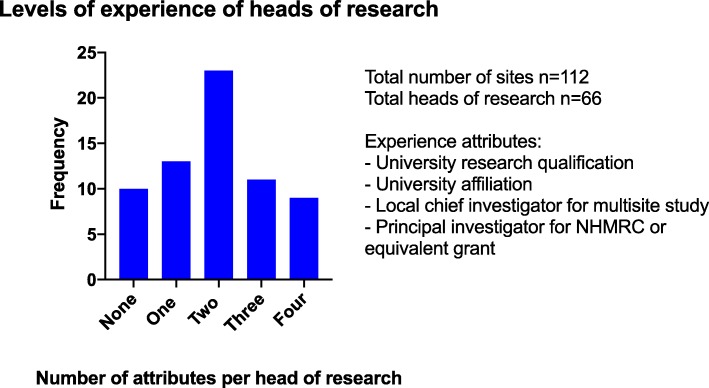
All EDs accredited for emergency medicine training in Australia and New Zealand were eligible to participate. Research leads or ED directors were invited via email and telephone to complete a survey. Data were collected regarding the presence of a research lead; their research experience; available research resources including colleagues, funding, departmental paid research time; publications; and research culture.
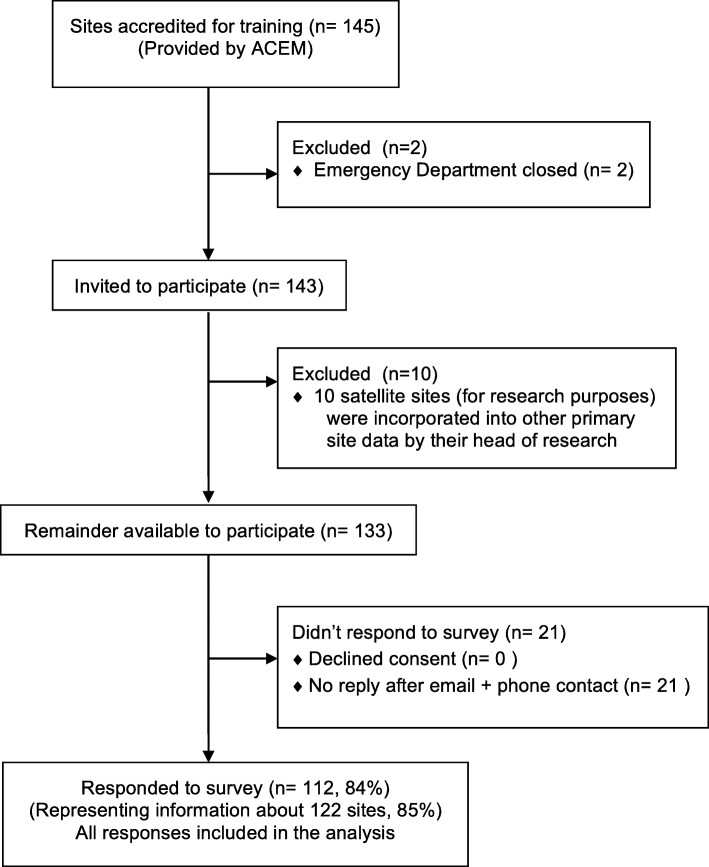
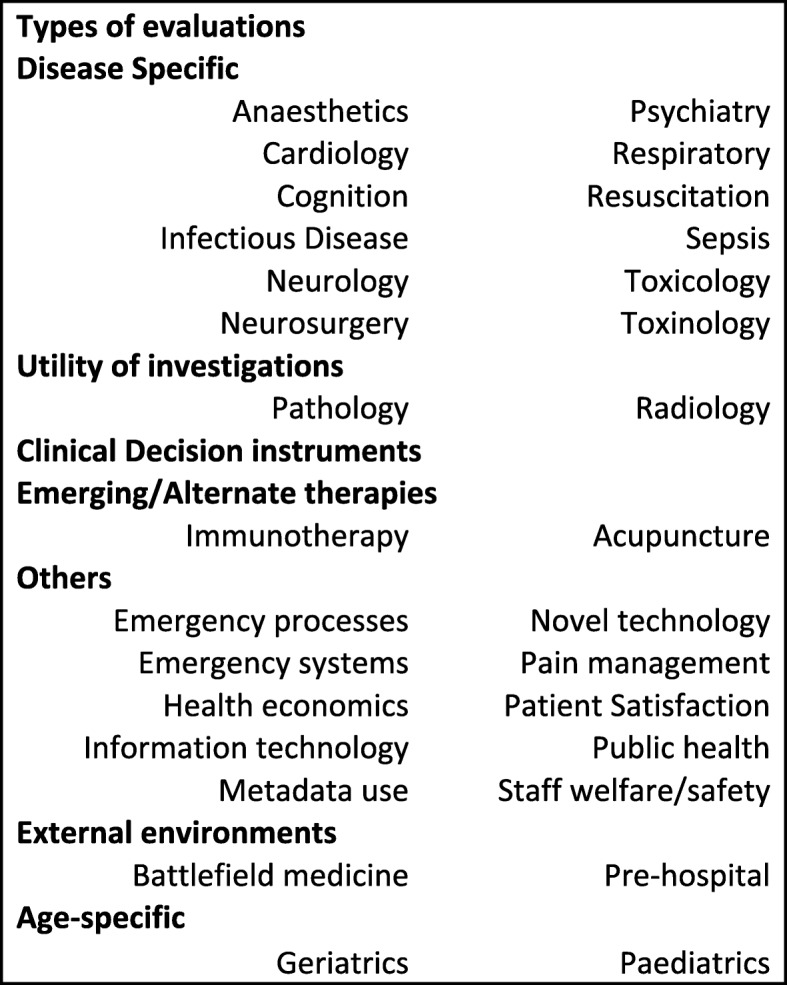
One hundred and twelve responses were received on behalf of 122 (84%) sites (10 satellite plus main) from a possible 143 sites with all types of hospitals and regions represented. Research leads were identified at 66 (59%) sites; 32 (29%) had a director of emergency medicine research. A wide range of research was underway. Ninety-six sites (66%) contributed data to multicentre projects. Twenty-one centres (17%) were highly productive with multiple resources (skilled colleagues, funding, staffing), a positive research culture and high-volume output. Sixty to seventy centres (50-58%) had limited resources, experienced an unsupportive research culture and authored manuscripts infrequently. Paid time for research directors was associated with increased research outputs.
ACEM sites have the capacity to undertake large multicentre studies with a varied network of sites and researchers. While some sites are well equipped for research, the majority of EDs had minimal research output.
急诊医学领域需要开展大型多中心研究,以推进临床护理并改善患者预后。澳大利亚急诊医学学院临床试验网络可供研究人员使用,以协助开展大型多中心研究。然而,目前尚无关于澳大利亚和新西兰急诊科研究能力的信息。
澳大利亚和新西兰所有获得急诊医学培训认证的急诊科均有资格参与。通过电子邮件和电话邀请研究负责人或急诊科主任完成一项调查。收集的数据包括是否有研究负责人;他们的研究经验;可用的研究资源,包括同事、资金、部门支付的研究时间;出版物;以及研究文化。
代表122个(84%)站点(10个卫星站点加主要站点)共收到112份回复,这些站点来自143个可能的站点,涵盖了所有类型的医院和地区。66个(59%)站点确定了研究负责人;32个(29%)设有急诊医学研究主任。正在进行广泛的研究。96个站点(66%)为多中心项目提供数据。21个中心(17%)生产力很高,拥有多种资源(技术熟练的同事、资金、人员配备)、积极的研究文化和大量的产出。60至70个中心(50 - 58%)资源有限,研究文化不支持,发表的手稿很少。研究主任的带薪时间与研究产出增加有关。
澳大利亚急诊医学学院的站点有能力通过多样化的站点和研究人员网络开展大型多中心研究。虽然一些站点具备良好的研究条件,但大多数急诊科的研究产出极少。