Cancer Care Ontario, Toronto, ON, Canada.
Canadian Centre for Applied Research in Cancer Control, Toronto, ON, Canada.
BMC Cancer. 2020 Apr 15;20(1):304. doi: 10.1186/s12885-020-06798-1.
For novel cancer treatments, effectiveness in clinical practice is not always aligned with clinical efficacy results. As such it is important to understand a treatment's real-world effectiveness. We examined real-world population-based comparative effectiveness of second-line ipilimumab versus non-ipilimumab treatments (chemotherapy or targeted treatments).
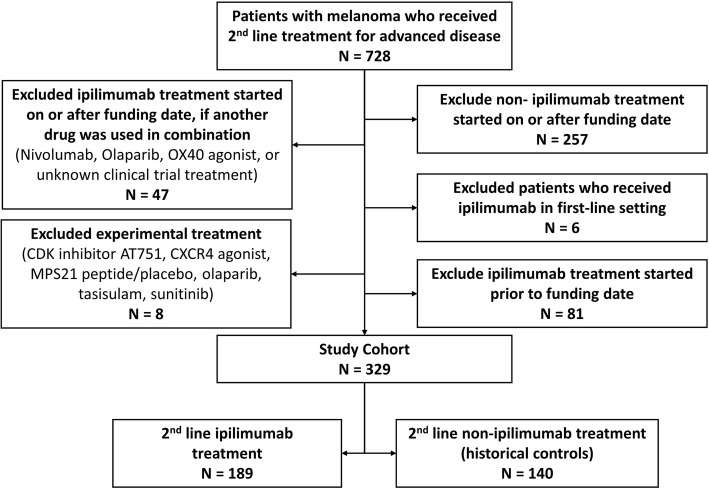
We used a cohort of melanoma patients receiving systemic treatment for advanced disease since April 2005 from Ontario, Canada. Patients were identified from provincial drug databases and the Ontario Cancer Registry who received second-line ipilimumab from 2012 to 2015 (treated) or second-line non-ipilimumab treatment prior to 2012 (historical controls). Historical controls were chosen, to permit the most direct comparison to pivotal trial findings. The cohort was linked to administrative databases to identify baseline characteristics and outcomes. Kaplan-Meier curves and multivariable Cox regression models were used to assess overall survival (OS). Observed potential confounders were adjusted for using inverse probability of treatment weighting (IPTW).
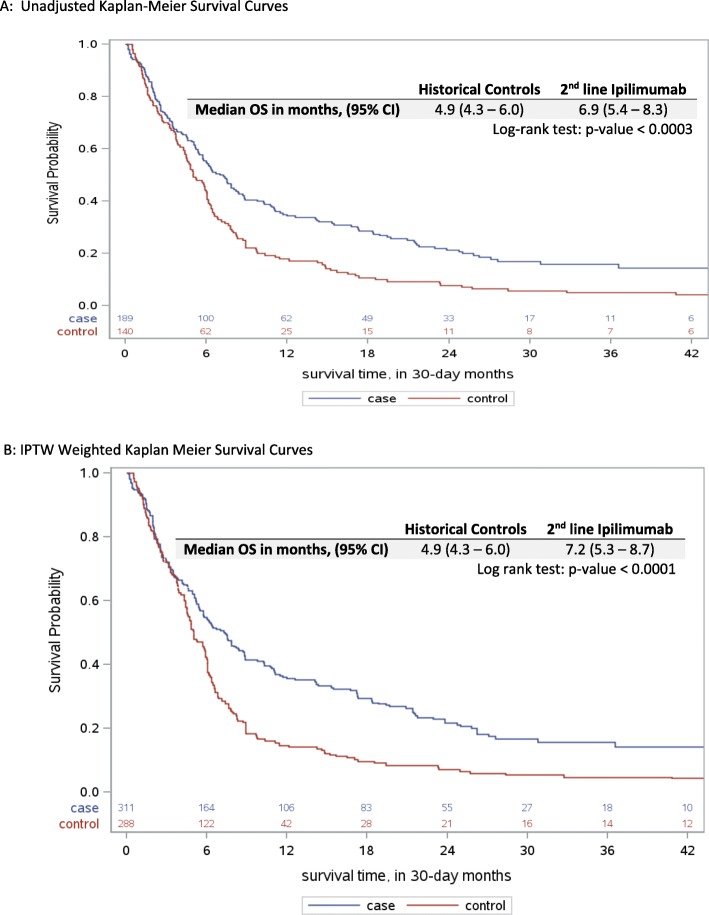
We identified 329 patients with metastatic melanoma (MM) who had received second-line treatments (189 treated; 140 controls). Patients receiving second-line ipilimumab were older (61.7 years vs 55.2 years) compared to historical controls. Median OS were 6.9 (95% CI: 5.4-8.3) and 4.95 (4.3-6.0) months for ipilimumab and controls, respectively. The crude 1-year, 2-year, and 3-year OS probabilities were 34.3% (27-41%), 20.6% (15-27%), and 15.2% (9.6-21%) for ipilimumab and 17.1% (11-23%), 7.1% (2.9-11%), and 4.7% (1.2-8.2%) for controls. Ipilimumab was associated with improved OS (IPTW HR = 0.62; 95% CI: 0.49-0.78; p < 0.0001).
This real-world analysis suggests second-line ipilimumab is associated with an improvement in OS for MM patients in routine practice.
对于新的癌症治疗方法,其在临床实践中的有效性并不总是与临床疗效结果一致。因此,了解治疗方法的实际效果非常重要。我们研究了二线伊匹单抗与非伊匹单抗治疗(化疗或靶向治疗)在真实人群中的比较疗效。
我们使用了 2005 年 4 月以来在加拿大安大略省接受晚期疾病系统治疗的黑色素瘤患者队列。患者从省级药物数据库和安大略癌症登记处中确定,他们在 2012 年至 2015 年期间接受二线伊匹单抗治疗(治疗组),或在 2012 年之前接受二线非伊匹单抗治疗(历史对照组)。选择历史对照组是为了使结果与关键试验发现进行最直接的比较。该队列与行政数据库相链接,以确定基线特征和结局。采用 Kaplan-Meier 曲线和多变量 Cox 回归模型评估总生存期(OS)。使用逆概率治疗加权(IPTW)调整潜在混杂因素。
我们确定了 329 名接受二线治疗的转移性黑色素瘤(MM)患者(治疗组 189 例,对照组 140 例)。接受二线伊匹单抗治疗的患者年龄较大(61.7 岁 vs 55.2 岁)。伊匹单抗和对照组的中位 OS 分别为 6.9(95%CI:5.4-8.3)和 4.95(4.3-6.0)个月。伊匹单抗的 1 年、2 年和 3 年 OS 率分别为 34.3%(27-41%)、20.6%(15-27%)和 15.2%(9.6-21%),对照组的分别为 17.1%(11-23%)、7.1%(2.9-11%)和 4.7%(1.2-8.2%)。伊匹单抗与 OS 改善相关(IPTW HR=0.62;95%CI:0.49-0.78;p<0.0001)。
这项真实世界分析表明,二线伊匹单抗治疗在常规实践中可改善 MM 患者的 OS。