Utunen Heini, Ndiaye Ngouille, Piroux Corentin, George Richelle, Attias Melissa, Gamhewage Gaya
Learning and Capacity Development Unit, World Health Organization Health Emergencies Programme, World Health Organization, Geneva, Switzerland.
J Med Internet Res. 2020 Apr 27;22(4):e19076. doi: 10.2196/19076.
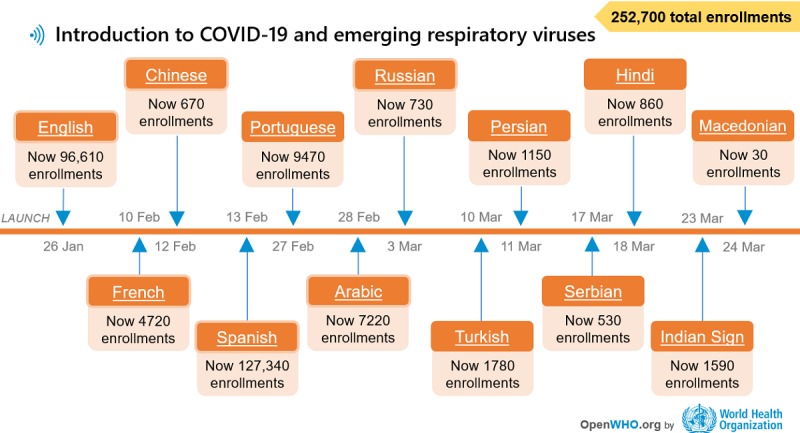
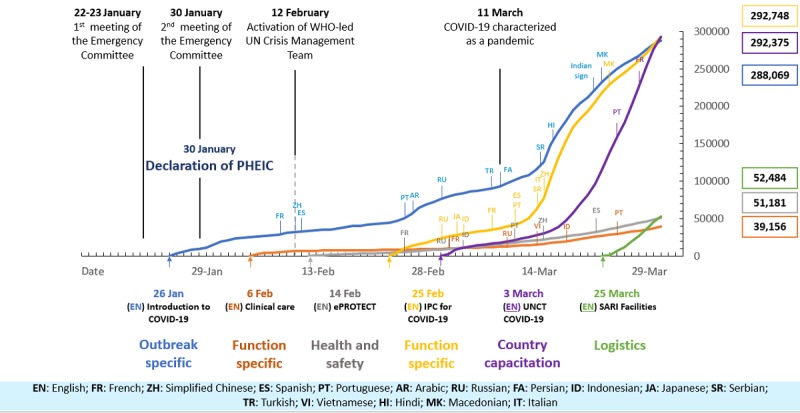
At the onset of the coronavirus outbreak, the World Health Organization's (WHO) Health Emergencies Learning and Capacity Development Unit, together with the WHO's health technical lead on coronaviruses, developed a massive open online course within 3 weeks as part of the global response to the emergency. The introductory coronavirus disease (COVID‑19) course was launched on January 26, 2020, on the health emergencies learning platform OpenWHO.org.
The aim of this paper is to investigate the geographic reach of different language courses accessed by a worldwide audience seeking information on COVID-19. Users' professional identities and backgrounds were explored to inform course owners on the use case. The course was developed and delivered via the open-access learning platform OpenWHO.org. The self-paced resources are available in a total of 13 languages and were produced between January 26 and March 25, 2020.
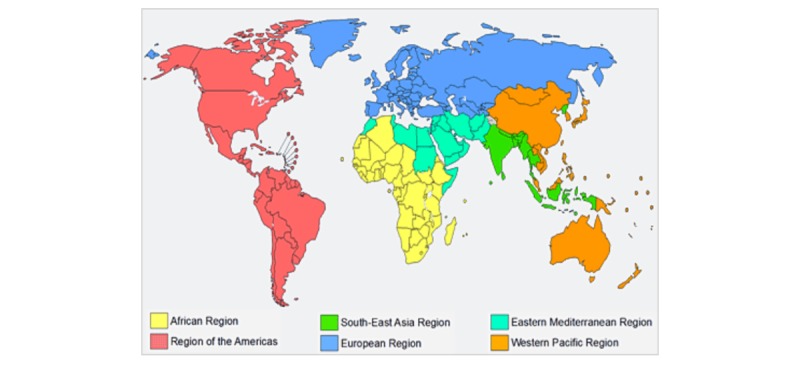
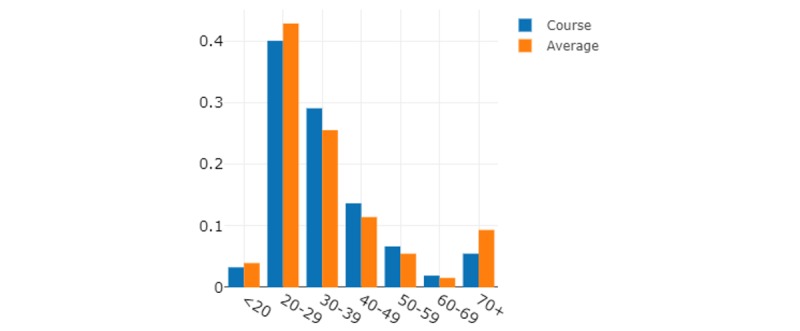
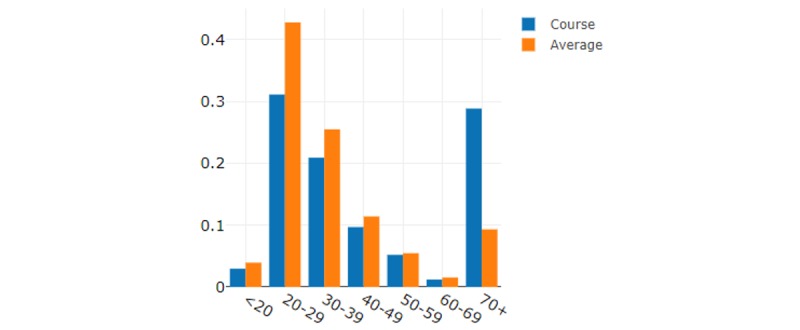
Data were collected from the online courses' statistical data and metrics reporting system on the OpenWHO platform. User patterns and locations were analyzed based on Google Analytics and the platform's own statistics capabilities, and data sets were overlaid. This analysis was conducted based on user location, with the data disaggregated according to the six WHO regions, the top 10 countries, and the proportion of use for each language version. Data included affiliation, gender, age, and other parameters for 32.43% (52,214/161,007) of the users who indicated their background.
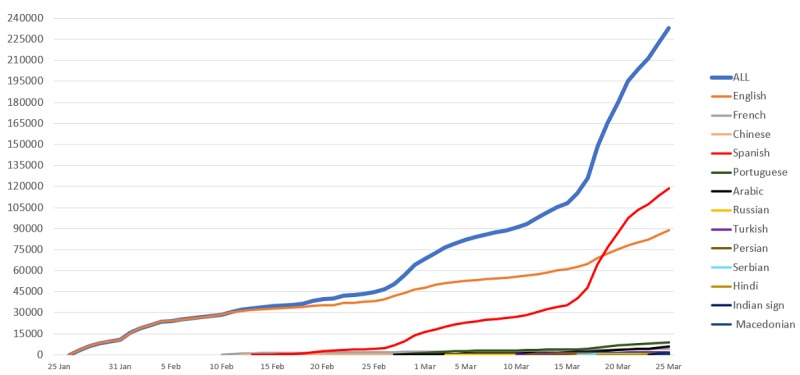
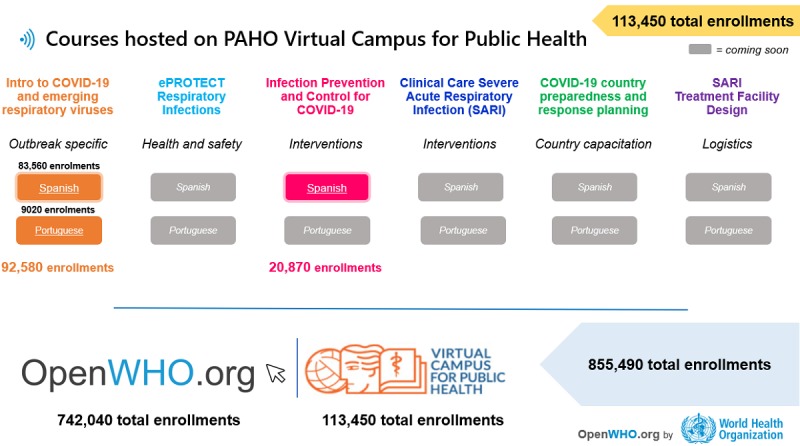
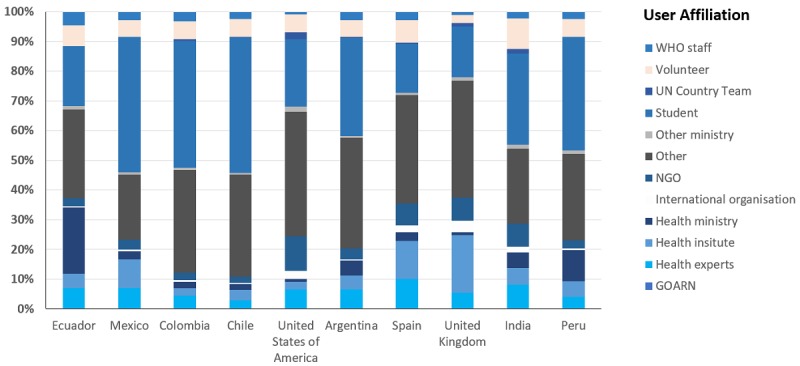
As of March 25, 2020, the introductory COVID-19 course totaled 232,890 enrollments across all languages. The Spanish language course was comprised of more than half (n=118,754, 50.99%) of all course enrollments, and the English language course was comprised of 38.21% (n=88,988) of enrollments. The WHO's Region of the Americas accounted for most of the course enrollments, with more than 72.47% (138,503/191,130) enrollment across all languages. Other regions were more evenly distributed with less than 10% enrollment for each. A total of 32.43% (52,214/161,007) of users specified a professional affiliation by choosing from the 12 most common backgrounds in the OpenWHO user profiles. Before the COVID-19 pandemic, users were spread over the 11 distinct affiliations, with a small fraction of users identifying themselves as "Other." With the COVID-19 introductory course, the largest number of users selected "Other" (16,527/52,214, 31.65%), suggesting a large number of users who were not health professionals or academics. The top 10 countries with the most users across all languages were Argentina, Chile, Colombia, Ecuador, India, Mexico, Peru, Spain, the United Kingdom, and the United States.
The online course has addressed a worldwide learning need by providing WHO's technical guidance packaged in simple formats for access and use. The learning material development was expedited to meet the onset of the epidemic. Initial data suggest that the various language versions of the course, in particular Spanish, have reached new user groups, fulfilling the platform's aim of providing learning everywhere to anyone that is interested. User surveys will be carried out to measure the real impact.
在冠状病毒疫情爆发之初,世界卫生组织(WHO)卫生应急学习与能力发展部门与WHO冠状病毒方面的卫生技术负责人合作,在3周内开发了一门大规模在线开放课程,作为全球应对该紧急情况的一部分。冠状病毒病(COVID-19)入门课程于2020年1月26日在卫生应急学习平台OpenWHO.org上推出。
本文旨在调查全球范围内寻求COVID-19信息的受众访问的不同语言课程的地理覆盖范围。探索用户的职业身份和背景,以便为课程所有者提供使用案例信息。该课程通过开放获取学习平台OpenWHO.org开发和提供。这些自主学习资源共有13种语言版本,于2020年1月26日至3月25日期间制作。
从OpenWHO平台上的在线课程统计数据和指标报告系统收集数据。基于谷歌分析和平台自身的统计功能分析用户模式和位置,并对数据集进行叠加。该分析基于用户位置进行,数据按WHO的六个区域、排名前十的国家以及每个语言版本的使用比例进行分类。数据包括32.43%(52,214/161,007)表明其背景的用户的所属机构、性别、年龄和其他参数。
截至2020年3月25日,COVID-19入门课程所有语言版本的注册人数总计232,890人。西班牙语课程占所有课程注册人数的一半以上(n = 118,754,50.99%),英语课程占注册人数的38.21%(n = 88,988)。WHO美洲区域占课程注册人数的大部分,所有语言版本的注册人数超过72.47%(138,503/191,130)。其他区域分布较为均匀,每个区域的注册人数均不到10%。共有32.43%(52,214/161,007)的用户通过从OpenWHO用户资料中12种最常见的背景中进行选择来指定职业所属机构。在COVID-19大流行之前,用户分布在11个不同的所属机构中,只有一小部分用户将自己标识为“其他”。在COVID-19入门课程中,选择“其他”的用户数量最多(16,527/52,214,31.65%),这表明有大量用户不是卫生专业人员或学者。所有语言版本中用户数量最多的前10个国家是阿根廷、智利、哥伦比亚、厄瓜多尔、印度、墨西哥、秘鲁、西班牙、英国和美国。
该在线课程通过以简单格式提供WHO的技术指南以供访问和使用,满足了全球范围的学习需求。学习材料的开发加快以应对疫情的爆发。初步数据表明,该课程的各种语言版本,特别是西班牙语版本,已覆盖新的用户群体,实现了该平台向任何感兴趣的人在任何地方提供学习资源的目标。将开展用户调查以衡量实际影响。