Department of Global Public Health, Karolinska Institutet, SE-171 77, Stockholm, Sweden.
Kisumu Medical Education Trust (KMET), Kisumu, Kenya.
BMC Public Health. 2020 Apr 15;20(1):493. doi: 10.1186/s12889-020-08578-9.
In Kenya, unsafe abortion is the leading cause of maternal deaths in adolescent girls aged 15-19 years, and a majority did not use a modern contraceptive before becoming pregnant. The aim of this study was to explore attitudes related to abortion and contraceptive use among secondary school teachers and student peer-counsellors in a low-resource setting in western Kenya.
A mixed methods design, combining a questionnaire-survey and focus group discussions (FGDs), was utilised to explore attitudes to abortion and contraceptive use among teachers (n = 15) and student peer-counsellors (n = 21) at a secondary school in Kisumu, Kenya. First, two Likert scale questionnaires were used: a modified version of the Stigmatising Attitudes, Beliefs and Actions (SABA) scale and the Contraceptive Use Stigma (CUS) scale. Secondly, four FGDs were conducted. Descriptive statistics and Abductive Thematic Network Analysis (ATNA) were used to analyse the data.
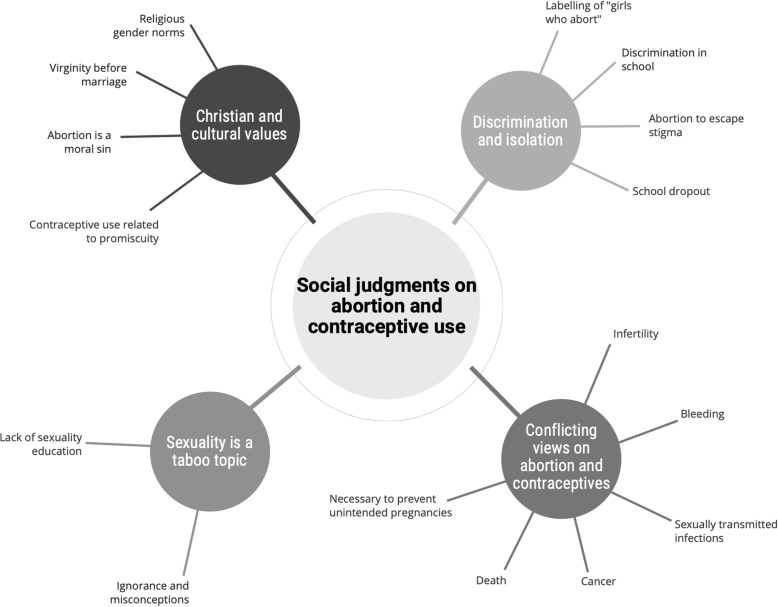
Overall, Social judgments on abortion and contraceptive use were found among teachers and student peer-counsellors, with similar patterns between sexes. Christian and cultural values; A majority, 28/36 considered abortion a sin, and chastity and purity before marriage were highly valued feminine ideals. Discrimination and isolation; 18/36 believed that a girl who has had an abortion might be a bad influence on other girls, and 13/35 stated that an adolescent girl cannot decide for herself if to use a contraceptive method. Conflicting views on abortion and contraceptives; A third (11/34) believed that contraceptives may cause infertility, and its use was related to promiscuity. Girls associated with abortion and contraceptive use were considered immoral, lacking parental guidance, and were used to represent bad examples in school. Although conflicting views were present, sexuality was considered a taboo topic, which left adolescents ignorant on contraceptive use.
Adolescent girls associated with abortion and contraceptive use are at risk for social judgements and discrimination, by both peers and teachers. Sexual and reproductive health training needs to be implemented in teacher education to increase knowledge on adolescent sexuality, abortion and contraceptive use to improve adolescents' sexual health and decrease the stigma.
This was a prestudy nested in a cluster randomised intervention study, registered on February 28, 2017, at ClinicalTrials.gov (NCT03065842).
在肯尼亚,不安全堕胎是导致 15-19 岁少女死亡的主要原因,且大多数少女在怀孕前没有使用现代避孕药具。本研究旨在探讨肯尼亚西部一所资源匮乏的中学教师和学生同伴辅导员对堕胎和避孕药具使用的态度。
采用问卷调查和焦点小组讨论(FGD)相结合的混合方法设计,探讨了基苏木一所中学教师(n=15)和学生同伴辅导员(n=21)对堕胎和避孕药具使用的态度。首先,使用了两份李克特量表问卷:一份是经过修改的污名化态度、信念和行为(SABA)量表,另一份是避孕药具使用污名(CUS)量表。其次,进行了 4 次 FGD。采用描述性统计和归纳主题网络分析(ATNA)对数据进行分析。
总的来说,教师和学生同伴辅导员对堕胎和避孕药具使用存在社会判断,性别之间存在相似模式。基督教和文化价值观;大多数(28/36)认为堕胎是一种罪过,婚前贞操和纯洁被视为高度女性化的理想。歧视和孤立;18/36 认为堕胎的女孩可能对其他女孩产生不良影响,13/35 表示少女不能自行决定是否使用避孕药具。对堕胎和避孕药具的看法存在冲突;三分之一(11/34)认为避孕药可能导致不孕,使用避孕药与滥交有关。与堕胎和避孕药具使用有关的女孩被认为不道德,缺乏父母指导,被用作学校的坏榜样。尽管存在冲突观点,但性仍然被视为禁忌话题,这使青少年对避孕药具使用一无所知。
与堕胎和避孕药具使用有关的少女面临来自同伴和教师的社会判断和歧视的风险。需要在教师教育中开展性与生殖健康培训,增加青少年对性、堕胎和避孕药具使用的了解,以改善青少年的性健康,减少污名化。
这是一项嵌套在集群随机干预研究中的预研究,于 2017 年 2 月 28 日在 ClinicalTrials.gov(NCT03065842)注册。