Department of Veterinary Medicine Virology Lab, College of Veterinary Medicine and Research Institute for Veterinary Science, Seoul National University DaeHakRo 1, GwanAk-Gu, Seoul, 151-742, Republic of Korea.
Department of Veterinary Microbiology and Infectious Diseases, Faculty of Veterinary Medicine, Vietnam National University of Agriculture, Hanoi, Vietnam.
BMC Vet Res. 2020 Apr 15;16(1):113. doi: 10.1186/s12917-020-02329-z.
with the advantage of sequencing technology, many novel porcine parvoviruses (PPV) rather than PPV1 has been reported. This study ultilized specific PCR- based method and gene- based analysis to study the presence and genetic diversity of porcine parvoviruses in South Korea in 2018.
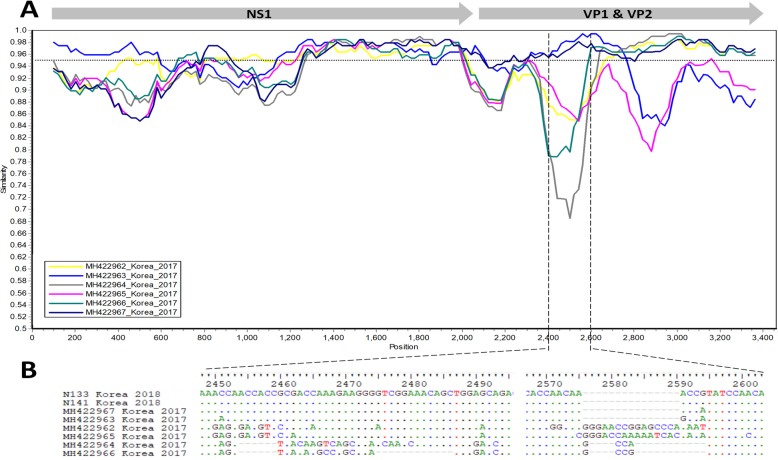
The present study was conducted in 2018 and found PPV1 and PPV7 in nine out of 151 field samples (organs and semen) by the PCR method. Among these, the complete genome sequences of five strains (N2, N91, N108, N133, and N141) were recovered. Phylogenic analysis revealed that the strains N2, N91, and N108 belong to the PPV1 genotype, while N133 and N141 belong to PPV7 genotype. The PPV7 strains collected in this study had deletion mutations in the VP2 gene but differed from that of PPV7 strains collected in 2017. Among the PPV1 strains, the amino acid variations in the B cell epitopes of the VP2 protein were observed between three Korean PPV1 field strains (N2, N91, and N108) and the reference PPV1 strains. Those substitutions resulted in six out of 12 predicted epitopes having significant differences in antigenic index compared to the other PPV1 strains.
This study confirmed the presence of different genotypes of porcine parvoviruses in South Korea. The PPVs circulating in South Korea were phylogenetically classified as PPV1 and PPV7 genotypes. Three Korean PPV1 strains collected in 2018 were predicted to have antigenic alteration in VP2 compared to several reference strains of PPV1.
随着测序技术的优势,已经报道了许多新型猪细小病毒(PPV)而不是 PPV1。本研究利用基于特定 PCR 的方法和基因分析,于 2018 年研究了韩国猪细小病毒的存在和遗传多样性。
本研究于 2018 年进行,通过 PCR 方法从 151 个现场样本(器官和精液)中发现了 9 个 PPV1 和 PPV7。其中,回收了 5 株(N2、N91、N108、N133 和 N141)的完整基因组序列。系统进化分析表明,N2、N91 和 N108 株属于 PPV1 基因型,而 N133 和 N141 株属于 PPV7 基因型。本研究中收集的 PPV7 株在 VP2 基因中发生缺失突变,但与 2017 年收集的 PPV7 株不同。在 PPV1 株中,N2、N91 和 N108 这三种韩国 PPV1 田间分离株与参考 PPV1 株的 VP2 蛋白 B 细胞表位的氨基酸变异。这些取代导致 12 个预测表位中的 6 个在抗原指数上与其他 PPV1 株有显著差异。
本研究证实了韩国存在不同基因型的猪细小病毒。在韩国循环的 PPVs 被系统进化分类为 PPV1 和 PPV7 基因型。2018 年收集的三种韩国 PPV1 株与几种参考 PPV1 株相比,VP2 预测具有抗原改变。