Discipline of Health Promotion, School of Health Sciences, National University of Ireland Galway, University Road, Galway, Ireland.
School of Public Health, University College Cork, College Road, Cork, Ireland.
Int J Behav Nutr Phys Act. 2020 Apr 15;17(1):48. doi: 10.1186/s12966-020-00948-1.
Eating outside the home contributes to poor dietary habits worldwide and is associated with increased body fat and weight gain. Evidence shows menu labelling is effective in promoting healthier food choices; however, implementation issues have arisen. The purpose of this systematic review was to synthesise the evidence on the perceived barriers and facilitators to implementation of menu labelling interventions from the perspective of the food service industry.
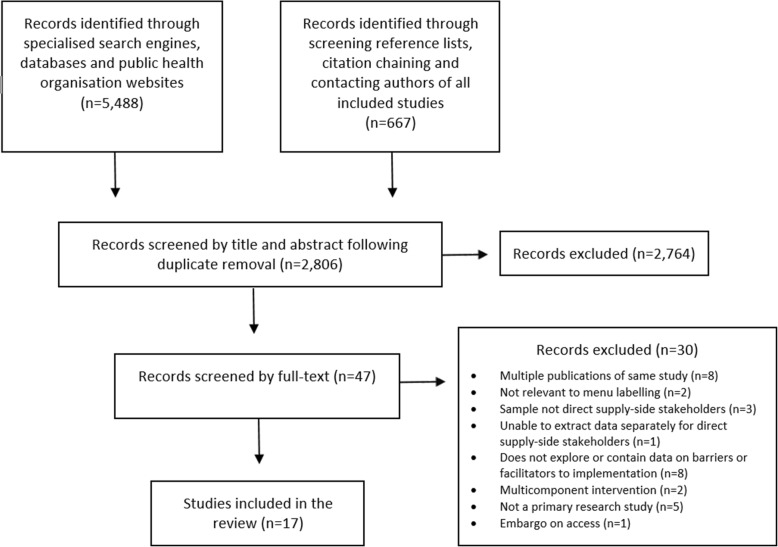
Peer-reviewed and grey literature were searched using databases, specialised search engines and public health organisation websites. Screening reference lists, citation chaining and contacting authors of all included studies were undertaken. Primary research studies relevant to direct supply-side stakeholders were eligible for inclusion. There were no restrictions on menu labelling scheme or format, study methods, publication year or language. At least two independent reviewers performed study selection, data extraction and quality appraisal. The results were synthesised using the 'best fit' framework synthesis approach, with reference to the Consolidated Framework for Implementation Research (CFIR).
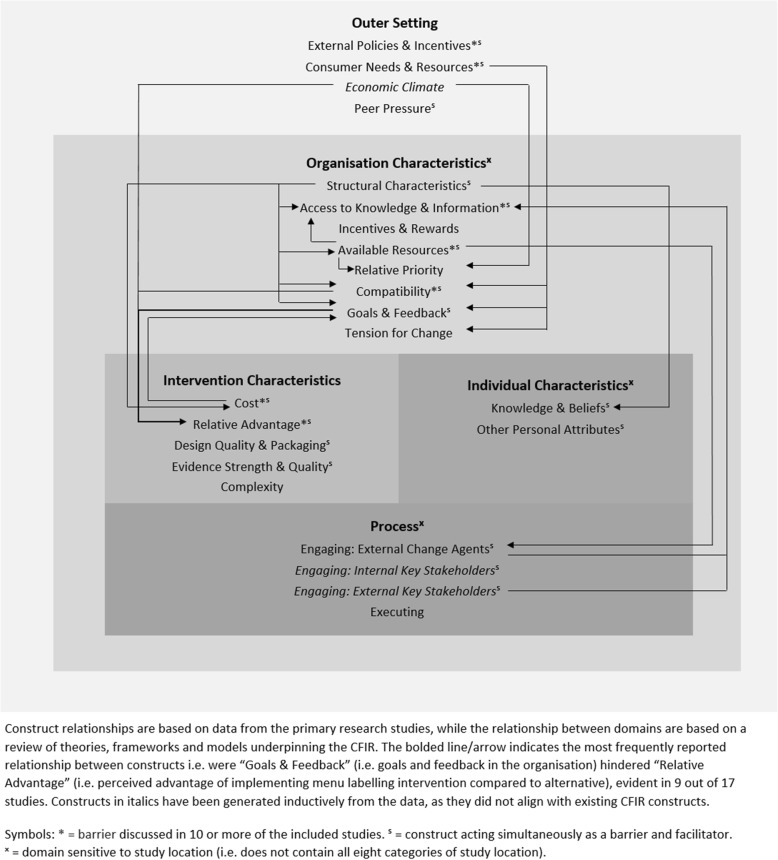
Seventeen studies met the eligibility criteria, with the majority rated as average quality (n = 10). The most frequently cited barriers were coded to the CFIR constructs 'Consumer Needs & Resources' (e.g. lack of customer demand for/interest in menu labelling, risk of overwhelmed/confused customers) and 'Compatibility' with organisation work processes (e.g. lack of standardised recipes, limited space on menus). Frequently cited facilitators were coded to the CFIR constructs 'Relative Advantage' of menu labelling (e.g. improved business image/reputation) and 'Consumer Needs & Resources' (e.g. customer demand for/interest in menu labelling, providing nutrition information to customers). An adapted framework consisting of a priori and new constructs was developed, which illustrates the relationships between domains.
This review generates an adapted CFIR framework for understanding implementation of menu labelling interventions. It highlights that implementation is influenced by multiple interdependent factors, particularly related to the external and internal context of food businesses, and features of the menu labelling intervention. The findings can be used by researchers and practitioners to develop or select strategies to address barriers that impede implementation and to leverage facilitators that assist with implementation effort.
Systematic review registration: PROSPERO CRD42017083306.
外出就餐会导致全球不良饮食习惯,并与体脂增加和体重增加有关。有证据表明,菜单标签在促进更健康的食物选择方面是有效的;然而,实施过程中出现了一些问题。本系统评价的目的是综合食品服务行业对菜单标签干预实施的感知障碍和促进因素的证据。
使用数据库、专业搜索引擎和公共卫生组织网站搜索同行评审和灰色文献。对所有纳入研究的参考文献进行筛选、引用链接和联系作者。符合直接供应方利益相关者的主要研究均符合纳入标准。菜单标签计划或格式、研究方法、出版年份或语言不受限制。至少有两名独立评审员进行了研究选择、数据提取和质量评估。结果使用“最佳契合”框架综合方法,参考综合实施研究框架(CFIR)进行综合。
17 项研究符合入选标准,其中大多数研究质量评价为中等(n=10)。引用最多的障碍被编码为 CFIR 结构“消费者需求和资源”(例如,消费者对菜单标签缺乏需求/兴趣,顾客有被淹没/困惑的风险)和“与组织工作流程的兼容性”(例如,缺乏标准化的食谱,菜单上的空间有限)。经常提到的促进因素被编码为 CFIR 结构“菜单标签的相对优势”(例如,改善业务形象/声誉)和“消费者需求和资源”(例如,顾客对菜单标签的需求/兴趣,向顾客提供营养信息)。制定了一个由预设和新结构组成的改编框架,该框架说明了各个领域之间的关系。
本综述生成了一个用于理解菜单标签干预实施的改编 CFIR 框架。它强调实施受到多个相互依存因素的影响,特别是与食品企业的外部和内部环境以及菜单标签干预措施的特点有关。研究人员和从业者可以利用这些发现来制定或选择策略,以解决阻碍实施的障碍,并利用有助于实施工作的促进因素。
系统评价注册:PROSPERO CRD42017083306。