Department of Pharmacology, National University of Singapore, Singapore, Singapore.
Centre for Sleep and Cognition, Department of Medicine, Yong Loo Lin School of Medicine, National University of Singapore, Singapore, Singapore.
Sci Rep. 2020 Apr 15;10(1):6457. doi: 10.1038/s41598-020-63540-4.
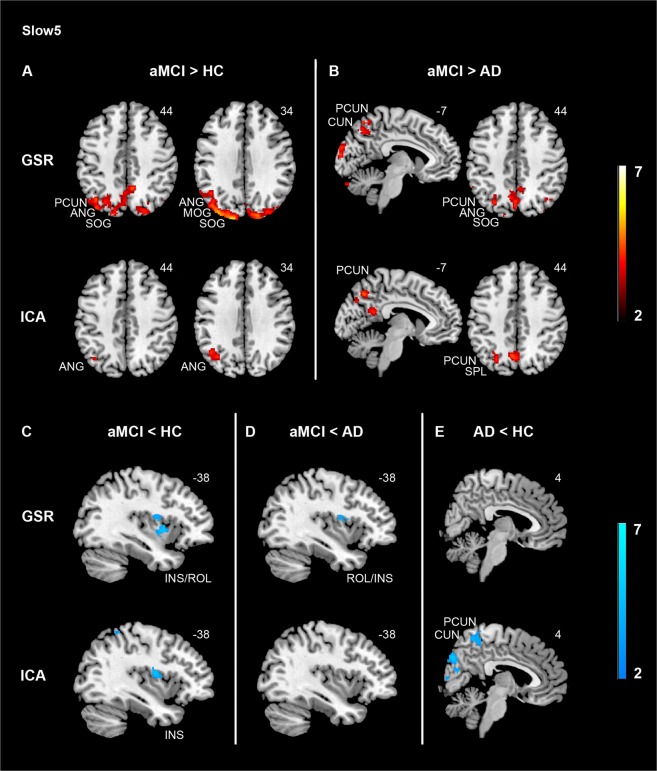
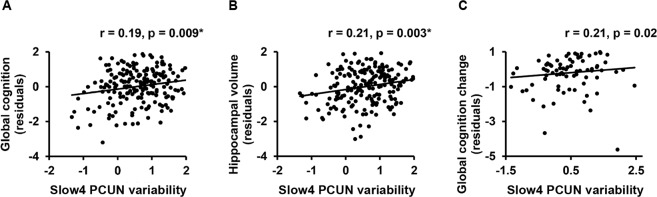
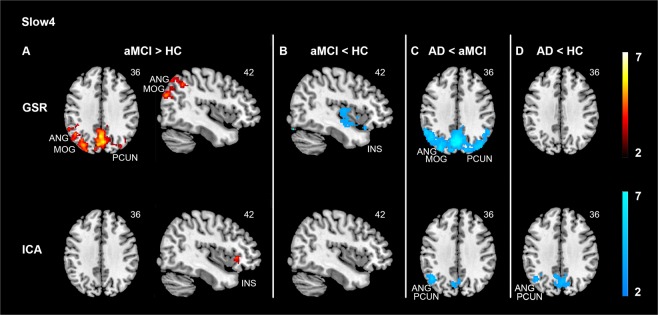
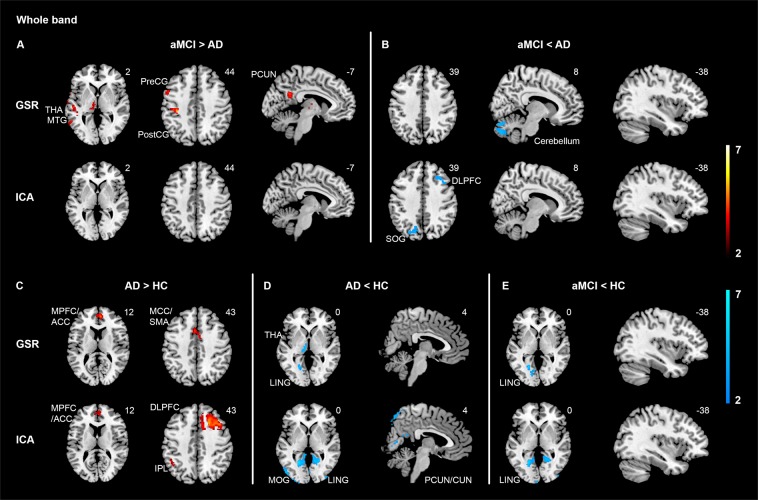
Optimal levels of intrinsic Blood-Oxygenation-Level-Dependent (BOLD) signal variability (variability hereafter) are important for normative brain functioning. However, it remains largely unknown how network-specific and frequency-specific variability changes along the Alzheimer's disease (AD) spectrum and relates to cognitive decline. We hypothesized that cognitive impairment was related to distinct BOLD variability alterations in two brain networks with reciprocal relationship, i.e., the AD-specific default mode network (DMN) and the salience network (SN). We examined variability of resting-state fMRI data at two characteristic slow frequency-bands of slow4 (0.027-0.073 Hz) and slow5 (0.01-0.027 Hz) in 96 AD, 98 amnestic mild cognitive impairment (aMCI), and 48 age-matched healthy controls (HC) using two commonly used pre-processing pipelines. Cognition was measured with a neuropsychological assessment battery. Using both global signal regression (GSR) and independent component analysis (ICA), results generally showed a reciprocal DMN-SN variability balance in aMCI (vs. AD and/or HC), although there were distinct frequency-specific variability patterns in association with different pre-processing approaches. Importantly, lower slow4 posterior-DMN variability correlated with poorer baseline cognition/smaller hippocampus and predicted faster cognitive decline in all patients using both GSR and ICA. Altogether, our findings suggest that reciprocal DMN-SN variability balance in aMCI might represent an early signature in neurodegeneration and cognitive decline along the AD spectrum.
内在血氧水平依赖(BOLD)信号变异性(以下简称变异性)的最佳水平对于正常的大脑功能很重要。然而,网络特异性和频率特异性变异性如何沿着阿尔茨海默病(AD)谱变化,以及与认知能力下降的关系,在很大程度上仍然未知。我们假设认知障碍与两个具有相互关系的大脑网络中的 BOLD 变异性改变有关,即 AD 特异性默认模式网络(DMN)和突显网络(SN)。我们使用两种常用的预处理管道,在 96 名 AD、98 名遗忘型轻度认知障碍(aMCI)和 48 名年龄匹配的健康对照(HC)中,检查了静息状态 fMRI 数据在两个特征慢频带中的变异性:slow4(0.027-0.073 Hz)和 slow5(0.01-0.027 Hz)。认知能力通过神经心理学评估量表进行测量。使用全局信号回归(GSR)和独立成分分析(ICA),结果通常表明 aMCI 中 DMN-SN 变异性平衡存在相互关系(与 AD 和/或 HC 相比),尽管与不同的预处理方法有关,存在明显的频率特异性变异性模式。重要的是,slow4 后 DMN 变异性降低与基线认知能力较差/海马体较小相关,并且使用 GSR 和 ICA 都可以预测所有患者认知能力下降更快。总的来说,我们的发现表明,aMCI 中相互关系的 DMN-SN 变异性平衡可能代表 AD 谱中神经退行性变和认知能力下降的早期特征。