Department of Urology, Korea University College of Medicine, Seoul, Republic of Korea.
Department of Biostatistics, College of Medicine, The Catholic University of Korea, Seoul, Republic of Korea.
Sci Rep. 2020 Apr 15;10(1):6476. doi: 10.1038/s41598-020-63595-3.
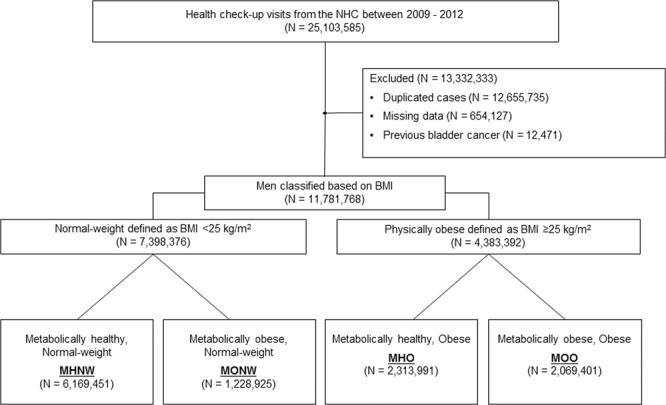
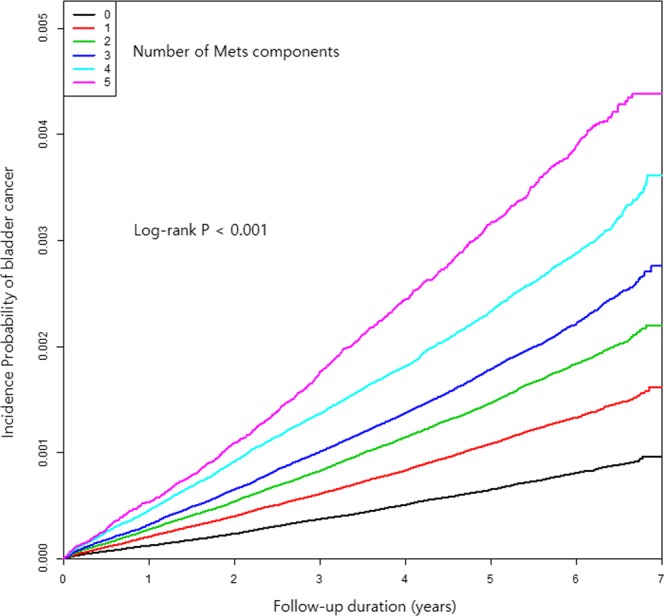
We assessed the association between metabolic health status and the incidence of bladder cancer using nationally representative data from the National Health Insurance System and National Health Checkups (NHC) databases in South Korea. Data for 11,781,768 men who participated in the NHC between 2009 and 2012 were analysed. The normal-weight and physically obese categories were defined as body mass indexes (BMI) < 25 and ≥25 kg/m, respectively. Metabolically obese was defined as the presence of ≥3 components of metabolic syndrome. The participants were stratified into metabolically healthy, normal-weight (MHNW); metabolically obese, normal-weight (MONW); metabolically healthy, obese (MHO); metabolically obese, obese (MOO). Multivariate-adjusted Cox regression analysis was conducted to examine the association between metabolic health status and the incidence of bladder cancer. The study participants included 17,777 men newly registered with bladder cancer. Analysis according to metabolic health status classification revealed a higher multivariable-adjusted hazard ratio in the MOO, MONW group than in the MHO group (1.307 [95% CI: 1.258-1.358], 1.183 [95% CI: 1.137-1.231] and 1.066 [95% CI: 1.017-1.119], respectively; hazard ratios given relative to MHNW group) We found an association between metabolic health status and the incidence of bladder cancer, with an increasing risk according to the number of metabolic health status components.
我们利用韩国国家健康保险系统和国民健康检查数据库中的全国代表性数据,评估了代谢健康状况与膀胱癌发病之间的关系。对 2009 年至 2012 年间参加国民健康检查的 11781768 名男性进行了数据分析。正常体重和肥胖的定义分别为体质指数(BMI)<25kg/m²和≥25kg/m²。代谢性肥胖定义为存在≥3 项代谢综合征成分。参与者被分为代谢健康且体重正常(MHNW)、代谢性肥胖且体重正常(MONW)、代谢健康且肥胖(MHO)、代谢性肥胖且肥胖(MOO)。采用多变量调整的 Cox 回归分析来研究代谢健康状况与膀胱癌发病之间的关系。研究参与者包括 17777 名新确诊膀胱癌的男性。根据代谢健康状况分类的分析显示,MOO 和 MONW 组的多变量调整后的危险比高于 MHO 组(1.307[95%CI:1.258-1.358]、1.183[95%CI:1.137-1.231]和 1.066[95%CI:1.017-1.119];与 MHNW 组相比,危险比分别为 1.307[95%CI:1.258-1.358]、1.183[95%CI:1.137-1.231]和 1.066[95%CI:1.017-1.119])。我们发现代谢健康状况与膀胱癌发病之间存在关联,随着代谢健康状况成分的数量增加,风险也随之增加。