Li Xiaotong, Su Hang, Zhong Na, Chen Tianzhen, Du Jiang, Xiao Ke, Xu Ding, Song Weidong, Jiang Haifeng, Zhao Min
Shanghai Mental Health Center, Shanghai Jiao Tong University School of Medicine, Shanghai, China.
Department of Physiological Rehabilitation, Shanghai Drug Rehabilitation Administration Bureau, Shanghai, China.
Front Psychiatry. 2020 Mar 31;11:191. doi: 10.3389/fpsyt.2020.00191. eCollection 2020.
Structural and functional alterations in the cerebellum have been consistently reported in addiction literatures. However, evidence implicating the resting-state cerebellar-cerebral functional connectivity in methamphetamine (MA) use disorder still remains limited.
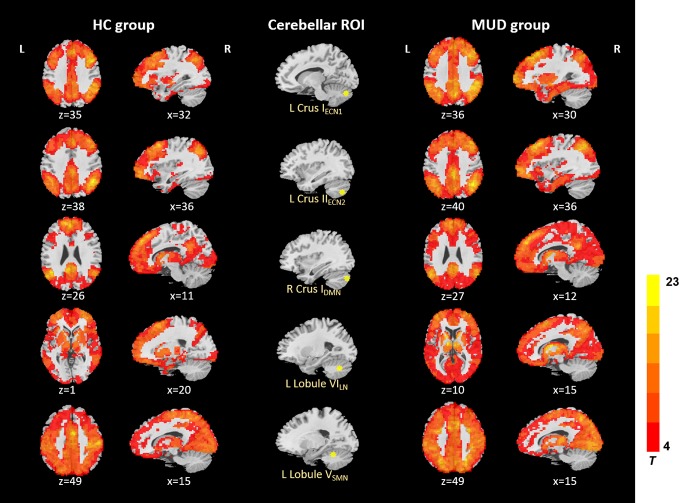
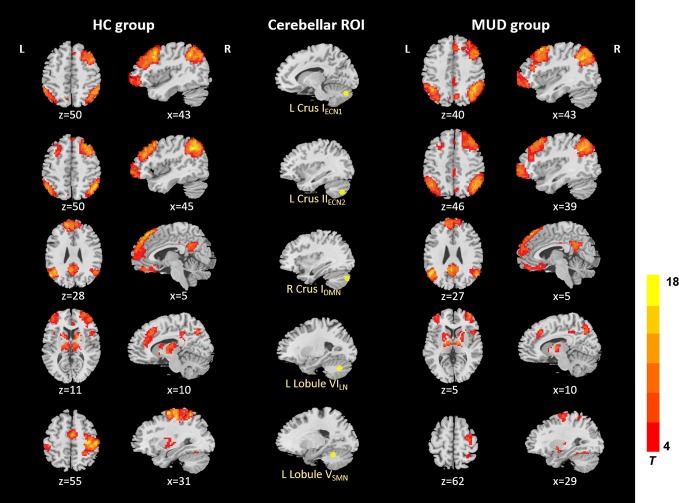
Resting-state functional magnetic resonance imaging (fMRI) scans were obtained from 34 MA dependent individuals with about six months abstinence and 31 healthy controls (well matched for age, gender and education) in this study. Seed-based functional connectivity analysis was employed to investigate the differences in cerebellar-cerebral functional connectivity between two groups. The correlations between significant functional connectivity and each clinical characteristic were also explored.
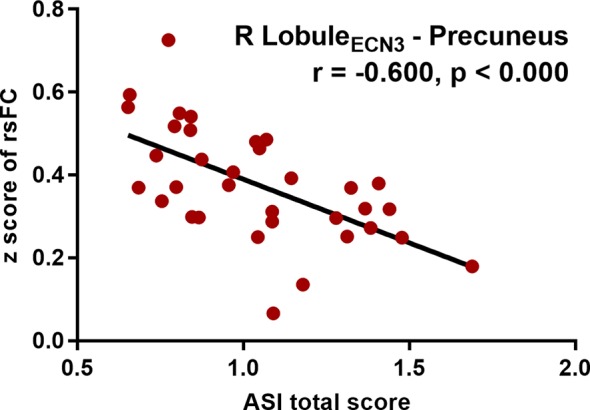
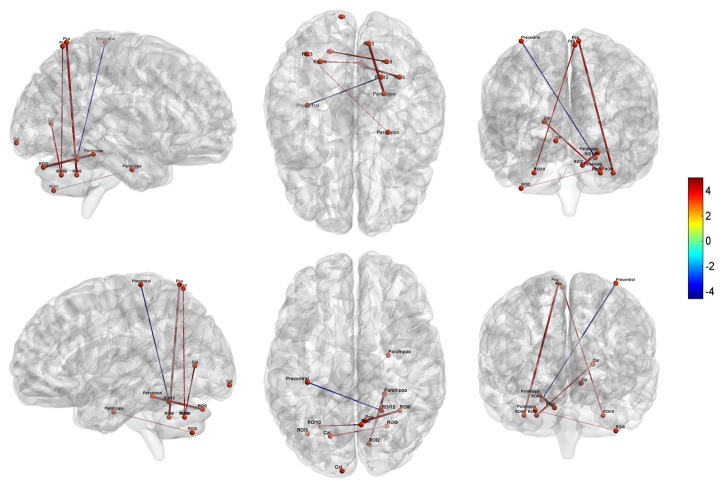
Compared to healthy controls, MA dependent individuals showed disrupted functional connectivity between the cerebellum and several cerebral functional networks, including the default-mode, affective-limbic, and sensorimotor networks. Within the MA group, functional connectivity of the right cerebellar lobule VI-precuneus coupling was negatively correlated with addiction severity.
The present study suggests that cerebellar dysfunction, in particular aberrant cerebellar-cerebral functional connectivity, might involve in neurobiological mechanism of MA dependence, which supply a potential target for therapeutic interventions in the future.
成瘾文献中一直报道了小脑的结构和功能改变。然而,关于静息态小脑-大脑功能连接与甲基苯丙胺(MA)使用障碍之间关系的证据仍然有限。
本研究对34名戒断约6个月的MA依赖个体和31名健康对照者(年龄、性别和教育程度匹配良好)进行了静息态功能磁共振成像(fMRI)扫描。采用基于种子点的功能连接分析来研究两组之间小脑-大脑功能连接的差异。还探讨了显著功能连接与各临床特征之间的相关性。
与健康对照者相比,MA依赖个体在小脑与几个大脑功能网络(包括默认模式、情感边缘和感觉运动网络)之间的功能连接中断。在MA组内,右侧小脑小叶VI-楔前叶耦合的功能连接与成瘾严重程度呈负相关。
本研究表明,小脑功能障碍,特别是异常的小脑-大脑功能连接,可能参与了MA依赖的神经生物学机制,这为未来的治疗干预提供了一个潜在靶点。