Yoo Dong Mi, Cho A Ra, Kim Sun
Department of Medical Education, College of Medicine, The Catholic University of Korea, Seoul, Korea.
J Educ Eval Health Prof. 2019;16:38. doi: 10.3352/jeehp.2019.16.38. Epub 2019 Dec 11.
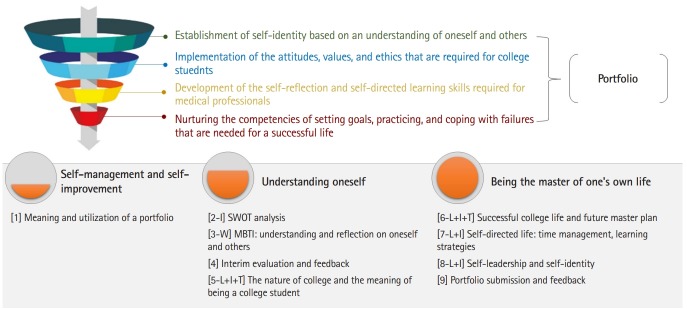
We have developed and operated a portfolio-based course aimed at strengthening pre-medical students' capabilities for self-management and self-improvement. In order to determine the effectiveness of the course and to establish future operational strategies, we evaluated the course and the students' learning experience.
The subjects of this study were 97 students of a pre-medical course "Self-development and portfolio I" in 2019. Their learning experience was evaluated through the professor's assessment of portfolios they had submitted, and the program was evaluated based on the responses of 68 students who completed a survey. The survey questionnaire included 32 items. Descriptive statistics were reported for quantitative data, including the mean and standard deviation. Opinions collected from the open-ended question were grouped into categories.
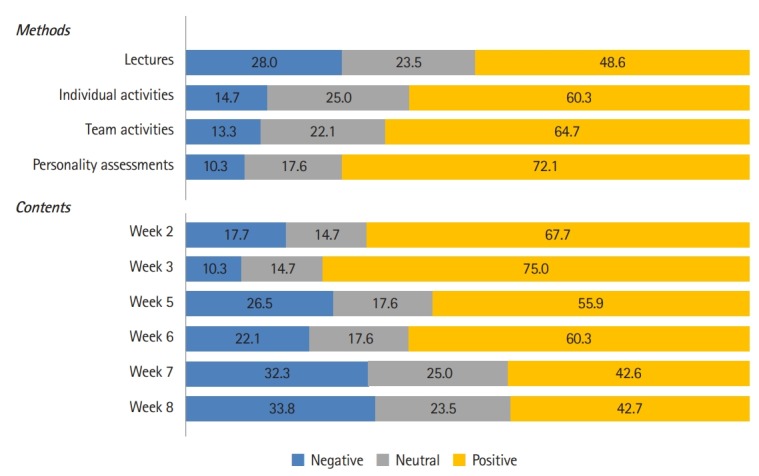
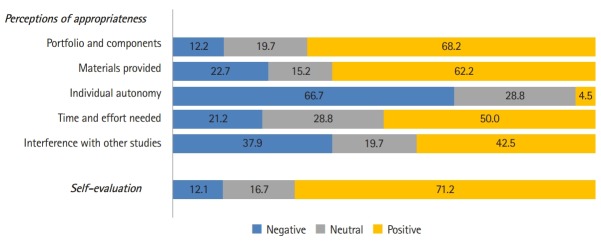
The evaluation of students' portfolios showed that only 6.2% of the students' portfolios were well-organized, with specific goals, strategies, processes, and self-reflections, while most lacked the basic components of a portfolio (46.4%) or contained insufficient content (47.4%). Students' responses to the survey showed that regular portfolio personality assessments (72.1%), team (64.7%), and individual (60.3%) activities were felt to be more appropriate as educational methods for this course, rather than lectures. Turning to the portfolio creation experience, the forms and components of the portfolios (68.2%) and the materials provided (62.2%) were felt to be appropriate. However, students felt that individual autonomy needed to be reflected more (66.7%) and that this course interfered with other studies (42.5%).
The findings of this study suggest that standardized samples, guidelines, and sufficient time for autonomous portfolio creation should be provided. In addition, education on portfolio utilization should be conducted in small groups in the future.
我们开发并运营了一门基于作品集的课程,旨在增强医学预科学生的自我管理和自我提升能力。为了确定该课程的有效性并制定未来的运营策略,我们对该课程及学生的学习体验进行了评估。
本研究的对象是2019年医学预科课程“自我发展与作品集I”的97名学生。通过教授对他们提交的作品集的评估来评价他们的学习体验,并根据68名完成调查的学生的回答对该课程进行评估。调查问卷包括32个项目。对定量数据报告描述性统计,包括均值和标准差。从开放式问题收集的意见被归类。
对学生作品集的评估表明,只有6.2%的学生作品集组织良好,有具体目标、策略、过程和自我反思,而大多数作品集缺乏作品集的基本组成部分(46.4%)或内容不足(47.4%)。学生对调查的回答表明,定期的作品集个性评估(72.1%)、团队(64.7%)和个人(60.3%)活动被认为比讲座更适合作为本课程的教育方法。谈到作品集创作体验,作品集的形式和组成部分(68.2%)以及提供的材料(62.2%)被认为是合适的。然而,学生们认为个人自主性需要更多体现(66.7%),并且该课程干扰了其他学习(42.5%)。
本研究结果表明,应提供标准化样本、指导方针和足够的自主创作作品集时间。此外,未来应分组进行作品集利用方面的教育。