Al-Azri Nasser Hammad
Emergency Department, Ibri Hospital, Ministry of Health, POB 134, 516 Akhdar, Ibri, Oman.
Int J Emerg Med. 2020 Apr 16;13(1):17. doi: 10.1186/s12245-020-00274-0.
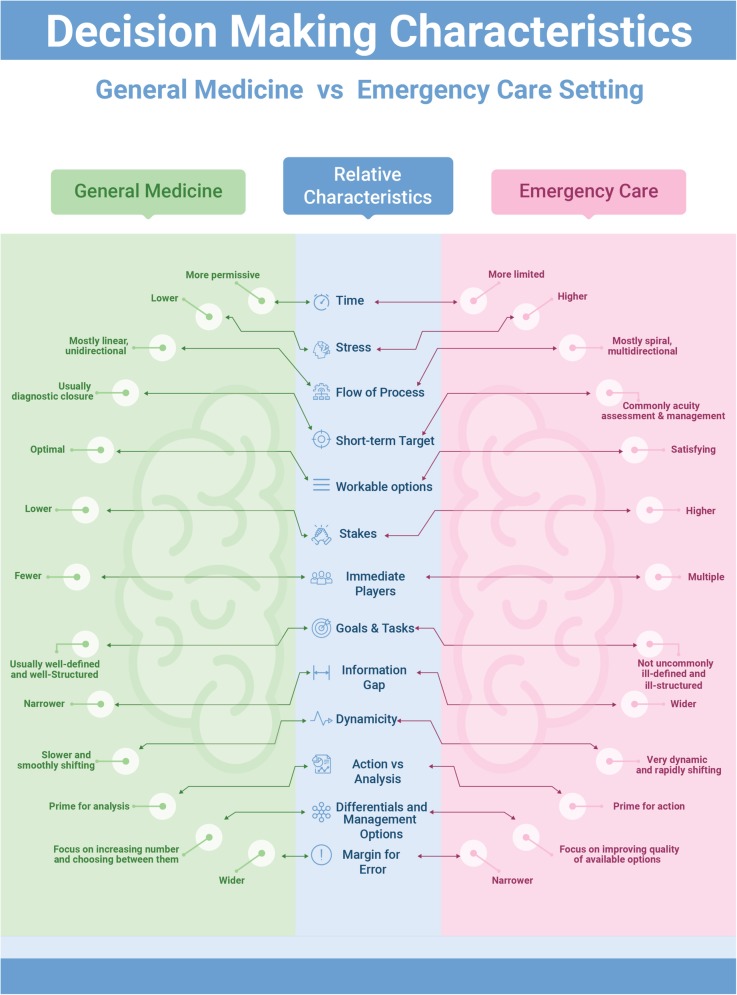
General medicine commonly adopts a strategy based on the analytic approach utilizing the hypothetico-deductive method. Medical emergency care and education have been following similarly the same approach. However, the unique milieu and task complexity in emergency care settings pose a challenge to the analytic approach, particularly when confronted with a critically ill patient who requires immediate action. Despite having discussions in the literature addressing the unique characteristics of medical emergency care settings, there has been hardly any alternative structured mental model proposed to overcome those challenges.
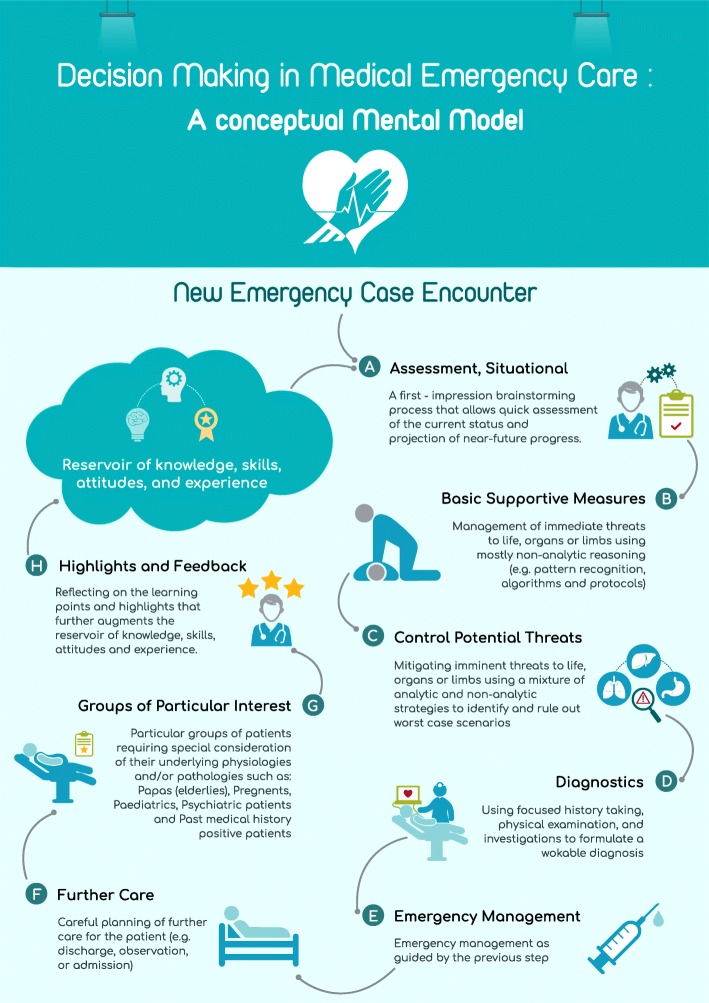
This paper attempts to address a conceptual mental model for emergency care that combines both analytic as well as non-analytic methods in decision making.
The proposed model is organized in an alphabetical mnemonic, A-H. The proposed model includes eight steps for approaching emergency cases, viz., awareness, basic supportive measures, control of potential threats, diagnostics, emergency care, follow-up, groups of particular interest, and highlights. These steps might be utilized to organize and prioritize the management of emergency patients.
Metacognition is very important to develop practicable mental models in practice. The proposed model is flexible and takes into consideration the dynamicity of emergency cases. It also combines both analytic and non-analytic skills in medical education and practice.
Combining various clinical reasoning provides better opportunity, particularly for trainees and novices, to develop their experience and learn new skills. This mental model could be also of help for seasoned practitioners in their teaching, audits, and review of emergency cases.
普通医学通常采用基于分析方法的策略,运用假设演绎法。医疗急救护理和教育也一直遵循类似的方法。然而,急救护理环境的独特环境和任务复杂性对分析方法构成了挑战,尤其是在面对需要立即采取行动的重症患者时。尽管文献中已有关于医疗急救护理环境独特特征的讨论,但几乎没有提出任何替代的结构化思维模型来克服这些挑战。
本文试图提出一种用于急救护理的概念性思维模型,该模型在决策过程中结合了分析方法和非分析方法。
所提出的模型以字母A-H的助记法进行组织。该模型包括处理紧急情况的八个步骤,即意识、基本支持措施、控制潜在威胁、诊断、急救护理、随访、特殊关注群体和重点。这些步骤可用于组织和确定对急诊患者的管理优先级。
元认知对于在实践中开发可行的思维模型非常重要。所提出的模型具有灵活性,并考虑到了紧急情况的动态性。它还在医学教育和实践中结合了分析和非分析技能。
结合各种临床推理为特别是实习生和新手提供了更好的机会来积累经验和学习新技能。这种思维模型对经验丰富的从业者在教学、审核和评估急诊病例时也可能有所帮助。