Department of Sport, Food and Natural Sciences, Western Norway University of Applied Sciences, Bergen, Norway.
The Norwegian Medical Association, Oslo, Norway.
BMC Psychiatry. 2020 Apr 16;20(1):175. doi: 10.1186/s12888-020-02583-3.
Physical inactivity and mental health problems are both major public health concerns worldwide. Although several studies have demonstrated the health benefits of regular physical exercise, few epidemiological studies have investigated the nature of the association between different aspects of physical exercise and mental health, and little is known regarding the possible link to suicidality.
To examine the association between frequency, intensity, and duration of physical exercise and mental health problems, and to explore whether low levels of physical activity is related to self-harm and suicide attempts among college and university students.
We employed data from the SHoT2018-study, a national health survey for higher education in Norway, in which 50,054 students aged 18-35 years participated. Physical exercise was assessed with three questions (frequency, intensity, and duration). Mental health problems were assessed with both a screening tool assessing psychological distress (Hopkins Symptom Checklist-25; HSCL-25) and self-reported depressive disorder (using a pre-defined list of conditions). Suicide attempts and self-harm were assessed with two items from the Adult Psychiatric Morbidity Survey.
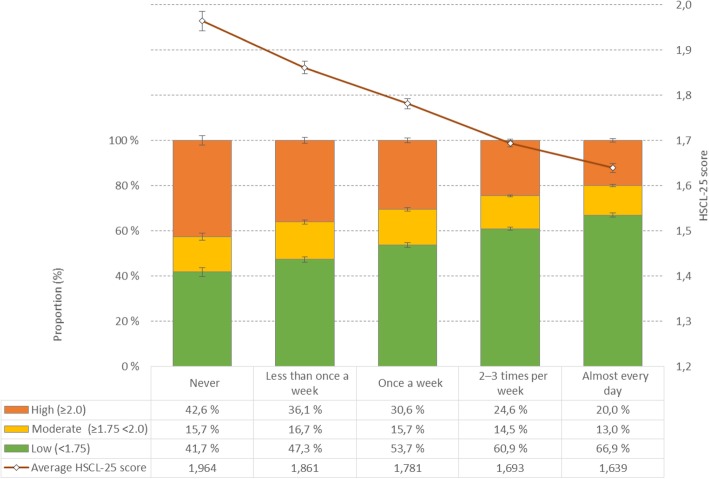
Physical exercise was negatively associated with all measures of mental health problems and suicidality in a dose-response manner. The strongest effect-sizes were observed for frequency of physical exercise. Women with low levels of physical activity had a near three-fold increased odds of both scoring high on the HSCL-25, and self-reported depression, compared to women exercising almost every day. Even stronger effect-sizes were observed for men (ORs ranging from 3.5 to 4.8). Also, physical exercise duration and intensity were significantly associated with mental health problems, but with generally smaller ORs. Similarly, graded associations were also observed when examining the link to self-harm and suicide attempts (ORs ranging from 1.9 to 2.5).
Given the demonstrated dose-response association between inactivity and both poor mental health, self-harm, and suicidal attempt, there is a need to facilitate college students to become more physically active. This is a shared responsibility that resides both on a political level and on the post-secondary institutions. The cross-sectional nature of the study means that one should be careful to draw firm conclusion about the direction of causality.
身体活动不足和心理健康问题都是全球主要的公共卫生关注点。尽管有几项研究表明有规律的体育锻炼对健康有益,但很少有流行病学研究调查体育锻炼的不同方面与心理健康之间的关联性质,也鲜少了解其与自杀倾向之间的可能联系。
研究身体活动的频率、强度和持续时间与心理健康问题之间的关系,并探讨大学生低水平身体活动是否与自我伤害和自杀企图有关。
我们使用了挪威高等教育国家健康调查 SHoT2018 的数据,该调查共有 50054 名 18-35 岁的学生参与。身体活动通过三个问题(频率、强度和持续时间)进行评估。心理健康问题则通过一个评估心理困扰的筛查工具(霍普金斯症状清单-25;HSCL-25)和自我报告的抑郁障碍(使用预先确定的疾病清单)进行评估。自杀企图和自我伤害通过成人精神疾病发病率调查的两个项目进行评估。
身体活动与所有心理健康问题和自杀倾向的衡量指标呈负相关,呈现出剂量反应关系。观察到的最强的效应大小与身体活动的频率有关。与几乎每天锻炼的女性相比,低水平身体活动的女性在 HSCL-25 上得分较高和自我报告的抑郁的几率增加了近两倍。对男性观察到更强的效应大小(比值比范围为 3.5 至 4.8)。此外,身体活动的持续时间和强度与心理健康问题显著相关,但比值比通常较小。同样,在检查与自我伤害和自杀企图的联系时,也观察到了分级关联(比值比范围为 1.9 至 2.5)。
鉴于身体活动不足与心理健康不良、自我伤害和自杀企图之间存在明显的剂量反应关系,需要促使大学生变得更加活跃。这是一个政治层面和高等教育机构都有责任的共同责任。由于研究的横断面性质,在得出关于因果关系的明确结论时应谨慎行事。