Department of Pathology, University of Alabama at Birmingham, WTI 320D, 1824 6th Avenue South, Birmingham, AL, 35233, USA.
O'Neal Comprehensive Cancer Center, University of Alabama at Birmingham, WTI 320D, 1824 6th Avenue South, Birmingham, AL, 35233, USA.
Cell Commun Signal. 2020 Apr 16;18(1):63. doi: 10.1186/s12964-020-00544-7.
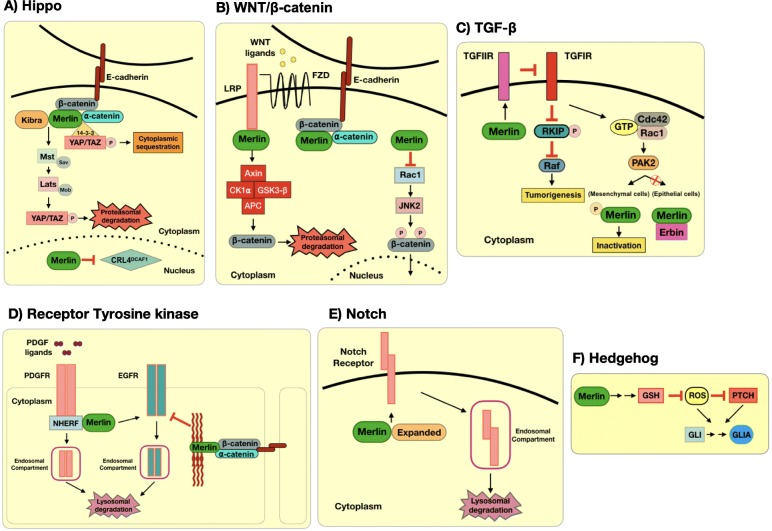
In this review, we describe how the cytoskeletal protein Merlin, encoded by the Neurofibromin 2 (NF2) gene, orchestrates developmental signaling to ensure normal ontogeny, and we discuss how Merlin deficiency leads to aberrant activation of developmental pathways that enable tumor development and malignant progression.
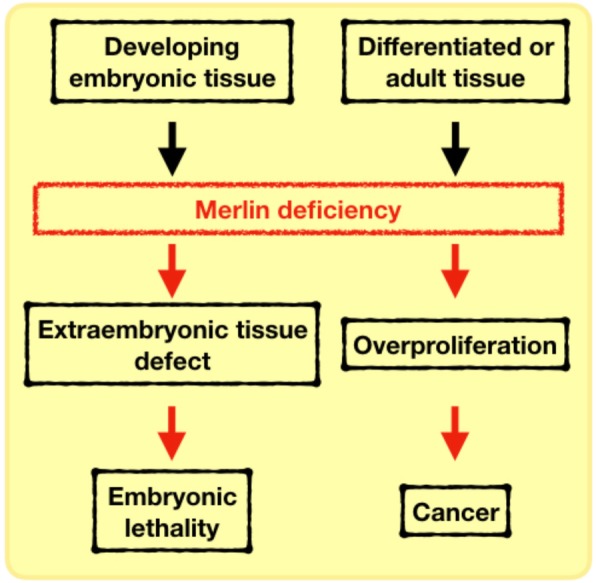
Parallels between embryonic development and cancer have underscored the activation of developmental signaling pathways. Hippo, WNT/β-catenin, TGF-β, receptor tyrosine kinase (RTK), Notch, and Hedgehog pathways are key players in normal developmental biology. Unrestrained activity or loss of activity of these pathways causes adverse effects in developing tissues manifesting as developmental syndromes. Interestingly, these detrimental events also impact differentiated and functional tissues. By promoting cell proliferation, migration, and stem-cell like phenotypes, deregulated activity of these pathways promotes carcinogenesis and cancer progression. The NF2 gene product, Merlin, is a tumor suppressor classically known for its ability to induce contact-dependent growth inhibition. Merlin plays a role in different stages of an organism development, ranging from embryonic to mature states. While homozygous deletion of Nf2 in murine embryos causes embryonic lethality, Merlin loss in adult tissue is implicated in Neurofibromatosis type 2 disorder and cancer. These manifestations, cumulatively, are reminiscent of dysregulated developmental signaling.
Understanding the molecular and cellular repercussions of Merlin loss provides fundamental insights into the etiology of developmental disorders and cancer and has the potential, in the long term, to identify new therapeutic strategies. Video Abstract.
在这篇综述中,我们描述了细胞骨架蛋白 Merlin(由神经纤维瘤病 2 基因 NF2 编码)如何协调发育信号以确保正常的个体发生,并讨论了 Merlin 缺失如何导致发育途径的异常激活,从而促进肿瘤发生和恶性进展。
胚胎发育和癌症之间的相似之处突显了发育信号通路的激活。Hippo、WNT/β-catenin、TGF-β、受体酪氨酸激酶(RTK)、Notch 和 Hedgehog 通路是正常发育生物学的关键参与者。这些通路的不受控制的活性或活性丧失会导致发育组织中的不良影响,表现为发育综合征。有趣的是,这些有害事件也会影响分化和功能组织。通过促进细胞增殖、迁移和干细胞样表型,这些通路的失调活性促进了致癌作用和癌症进展。NF2 基因产物 Merlin 是一种肿瘤抑制因子,其经典作用是诱导接触依赖性生长抑制。Merlin 在生物体的不同发育阶段发挥作用,从胚胎到成熟状态。虽然 NF2 基因在鼠胚胎中的纯合缺失导致胚胎致死,但 Merlin 在成年组织中的缺失与 2 型神经纤维瘤病和癌症有关。这些表现,综合起来,类似于发育信号的失调。
了解 Merlin 缺失的分子和细胞后果为发育障碍和癌症的病因提供了基本的见解,并有可能长期确定新的治疗策略。