Keramidaki Konstantia, Tsagari Amalia, Hiona Mina, Risvas Grigoris
Outpatient Οbesity Clinic, EASO accredited Center for Obesity Management (COM), 1 Propaedeutic Internal Medicine Department, University Hospital of Thessaloniki AHEPA, Thessaloniki, Greece.
General Hospital of Attica «ΚΑΤ», Athens, Greece.
J Frailty Sarcopenia Falls. 2019 Dec 1;4(4):91-101. doi: 10.22540/JFSF-04-091. eCollection 2019 Dec.
We investigated the coexistence of sarcopenia and obesity in older adults≥65 years diagnosed with osteoporosis and the association with Quality of Life (QoL).
A Cross-sectional survey has been performed on a randomized sample of 50 diagnosed osteoporotic elderly people from both sexes (Men=16; Women=34).
Quantitative ultrasound was conducted to identify osteoporosis and defined with a T score ≤2.5. Validated anthropometric equations were used in order to estimate body fat percentage and skeletal muscle mass so as to detect the reallocation of body fat and lean muscle. 10m gait speed and hand grip strength was measured in order to diagnose sarcopenia according to European Society for Clinical Nutrition and Metabolism (ESPEN) algorithm. The evaluation of QoL was conducted using a QoL questionnaire specific to osteoporosis. The data were analyzed with descriptive statistics and a chi-square test was performed to examine if Osteosarcopenic Obesity (OSO) is sex related and the correlation between OSO and QoL.
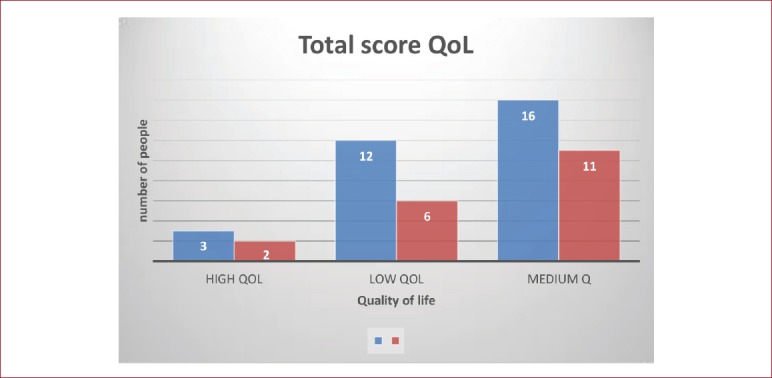
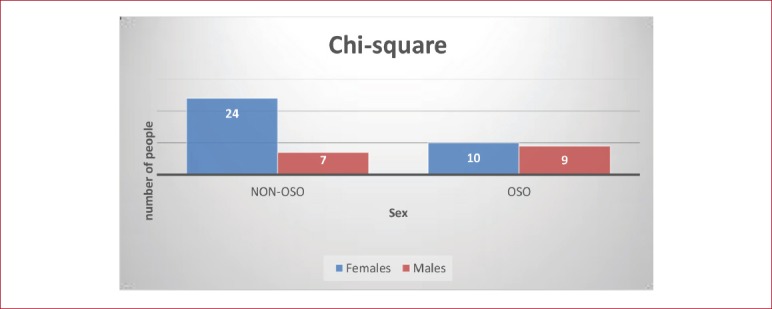
From the 50 participants, 40%(n=19) were classified as people with OSO and 60%(n=31) without OSO. From n=19 people that experienced OSO women represent 20% (n=9) and men 18% (n=9); with the latter had a greater decline in muscle mass than women, while women had lower BMD than men according to the z score. OSO is not related with sex (p>.05) and there is no significant association between OSO and QoL (p> .05 for all the domains of QoL questionnaire).
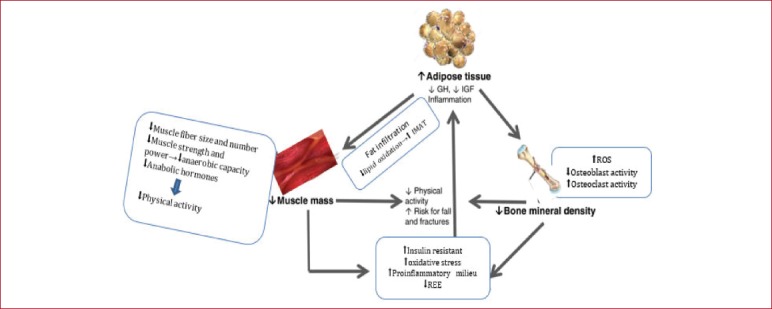
Osteoporosis in the elderly often coexists with reduced muscle mass and muscle strength as well as an increase in adiposity and was independently associated with QoL. People that experience OSO presenting lower functionality that increases the risk for falls and bone fractures originated from the decline in bone and muscle mass, and increased adiposity. Increased awareness of OSO may help develop efficient interventions and public health policies for healthier and more active elderly people.
我们调查了≥65岁被诊断为骨质疏松症的老年人中肌肉减少症和肥胖症的共存情况以及与生活质量(QoL)的关联。
对50名确诊为骨质疏松症的男女老年人(男性=16;女性=34)的随机样本进行了横断面调查。
进行定量超声检查以确定骨质疏松症,并以T值≤2.5来定义。使用经过验证的人体测量方程来估计体脂百分比和骨骼肌质量,以便检测体脂和瘦肌肉的重新分配。根据欧洲临床营养与代谢学会(ESPEN)算法测量10米步速和握力,以诊断肌肉减少症。使用特定于骨质疏松症的生活质量问卷对生活质量进行评估。对数据进行描述性统计分析,并进行卡方检验,以检查骨质疏松性肥胖(OSO)是否与性别相关以及OSO与生活质量之间的相关性。
在50名参与者中,40%(n = 19)被归类为患有OSO的人,60%(n = 31)没有OSO。在n = 19名经历OSO的人中,女性占20%(n = 9),男性占18%(n = 9);后者的肌肉质量下降幅度大于女性,而根据z值,女性的骨密度低于男性。OSO与性别无关(p>0.05),并且OSO与生活质量之间没有显著关联(生活质量问卷的所有领域p>0.05)。
老年人的骨质疏松症常与肌肉质量和力量下降以及肥胖增加同时存在,并且与生活质量独立相关。经历OSO的人表现出较低的功能,这增加了因骨量和肌肉量下降以及肥胖增加而导致跌倒和骨折的风险。提高对OSO的认识可能有助于制定有效的干预措施和公共卫生政策,以促进老年人更健康、更活跃。